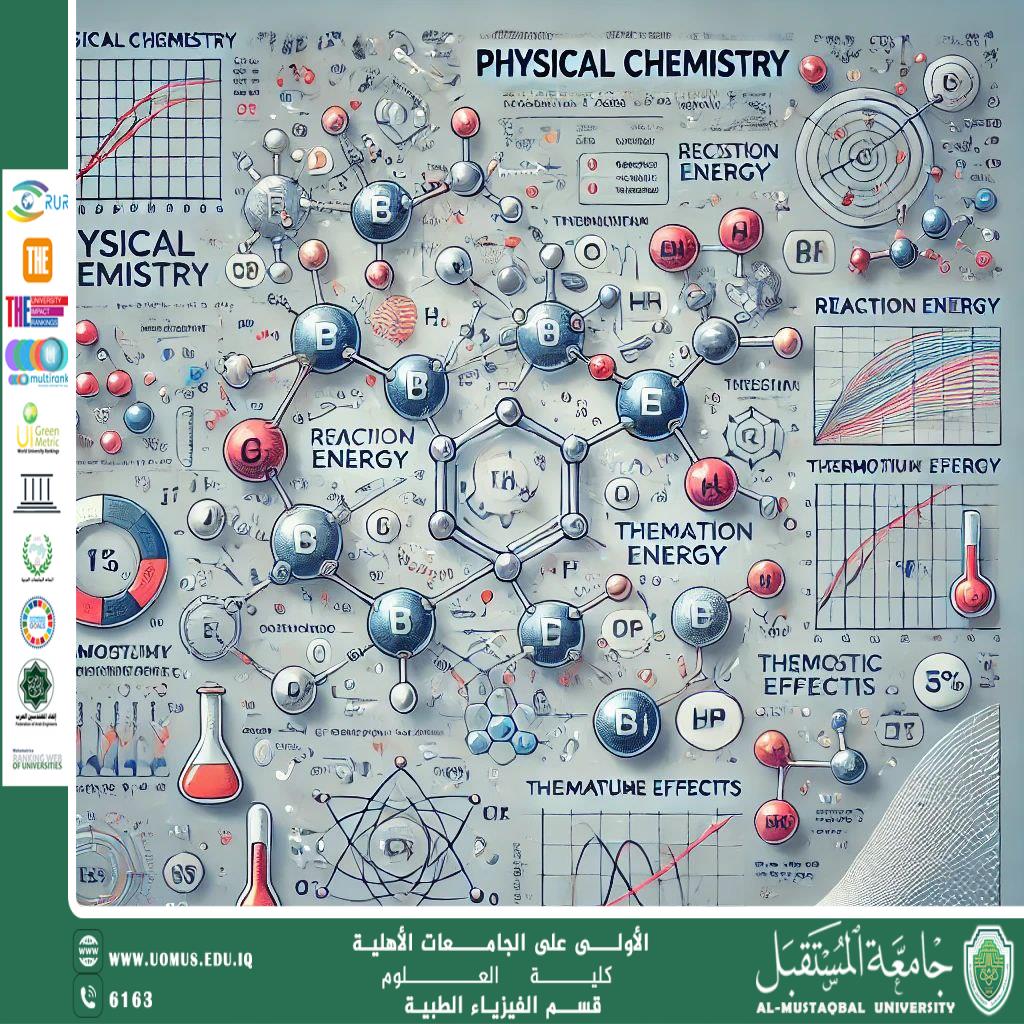
The Scientific Article by Assistant Lecturer (Ahmed Abdel Salam) Entitled "Physicochemistry"
11/03/2025 Share :
Physicschemistry is a branch of chemical science that combines physical and chemical principles to understand chemical and physical phenomena. This field relies on explaining chemical processes using physical foundations and laws such as thermodynamics, statistical mechanics, and electromagnetism. The importance of physicschemistry lies in the fact that it is possible to understand how physical factors such as temperature, pressure, and mechanical properties affect chemical reactions, as well as how chemical reactions affect physical properties. <br />1. Chemical and physical reactions:<br />Chemical reactions are processes in which the chemical composition of compounds is changed, while physical processes focus on changes in the physical states of materials (such as phase changes between liquid, gas, or solid). In physicschemistry, the relationship between these changes and physical factors such as temperature and pressure is studied, and how they affect the rate of a chemical reaction. <br />2. Thermodynamics:<br />Thermodynamics is one of the fundamental fields in physicschemistry, as it studies the transfer of energy and heat in chemical systems. The laws of thermodynamics state that energy is neither created nor destroyed, but rather transformed from one form to another. By applying these laws, we can calculate changes in the internal energy of chemical systems, which is vital to understanding chemical reactions, such as measuring changes in enthalpy (heat) and changes in entropy (randomness).<br />3. Chemical structure and its physical properties:<br />The chemical structure of compounds affects their physical properties such as density, electrical conductivity, and boiling point. Studying this relationship allows physicists and chemists to design new materials with specific specifications. For example, studying the relationship between the structure of a molecule and its properties such as transparency or thermal conductivity is useful in developing nanomaterials or semiconductors.<br />4. Spectroscopy:<br />Spectroscopy is an important method used in physical chemistry to understand the interactions between radiation and materials. This type of analysis is used to understand how chemical reactions affect physical properties such as light absorption or spectral emission. Techniques such as infrared or ultraviolet spectroscopy can be used to examine interactions between molecules.<br />5. Electrochemical reactions:<br />Physical chemistry studies the reactions that occur in electrochemical systems such as battery cells and electrodes. Through these studies, it is possible to understand how chemical reactions affect the transfer of electrons and how these phenomena can be used to generate or store energy.<br />6. Applications in industries:<br />The field of physical chemistry is essential in the development of many industries such as the pharmaceutical, energy, and building materials industries, as well as in the environment. For example, physical chemistry can be used to improve the efficiency of solar cells or batteries or in the design of new materials with specific properties such as advanced materials in the electronics industry.<br />Conclusion:<br />Physical chemistry provides a means of understanding how physical and chemical factors can interact and affect each other, which is essential for understanding the multiple interactions in complex chemical systems. Using physical chemistry tools, technological, environmental, and industrial products can be improved, which enhances the development of new research and improvements in the fields of chemistry and physics.<br /><br />"AL_mustaqbal University is the first university in Iraq"