Gravitational Waves artical by Msc.Ali Salman
24/03/2025 Share :
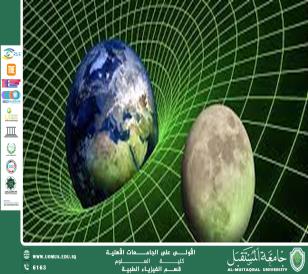
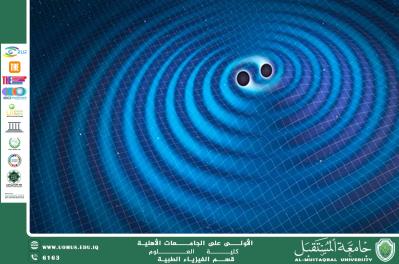
A New Gateway to Understanding the Universe<br />Gravitational waves are one of the most fascinating phenomena in astrophysics, providing a new way to study the universe and understand major cosmic events. These waves, predicted by Albert Einstein in 1916 as part of his general theory of relativity, are ripples in the very fabric of spacetime. They revolutionize our perspective of the cosmos, adding a new dimension to traditional astronomical observations based on light and other electromagnetic radiation.<br />What Are Gravitational Waves?<br />Gravitational waves are disturbances that spread through spacetime due to changes in the distribution of mass and energy. Unlike sound or light waves, which travel through a medium, gravitational waves propagate through spacetime itself.<br /> <br />Imagine them as ripples on the surface of a lake when a stone is thrown in. In this case, however, the 'stone' represents massive objects such as black holes or neutron stars, and the waves travel through the fabric of spacetime. These waves possess unique properties that distinguish them from other types of waves, like light or sound.<br /> <br />How Are Gravitational Waves Generated?<br />Gravitational waves are produced when massive objects move asymmetrically, causing distortions in the surrounding spacetime. Several key scenarios generate gravitational waves:<br />1. Black Hole Mergers: When two black holes spiral toward each other, they rotate at extremely high speeds before merging into one.<br />2. Neutron Star Collisions: These incredibly dense remnants of exploded stars emit gravitational waves when they collide.<br />3. Supernova Explosions: A massive star can generate gravitational waves if the explosion is asymmetrical.<br />4. Early Universe Events: Some gravitational waves originated after the Big Bang, providing insights into the origins of the universe.<br /> <br />Detecting Gravitational Waves<br />Detecting gravitational waves has been a long-term goal for scientists due to their extremely weak effects on Earth. This goal was finally achieved on September 14, 2015, when the Laser Interferometer Gravitational-Wave Observatory (LIGO) detected the first wave produced by the merger of two black holes 1.3 billion light-years away.<br />The Importance of Studying Gravitational Waves<br />1. A New Window into the Universe - They provide a unique way to study phenomena like black hole mergers.<br />2. Testing General Relativity - They help test Einstein’s theory under extreme conditions.<br />3. Studying Black Holes and Neutron Stars - The only direct tool to detect these mysterious objects.<br />4. Understanding the Origins of the Universe - Gravitational waves carry data about the universe’s earliest moments.<br /><br /><br /><br /><br /><br /><br /><br />The Future of Gravitational Wave Research<br />With technological advancements and the success of observatories like LIGO and Virgo, efforts are being made to develop more advanced detection systems such as LISA (Laser Interferometer Space Antenna), a space-based observatory designed to detect lower-frequency gravitational waves.<br />Conclusion<br />The study of gravitational waves represents a revolution in astronomy and physics, offering an unprecedented window into cosmic events. With improved technology, we expect groundbreaking discoveries that will change our understanding of the universe.<br />"AL_mustaqbal University is the first university in Iraq"<br />