Scientific Article by Assistant Lecturer (Mohammed Abdulzahra) Entitled “The Most Famous Physics Experiments Throughout History”
05/04/2025 Share :
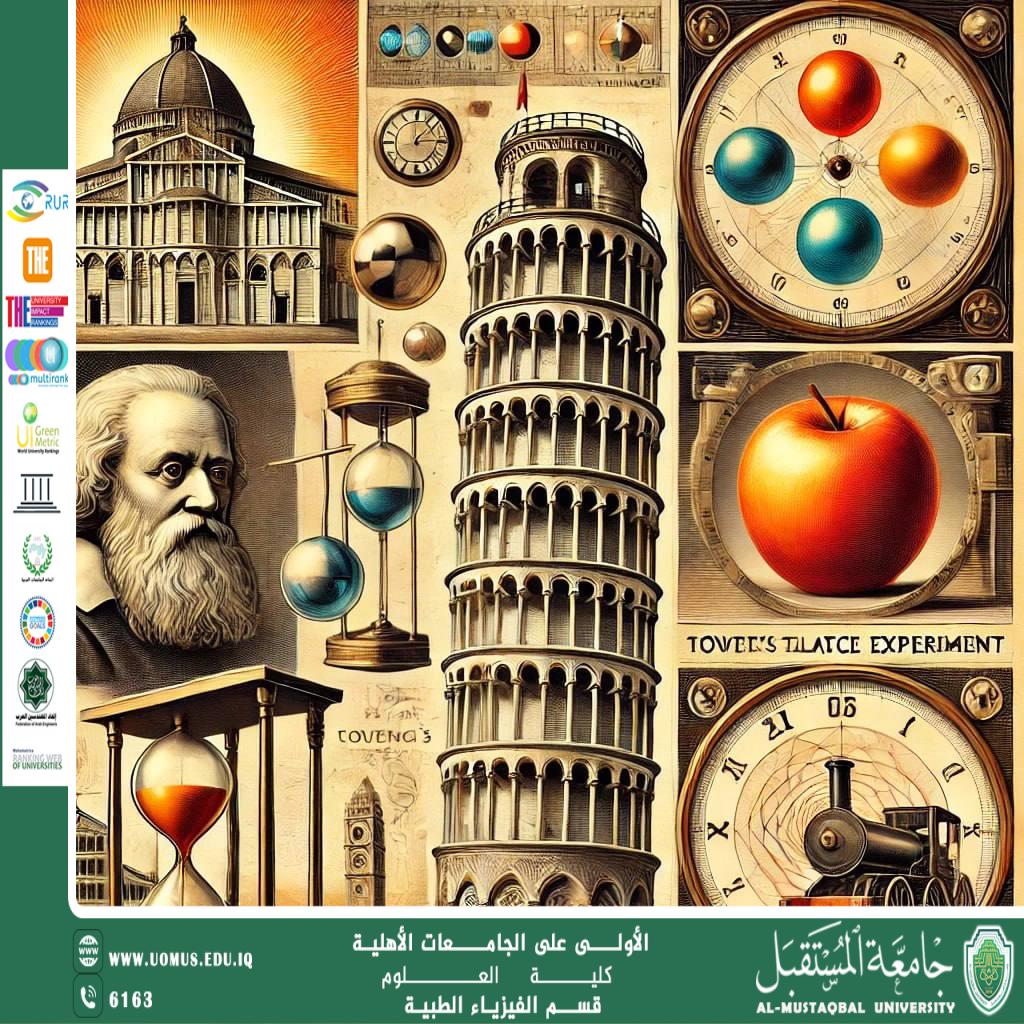
The Most Famous Physics Experiments in History<br /><br />Throughout history, experiments have been the backbone of physics, testing theories and shaping our understanding of the universe. Some experiments stand out as milestones that transformed science and laid the foundations for concepts still studied today. Let’s explore some of these remarkable experiments:<br /><br />1. Galileo’s Free Fall Experiment (17th Century):<br />According to popular accounts, Galileo Galilei dropped two spheres of different masses from the Leaning Tower of Pisa. He demonstrated that objects fall at the same acceleration regardless of their mass, disproving Aristotle’s long-held beliefs.<br /><br />2. Newton’s Prism Experiment (1665):<br />Isaac Newton passed sunlight through a glass prism, observing its dispersion into a spectrum of colors. This experiment revealed that white light is composed of multiple colors and laid the groundwork for modern optics.<br /><br />3. The Michelson-Morley Experiment (1887):<br />This experiment aimed to detect the “luminiferous aether,” believed to be the medium through which light traveled. The results showed no evidence of aether, paving the way for Einstein’s theory of relativity.<br /><br />4. Millikan’s Oil Drop Experiment (1909):<br />Robert Millikan measured the charge of the electron by observing tiny oil droplets suspended in an electric field. His work provided the first precise value of the elementary electric charge, deepening our understanding of atomic structure.<br /><br />5. Young’s Double-Slit Experiment (1801):<br />Thomas Young demonstrated the wave nature of light by passing it through two closely spaced slits, producing an interference pattern. This experiment later became crucial in understanding quantum mechanics.<br /><br />6. Rutherford’s Gold Foil Experiment (1911):<br />Ernest Rutherford fired alpha particles at a thin sheet of gold foil, expecting them to pass straight through. Instead, some particles bounced back, leading to the discovery of the atomic nucleus and reshaping atomic theory.<br /><br />7. Einstein’s Photoelectric Effect (1905):<br />Einstein explained the emission of electrons from a metal surface when struck by light, showing that light behaves as discrete particles called photons. This experiment was pivotal in establishing quantum theory.<br /><br />8. LIGO and the Detection of Gravitational Waves (2015):<br />The Laser Interferometer Gravitational-Wave Observatory (LIGO) detected gravitational waves from the merger of two black holes, confirming a century-old prediction by Einstein and opening new avenues for observing the universe.<br /><br />Conclusion:<br />These experiments were not just scientific breakthroughs; they reshaped our understanding of the natural world. Each one answered profound questions and sparked new ones, driving physics forward. Perhaps the next groundbreaking experiment is already underway, waiting to redefine what we know about reality once again.<br />"AL_mustaqbal University is the first university in Iraq"<br/><br/><a href=https://uomus.edu.iq/Default.aspx target=_blank>al-mustaqbal University Website</a>