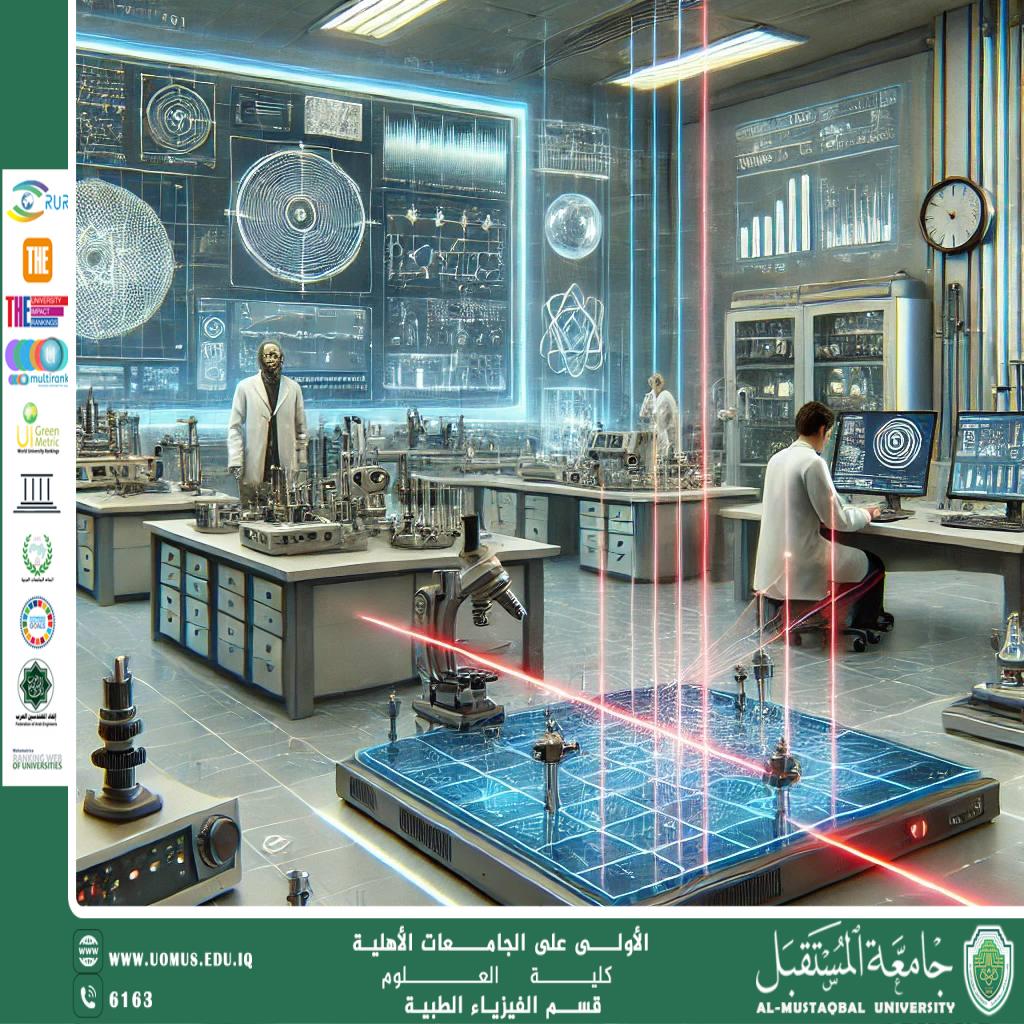
Physics Laboratories: Their Role and Importance in Scientific Research and Education Prepared by: Zahraa Basim – Department of Physics
05/04/2025 Share :
Physical laboratories: their role and importance in scientific research and education. Physics Laboratories are an essential part of scientific research and education in the field of physics, providing an experimental environment that helps in understanding physical laws and theories through practical experience. These laboratories play an important role in developing new technologies, improving industrial processes, and providing scientific solutions to various engineering and natural problems. The importance of physical laboratories 1. Enhancing the practical understanding of physical theories • Laboratories provide an opportunity to practically apply theoretical concepts, which enhances the absorption of physical laws such as Newton's law, thermodynamics, and electromagnetics. • It helps reduce the gap between theoretical and practical education, making understanding more clear and realistic. 2. Develop experimental and analytical skills • Students learn how to use physical tools and devices such as ammeters, voltmeters, spectrometers, and lasers. • Developing statistical analysis skills, where students analyze data and measure errors in experiments. 3. Supporting scientific research and technological development • Physical laboratories are used in advanced research, such as the study of nanomaterials, particle physics, and laser techniques. • It contributes to the development of modern technology, such as electronic devices, renewable energy, and medical physics applications. <br />Physical Laboratory Types 1. Classic Mechanical Laboratories • It studies the laws of motion, gravity, and collisions. • Devices such as pendulums, dynamic tracks, and friction measuring devices are used. 2. Electricity and Magnetic Labs • It focuses on studying electrical currents, electrical circuits, and magnetic fields. • The devices used include generators, coils, and electrical magnets. 3. Optical and laser laboratories • It is concerned with the experiments of reflection and refraction of light, interference and diffraction, and laser applications. • Devices such as mirrors, lenses, light spectrometer, and high-resolution lasers are used. 4. Thermodynamic Laboratories and Thermal Physics • It studies the relationship between heat, energy and work. • Experiments include thermal expansion, heat transfer, and temperature effects on materials. 5. Modern Physics and Atomic Physics Laboratories • Focus on quantum mechanics, particle physics, and relativity. • Advanced devices such as spectroscopy, gas-discharge pipes, and radiation gauges include. Advanced instruments and techniques in physical laboratories • Optical spectrometers: used to study the properties of materials. • Laser and Interference Devices: They are used in visual and engineering physics applications. • Digital Simulators and Computerized Experiments: Helps analyze data with higher accuracy and reduce experimental error. Challenges facing physical laboratories 1. High Hardware Costs: Some experiments need sophisticated and expensive equipment. 2. The need for continuous maintenance: the equipment needs periodic calibration to maintain its accuracy. 3. Lab safety: handling high currents, lasers, and radiation require strict safety protocols. Conclusion Physical laboratories play a major role in education, scientific research, and technological development. By combining practical experience and theoretical analysis, laboratories contribute to the development of physical sciences, improve engineering processes, and discover new technologies that drive scientific innovation.<br />"AL_mustaqbal University is the first university in Iraq"<br /><br/><br/><a href=https://uomus.edu.iq/Default.aspx target=_blank>al-mustaqbal University Website</a>