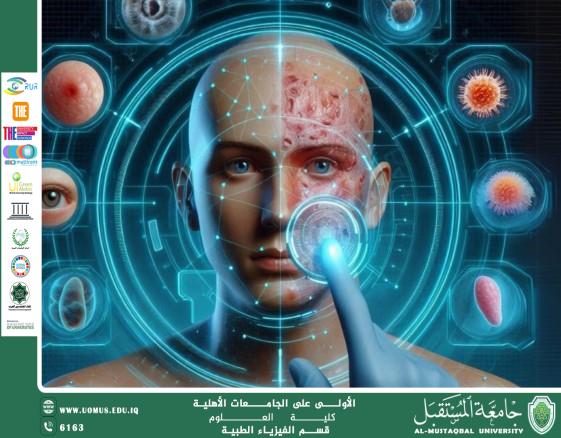
A scientific article by the teaching assistant (Zahraa Basem Hamza) entitled "Artificial Intelligence in Discovering Cancer Treatment: A Medical Revolution in the Age of Technology"
12/04/2025 Share :
Abstract:<br />Cancer remains one of the most formidable health challenges of the modern era. Given its complexity and the diversity of its forms, it has become essential to harness advanced technologies to enhance detection and treatment methods. In recent years, artificial intelligence (AI) has emerged as a transformative tool in medicine, especially in cancer research. This paper explores the role of AI in accelerating drug discovery, analyzing genetic data, and creating personalized treatment plans, in addition to the challenges faced in its implementation.<br /><br />⸻<br /><br />Introduction:<br /><br />Cancer is a complex disease caused by genetic and cellular changes that lead to abnormal cell growth. Traditionally, the process of discovering cancer treatments has taken many years, but AI offers more efficient and faster solutions by analyzing massive amounts of medical data and helping researchers understand the mechanisms of the disease in greater depth.<br /><br />⸻<br /><br />1. Applications of Artificial Intelligence in Cancer Treatment<br /> 1. Genetic and Medical Data Analysis:<br />Advanced algorithms are used to analyze patients’ genetic sequences and identify mutations associated with specific types of cancer.<br /> 2. Early Diagnosis:<br />Deep learning techniques assist in analyzing medical imaging such as mammograms and MRIs with a level of precision that sometimes exceeds human capability, facilitating early cancer detection.<br /> 3. Drug Discovery:<br />AI systems simulate biological interactions and predict the effectiveness of chemical compounds, significantly reducing the time needed for drug discovery.<br /> 4. Personalized Treatment Plans:<br />Based on each patient’s genetic profile and tumor type, AI can help tailor treatment protocols, increasing their effectiveness and reducing side effects.<br /><br />⸻<br /><br />2. Real-World Examples<br /> • DeepMind, a subsidiary of Google, has used AI algorithms to predict the structure of cancer-related proteins.<br /> • In the U.S., researchers have used IBM Watson systems to analyze medical records and recommend treatment plans for cancer patients.<br /><br />⸻<br /><br />3. Challenges and Ethical Concerns<br /> • Data Privacy: AI applications require access to sensitive medical data, raising concerns about patient confidentiality.<br /> • Algorithmic Bias: Some AI models may produce biased outcomes if trained on imbalanced datasets.<br /> • Regulatory Gaps: There is still a need for clear legal frameworks to govern the use of AI in the medical field.<br /><br />⸻<br /><br />Conclusion:<br /><br />Artificial intelligence holds tremendous promise in the research and treatment of cancer, offering new hope for improved patient outcomes and faster drug development. However, it must be used responsibly, with careful attention to ethical and legal considerations to ensure maximum benefit while protecting patients’ rights.<br /><br /><br />"AL_mustaqbal University is the first university in Iraq"<br/><br/><a href=https://uomus.edu.iq/Default.aspx target=_blank>al-mustaqbal University Website</a>