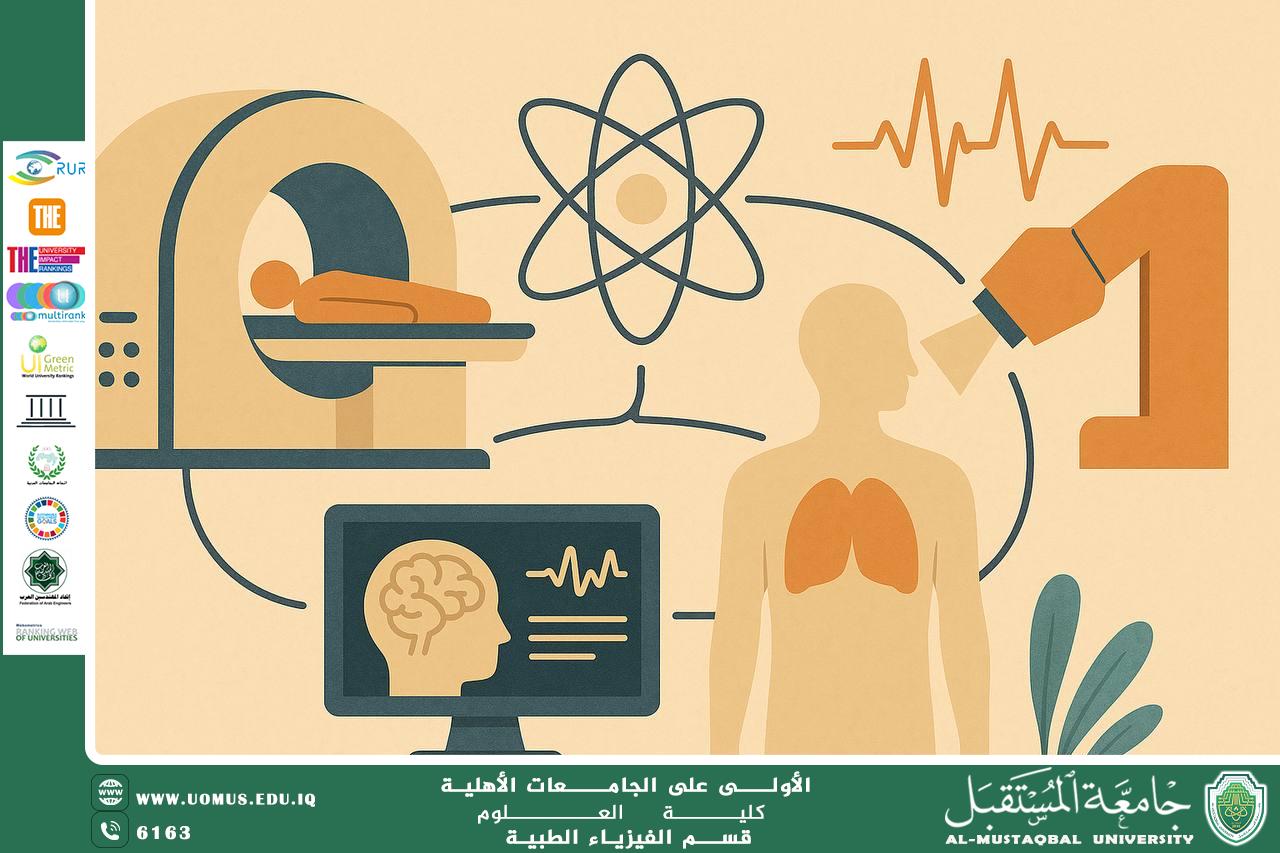
A Scientific Article by ( Asst. Lecturer Ammar Kareem) Title: “The Relationship Between Engineering and Medical Physics: Integrating Science and Technology in Healthcare”
15/04/2025 Share :
Introduction<br /><br />In modern times, engineering and medical physics have become deeply interconnected and complementary fields. Physical principles are applied through engineering solutions to develop technologies that aid in disease diagnosis, treatment, and improving patients’ quality of life. This integration forms the foundation of many innovations such as MRI scanners, X-ray machines, radiation therapy systems, and smart prosthetics.<br /><br />⸻<br /><br />What Is Medical Physics?<br /><br />Medical physics is a branch of applied physics focused on applying physical principles in the medical field, particularly in diagnostics and therapy. It includes the use of radiation, ultrasound, magnetism, and nuclear physics to understand and treat human health conditions.<br /><br />⸻<br /><br />The Role of Engineering in Medical Physics<br /><br />Engineering—particularly electrical, mechanical, and electronic engineering—plays a central role in designing and building medical devices based on physical concepts. The relationship is evident in several areas:<br /><br />1. Medical Device Design<br /><br />Devices such as MRI machines, CT scanners, and ultrasound systems rely on complex physical principles and require precise engineering to ensure safety and performance.<br /><br />2. Radiation Therapy<br /><br />Engineers collaborate with medical physicists to design radiation therapy systems, such as linear accelerators, ensuring high-precision radiation delivery while minimizing harm to healthy tissues.<br /><br />3. Software and Control Systems<br /><br />Engineers develop automation and simulation software for medical devices, which help enhance accuracy and efficiency during diagnostic procedures.<br /><br />4. Safety and Maintenance<br /><br />Engineering is vital for safety protocols and the technical maintenance of medical devices to ensure their operation stays within safe and effective boundaries.<br /><br />⸻<br /><br />Examples of Collaboration Between the Fields<br /> • PET/MRI Machines: Combine nuclear physics and magnetic resonance imaging, requiring advanced engineering to integrate both systems.<br /> • 3D Imaging Systems: Use physics-based models and engineering software to analyze images and reconstruct detailed 3D representations of internal body structures.<br /><br />⸻<br /><br />Conclusion<br /><br />The relationship between engineering and medical physics is a collaborative and integrative one, forming the backbone of modern medical technology. With the rise of artificial intelligence and robotics, this synergy is expected to expand further, bringing even more precision to diagnosis and treatment, and elevating the standards of healthcare.<br /><br /><br /><br />"AL_mustaqbal University is the first university in Iraq"<br/><br/><a href=https://uomus.edu.iq/Default.aspx target=_blank>al-mustaqbal University Website</a>