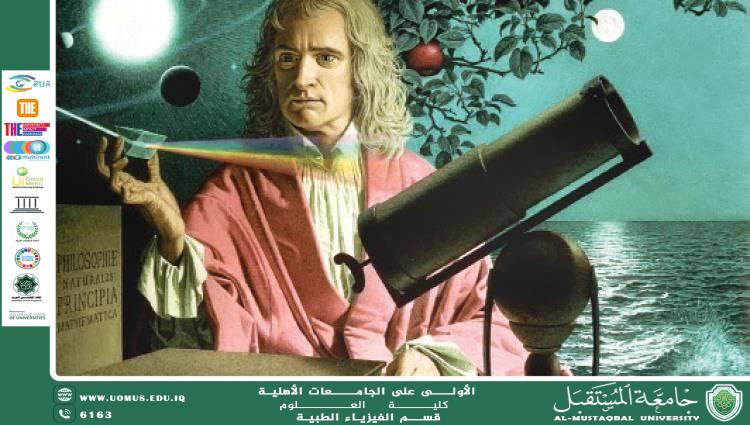
A scientific article by the teaching assistant (Ahmed Abdel Salam) entitled “Newton’s Laws of Motion: The Scientific Basis for Understanding Motion in the Universe”
15/04/2025 Share :
Introduction:<br />Isaac Newton (1643–1727) is considered one of the greatest scientists in human history. One of his most notable scientific achievements was his formulation of three fundamental laws that explain the motion of objects and are the cornerstone of classical physics. These laws are still used today to explain and study everything that moves, from cars and airplanes to planets and stars.<br /><br />---<br /><br />Newton's First Law (Law of Inertia):<br />"A body at rest will remain at rest, and a body in motion will remain in uniform motion unless acted upon by an external force that changes its state."<br /><br />Explanation:<br />This law states that objects do not change their state of motion on their own. If an object is at rest, it will not begin to move unless acted upon by a force. If an object is moving at a constant speed, it will not stop or change direction unless acted upon by an external force (such as friction or gravity).<br /><br /> ---<br /><br />Newton's Second Law:<br />"When a force acts on an object, it produces an acceleration that is directly proportional to the magnitude of the force and inversely proportional to its mass."<br />Mathematically written:<br />F = m × a<br /><br />Explanation:<br />F represents force,<br />m represents mass,<br />a represents acceleration.<br /><br />This law relates the force acting on an object, its mass, and the resulting acceleration. For example, the greater the force on a given object, the greater its acceleration. The greater its mass, the less it responds (i.e., accelerates) to the same force.<br /><br />---<br /><br />Newton's Third Law (Law of Action and Reaction):<br />"For every action, there is an equal and opposite reaction."<br /><br />Explanation:<br />When you push an object, it pushes back with an equal force in the opposite direction. This law explains how airplanes and rockets are able to take off: gases push back with a force, producing a reaction that propels the plane or rocket forward.<br /><br /> ---<br /><br />Importance of Newton's Laws:<br /><br />They are used in the design of vehicles, aircraft, and machines.<br /><br />They help calculate forces and acceleration in engineering and physics.<br /><br />They explain everyday motions, from falling objects to car collisions.<br /><br />---<br /><br />Conclusion:<br />Newton's three laws represent the golden rule for understanding motion in the physical world. Although they don't apply precisely at very high speeds or in the atomic world (where relativity and quantum mechanics are used), they remain the cornerstone of most practical applications we see around us every day.<br /><br /><br /><br />"AL_mustaqbal University is the first university in Iraq"<br/><br/><a href=https://uomus.edu.iq/Default.aspx target=_blank>al-mustaqbal University Website</a>