
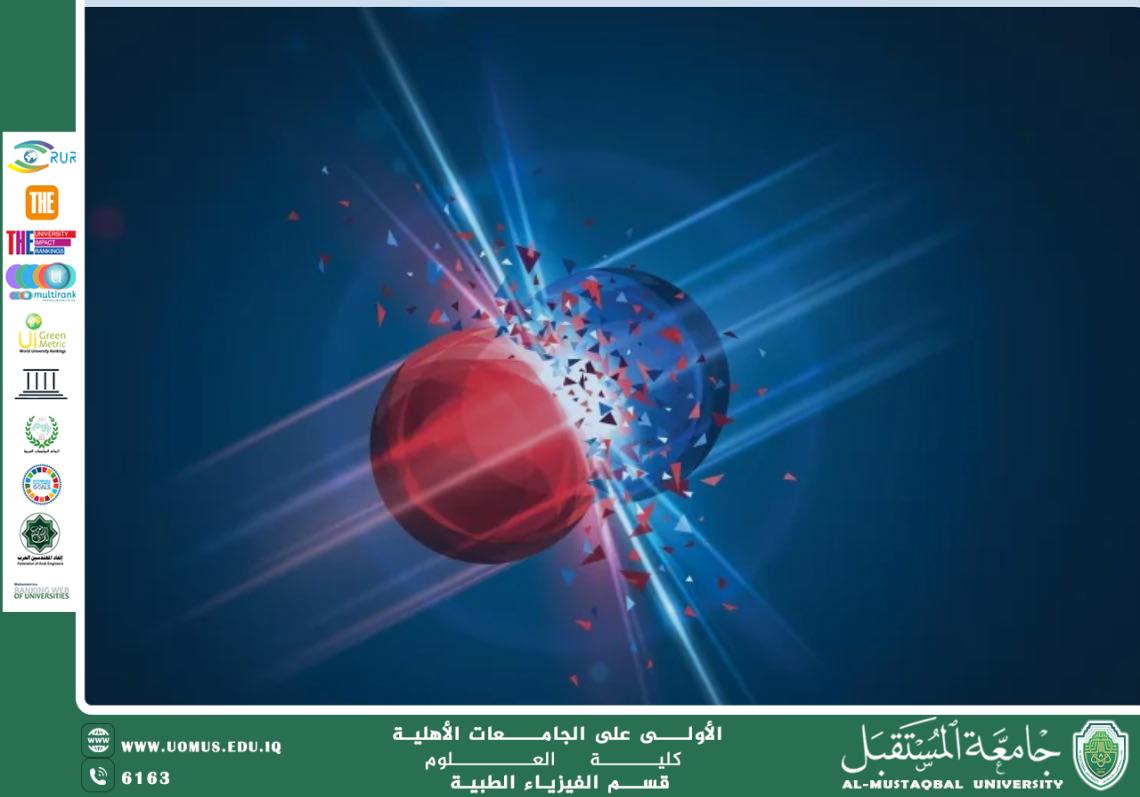
A scientific article by the lecturer (Dr. Karim Abis Handoul) entitled "Quantum Time: When Time Flows in Two Directions"
16/04/2025 Share :
Physicists at the University of Surrey in the UK have discovered that within certain quantum systems, time can flow in two opposite directions simultaneously. This stands in stark contrast to our everyday reality, where time flows in only one direction—toward the future.<br /><br />For centuries, scientists have debated the reason behind the arrow of time—the concept that time irreversibly moves from the past to the future. While this seems intuitive in our lived experience, the fundamental laws of physics do not inherently prefer one direction. Whether time moves forward or backward, the equations remain unchanged.<br /><br />The Arrow of Time<br />In physical laws, moving through time is like moving through space—there is no inherent up or down. Similarly, physical laws function equally well in both directions of time. They can predict a system’s future or reconstruct its past.<br /><br />A team of scientists links the arrow of time to the second law of thermodynamics, which states that entropy (disorder) always increases in a closed system. You can observe this easily in your car: not all the energy from gasoline is used to move the vehicle. Some is lost as engine noise, some as heat from the engine, and some through friction between gears. But can you recover all that lost energy?<br /><br />No—you can't. Entropy always increases. A hot cup of coffee cools down over time, but it never heats itself spontaneously. An egg that falls and breaks will never fix itself. In this way, increasing entropy is directly tied to the arrow of time, as the progression of events in the universe requires a time gradient.<br /><br />The Strange World of Quantum Mechanics<br />However, a new study published in Scientific Reports examined this concept within the context of how a quantum system interacts with its environment—a scenario known as an open quantum system.<br /><br />The findings revealed that when applying a common mathematical approach (the Markov approximation), the quantum system behaved identically whether time moved forward or backward. In other words, two directions of time emerged instead of one.<br /><br />This doesn't mean time travel is possible. We won't see broken eggs magically reassembling in real life. These phenomena apply only under specific quantum conditions.<br /><br />Still, these findings suggest that the direction of time might not be as fixed as it appears. The study offers a new perspective on one of physics' greatest mysteries. Understanding the true nature of time could have profound implications for quantum mechanics, cosmology, and beyond.<br /><br /><br /><br />"AL_mustaqbal University is the first university in Iraq"<br/><br/><a href=https://uomus.edu.iq/Default.aspx target=_blank>al-mustaqbal University Website</a>