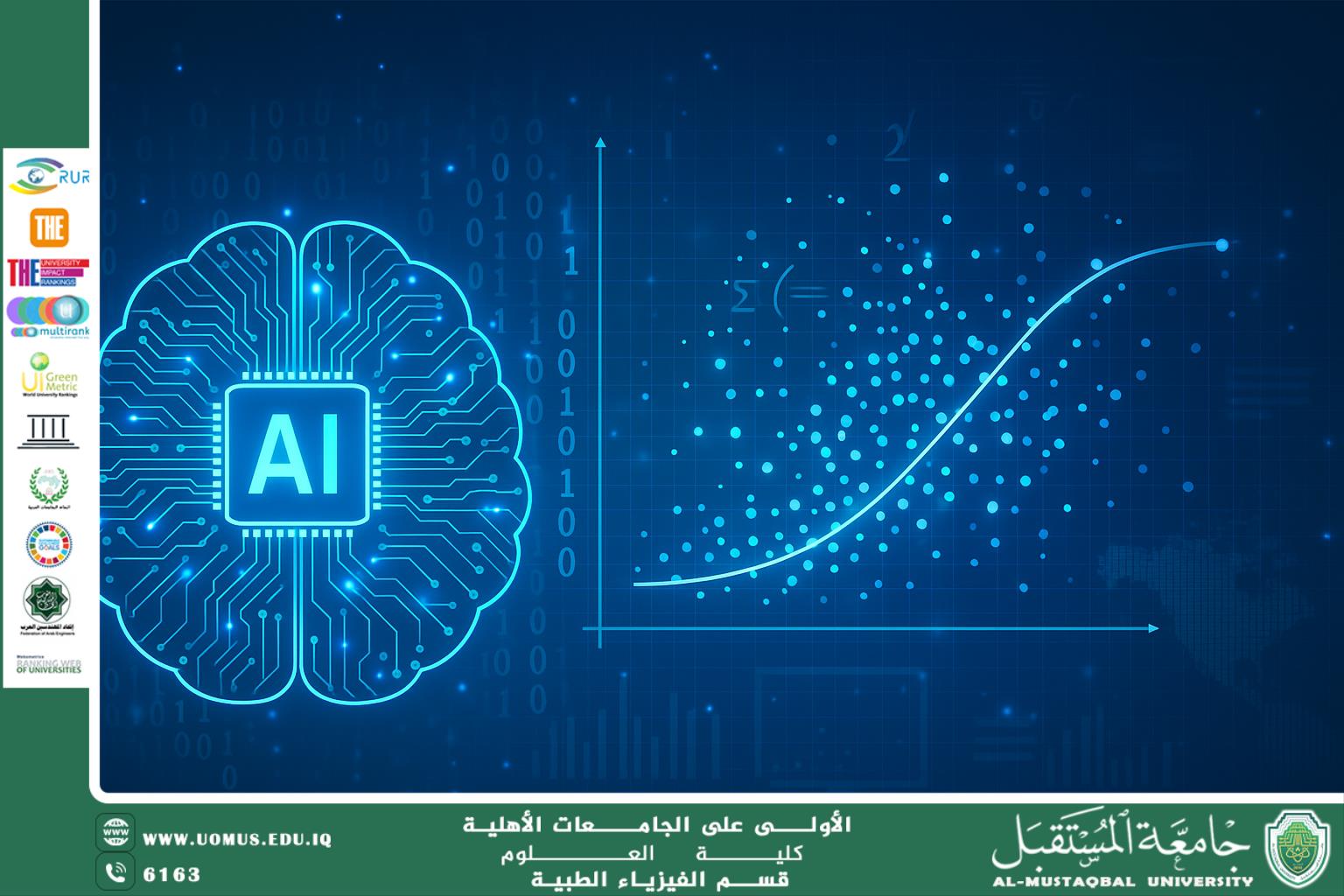
A scientific article by the teaching assistant (Mohamed Abdel Zahra) entitled "Artificial Intelligence and the Physics of Big Data"
19/04/2025 Share :
Introduction<br />In the age of information and digital explosion, big data has become a fundamental element across various scientific fields, particularly physics. Modern physical experiments—especially in areas like particle physics and astrophysics—generate massive amounts of data, far beyond the capacity of human analysis. This is where artificial intelligence (AI) emerges as a vital tool for analyzing this data and extracting patterns and insights with speed and precision.<br /><br />Artificial Intelligence in the Service of Physics<br />Artificial intelligence, especially machine learning (ML) and deep learning (DL) techniques, relies on building computational models that learn from data without being explicitly programmed. This makes it ideal for handling the massive datasets produced by complex physical experiments.<br /><br />Key Applications of AI in Physics<br /><br />Particle Physics<br />In experiments like the Large Hadron Collider (LHC) at CERN, particle collisions generate billions of events per second. Researchers use AI techniques to identify rare signals that may indicate the presence of new particles, such as the Higgs boson, or provide evidence of physics beyond the Standard Model.<br /><br />Astrophysics<br />AI algorithms assist in:<br /><br />Analyzing astronomical images to classify galaxies<br /><br />Discovering exoplanets by analyzing light curves<br /><br />Predicting the behavior of neutron stars and black holes<br /><br />Materials Physics<br />AI is used to design new materials by predicting their physical properties based on their atomic structure, saving time and effort in laboratory experiments.<br /><br />Medical Physics<br />Through machine learning, nuclear imaging data can be analyzed to diagnose tumors more accurately and monitor patients' response to radiotherapy.<br /><br />Tools and Techniques Used<br /><br />Artificial Neural Networks (ANNs)<br /><br />Reinforcement Learning Algorithms<br /><br />Image analysis and pattern recognition techniques<br /><br />Classification and clustering algorithms<br /><br />Future Challenges<br />Despite its vast potential, AI still faces several challenges, such as:<br /><br />The need for clean, accurate input data (Data Cleaning)<br /><br />Interpreting the results of complex models (Explainability)<br /><br />Ensuring privacy and security, especially in medical or sensitive data<br /><br />Conclusion<br />The integration of artificial intelligence with big data physics represents a paradigm shift in the way scientific research is conducted. As tools and algorithms continue to evolve, AI is expected to play an increasingly important role in accelerating physical discoveries and enhancing our understanding of the universe’s most complex phenomena.<br /><br /><br />"AL_mustaqbal University is the first university in Iraq"<br/><br/><a href=https://uomus.edu.iq/Default.aspx target=_blank>al-mustaqbal University Website</a>