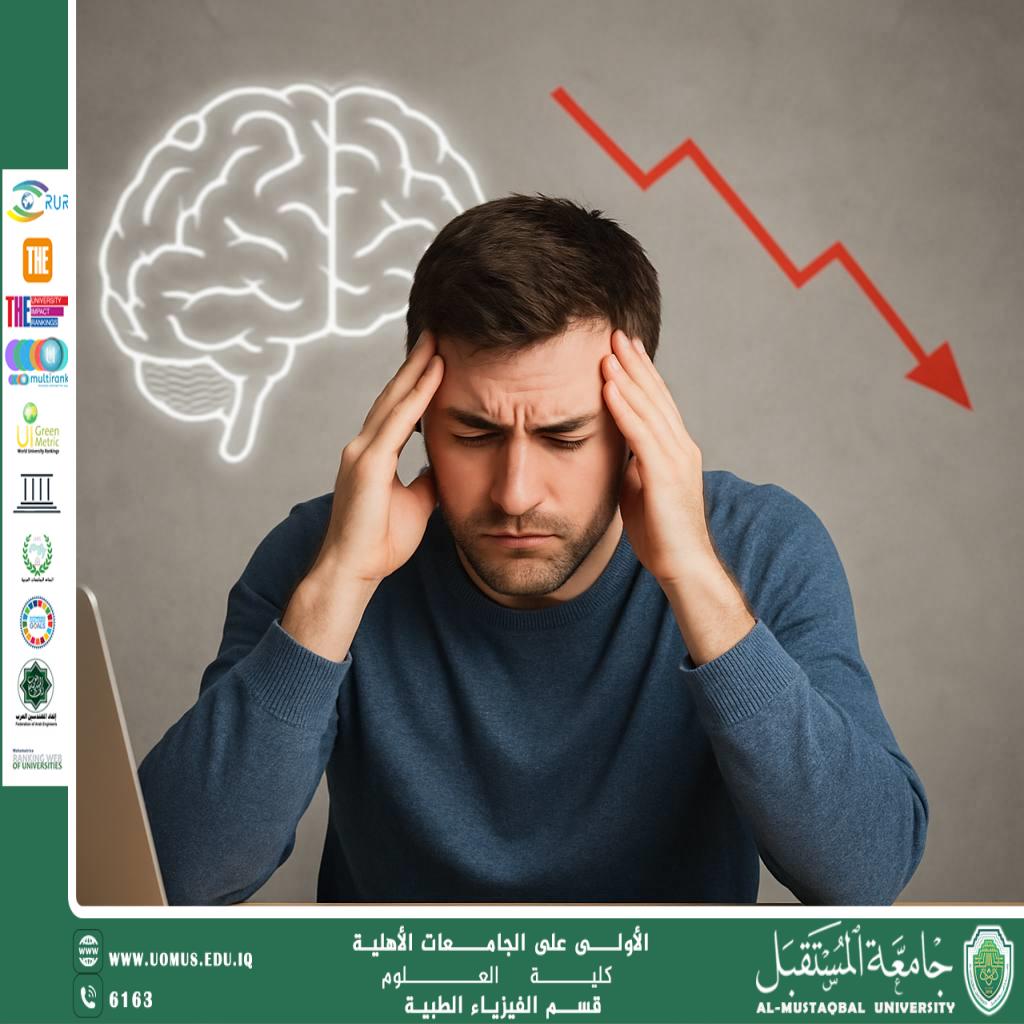
A scientific article by the teaching assistant (Nour Al-Huda Ahmed) entitled “Confronting Failure: A Scientific Perspective to Enhance Adaptation and Success”
19/04/2025 Share :
Failure is an integral part of the human experience and can, at times, serve as a powerful catalyst for personal development and growth. From a scientific standpoint, how we deal with failure plays a critical role in shaping our psychological resilience and our ability to learn and improve.<br /><br />What Is Failure from a Neuroscientific Perspective?<br /><br />Recent studies in neuroscience show that failure activates specific areas in the brain, such as the prefrontal cortex—responsible for decision-making and critical thinking. When we experience failure, the brain receives signals that help it adjust behavior and avoid similar mistakes in the future. This means that failure is not just a negative experience; it is a crucial learning process.<br /><br />Failure and Learning: A Proven Connection<br /><br />In a study conducted at Stanford University, researchers found that students who viewed failure as a learning opportunity showed greater improvement in academic performance compared to those who saw it as a sign of incapability. This highlights the importance of a growth mindset—the belief that intelligence and abilities can be developed through practice and effort.<br /><br />Failure and Psychological Resilience<br /><br />Psychological resilience refers to the ability to recover from stress and adversity. Research shows that individuals who face failure in a healthy way and learn from the experience tend to be more adaptable when facing future challenges. Skills associated with resilience include self-awareness, positive thinking, and cognitive reappraisal.<br /><br />How to Effectively Deal with Failure<br /> 1. Reframe the experience: Instead of seeing failure as a final defeat, consider it constructive feedback for improvement.<br /> 2. Process your emotions: It’s important to acknowledge and understand negative feelings rather than suppressing them.<br /> 3. Identify lessons learned: What insights did you gain from the experience? How can you act differently next time?<br /> 4. Keep trying: Giving up halts growth. Continuing to try after failure leads to eventual success.<br /><br />Conclusion<br /><br />From both a scientific and psychological perspective, failure is not the end of the road—it is the beginning of deeper self-awareness and growth. Turning failure into an opportunity requires conscious effort and mental training, but it is a long-term investment in building a more resilient and capable version of yourself.<br /><br /><br /><br />"AL_mustaqbal University is the first university in Iraq"<br/><br/><a href=https://uomus.edu.iq/Default.aspx target=_blank>al-mustaqbal University Website</a>