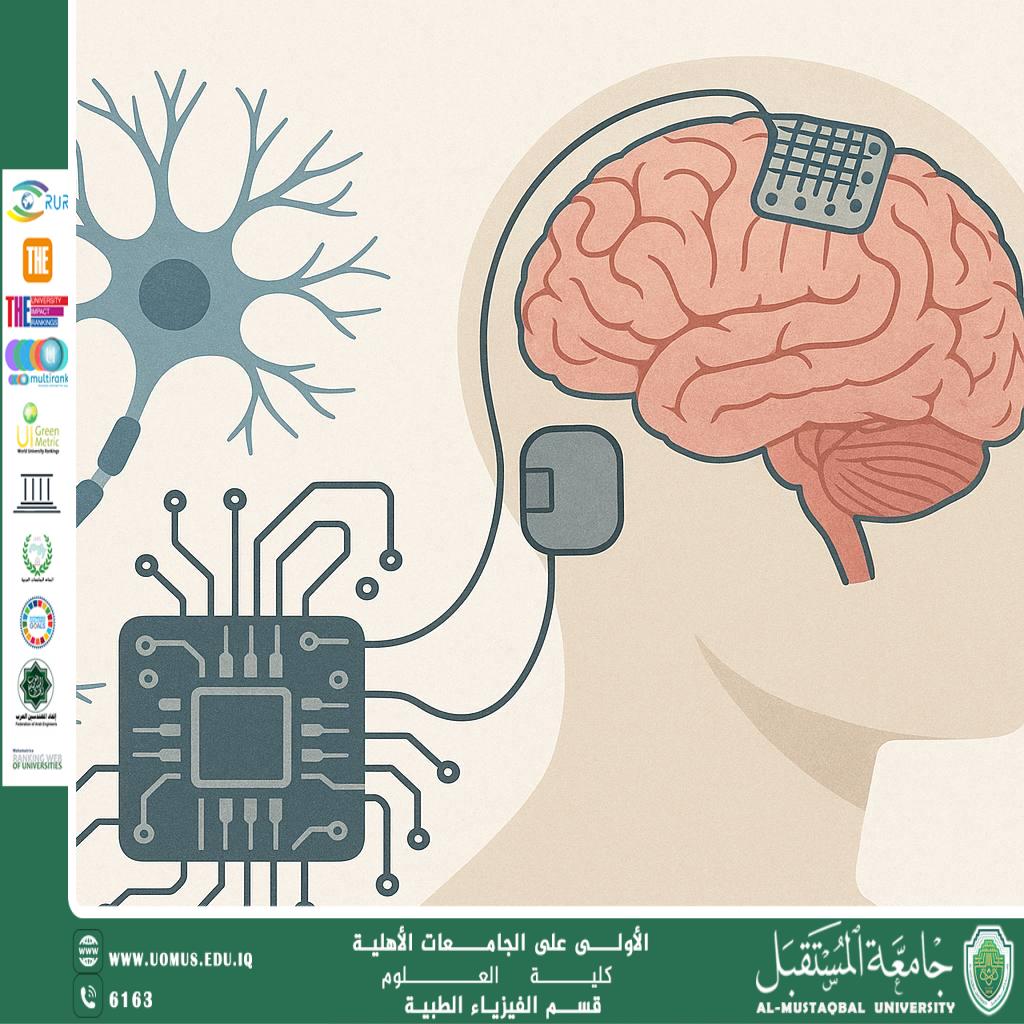
A scientific article by the lecturer ( Assistant Lecturer Ammar Karim) entitled “Bioelectronics: When electronic circuits meet neurons. A review of electronic brain stimulation devices and smart organ implants.”
20/04/2025 Share :
Introduction<br />In an era of rapid technological and medical advancement, bioelectronics has emerged as one of the most fascinating interdisciplinary fields. It combines electronic engineering with neuroscience, forming a new bridge between machines and the human body. Electronic circuits are no longer confined to computers and smartphones—they are now implanted inside the human body, directly interacting with nerves and cells, particularly in the brain, offering hope for treating complex neurological disorders and enhancing organ functionality.<br /><br />1. Brain Stimulation Devices<br />One of the most prominent applications in this field is Deep Brain Stimulation (DBS). This technique involves implanting fine electrodes into specific areas of the brain. These electrodes send electrical pulses to regulate abnormal neural activity. Notable uses include:<br /> • Parkinson’s Disease Treatment: DBS helps reduce tremors and muscle stiffness.<br /> • Treatment-Resistant Depression: Stimulating mood-related areas in the brain can bring significant improvement.<br /> • Obsessive-Compulsive Disorder and Epilepsy: Studies show positive outcomes in reducing symptoms and seizures.<br /><br />These devices are remotely programmable and can be customized for each patient, offering flexible and precise treatment options.<br /><br />2. Smart Organ Implants<br />Smart implants are electronic devices placed inside the body to perform sensory or regulatory functions. Examples include:<br /> • Cochlear Implants: Devices implanted in the inner ear to help people with hearing loss perceive sounds again.<br /> • Bionic Eyes (Retinal Implants): Used to restore partial vision by converting visual data into neural signals.<br /> • Smart Pacemakers: These advanced heart regulators can communicate with smartphone apps, transmit real-time data, and issue alerts in case of irregularities.<br /> • Neural-Controlled Prosthetics: Equipped with sensors and electronic chips, these prosthetics interpret brain signals to enable more natural movement and control for amputees.<br /><br />3. Ethical and Technical Challenges<br />Despite significant progress, bioelectronics faces multiple challenges:<br /> • Biological Safety: Implanted devices must be fully biocompatible to avoid infections or immune rejection.<br /> • Privacy Concerns: With smart implants transmitting data to the cloud, patient data privacy becomes a serious concern.<br /> • Autonomy and Control: To what extent should humans alter or stimulate brain function? Are we approaching a reality where external systems could influence thoughts or behavior?<br /><br />Conclusion<br />Bioelectronics is no longer science fiction—it is a reality unfolding daily, blending electronic precision with the complexity of the human nervous system. It represents a major leap toward a world where the boundary between human and machine becomes increasingly fluid. Technology, in this context, does not diminish humanity but enhances it. Nevertheless, this revolution must be guided by strong ethical and legal frameworks to ensure it serves humanity rather than controls it.<br /><br /><br /><br /><br />"AL_mustaqbal University is the first university in Iraq"<br/><br/><a href=https://uomus.edu.iq/Default.aspx target=_blank>al-mustaqbal University Website</a>