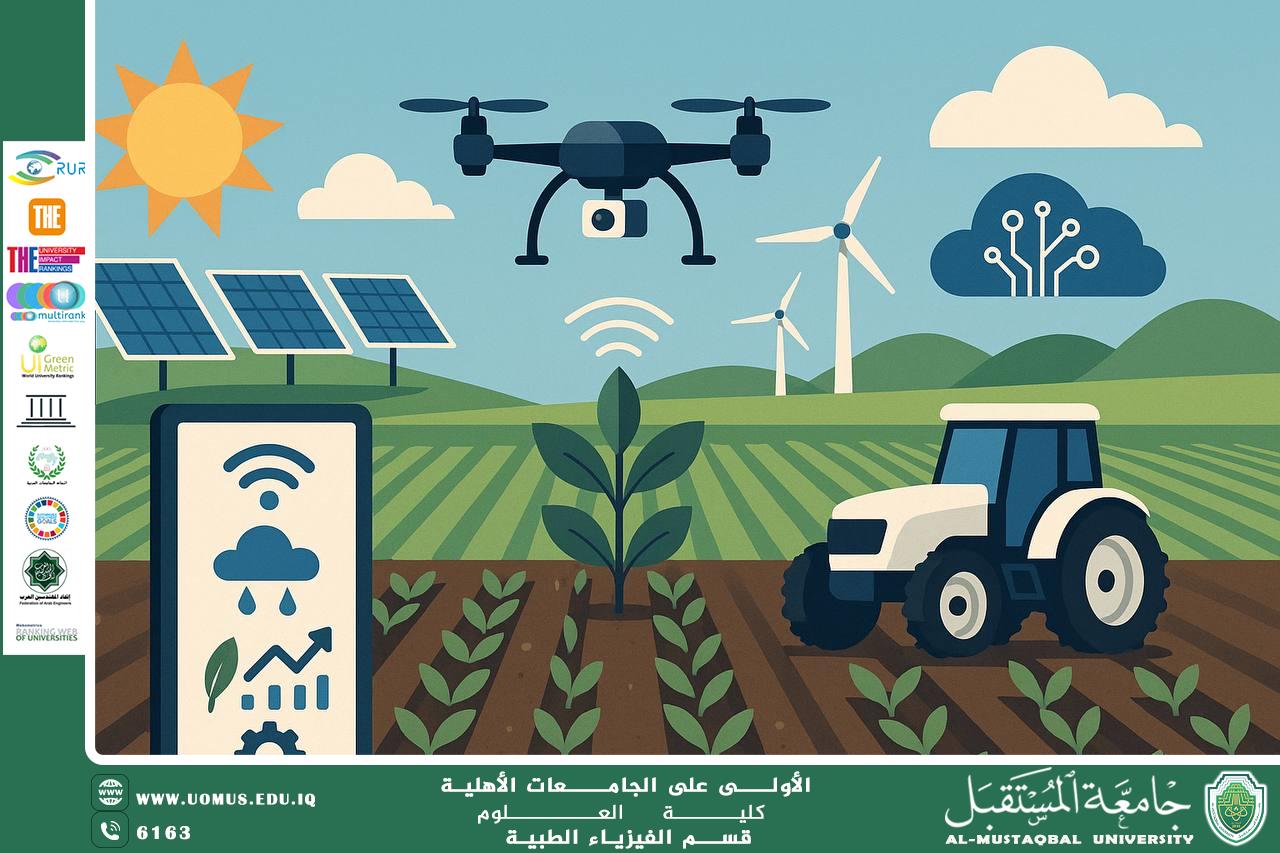
A scientific article by the administrator (Noor Issa) entitled “Smart Agriculture: Integrating Technology with Sustainability to Increase Production and Reduce Environmental Impact”
23/04/2025 Share :
Summary:<br />Traditional agriculture faces growing challenges due to climate change, population growth, and dwindling natural resources. With the advancement of modern technologies, the concept of “Smart Agriculture” has emerged as an integrated system aimed at improving agricultural production while preserving the environment. It does this by employing data, artificial intelligence, the Internet of Things, and clean energy. This article highlights the concept of smart agriculture, its applications, and its impact on enhancing environmental sustainability and increasing production efficiency.<br /><br />⸻<br /><br />Introduction<br />Agriculture is one of the most vital sectors of the global economy, but in recent years, it has been confronted with deep challenges such as water scarcity, land degradation, and climate change. These problems necessitate the development of new agricultural practices that combine increased productivity with environmental and economic sustainability. This has led to the emergence of “Smart Agriculture” or “Precision Agriculture” as an innovative solution relying on advanced digital technologies.<br /><br />⸻<br /><br />The Concept of Smart Agriculture<br />Smart agriculture refers to the use of technology to improve agricultural processes from planning and production to harvesting and distribution. This strategy includes several tools such as:<br /> • Sensor devices to measure soil moisture, air temperature, and nutrient levels.<br /> • Artificial intelligence and machine learning to analyze data and predict diseases and climate changes.<br /> • Smart irrigation systems that reduce water waste through precise control based on crop needs.<br /> • Drones for aerial monitoring and early detection of pests and changes in plant health.<br /> • Agricultural Internet of Things (IoT) to connect all systems and analyze data in real-time.<br /><br />⸻<br /><br />The Relationship Between Smart Agriculture and Sustainability<br />Smart agriculture plays a key role in achieving a balance between agricultural production and resource efficiency. Its main contributions to sustainability include:<br /> 1. Reducing water consumption through smart irrigation systems that rely on accurate data about soil and plant needs.<br /> 2. Minimizing fertilizer and pesticide use by analyzing aerial imagery and environmental data to determine precise quantities, thereby reducing chemical pollution.<br /> 3. Increasing agricultural productivity through early detection of diseases and pests, and optimizing planting and harvesting times based on accurate weather data.<br /> 4. Lowering environmental impact by reducing carbon emissions from agricultural processes and improving energy and fuel efficiency.<br /><br />⸻<br /><br />Practical Applications of Smart Agriculture<br /> • Smart vertical farming projects using digitally controlled environments for light, humidity, and temperature in urban settings.<br /> • Big data-driven agriculture that analyzes millions of environmental data points to provide instant recommendations to farmers.<br /> • Autonomous farms using robots and intelligent machinery to plant, maintain, and harvest crops without human intervention.<br /><br />⸻<br /><br />Future Challenges<br />Despite the significant benefits of smart agriculture, several challenges hinder its widespread adoption, including:<br /> • High initial investment costs.<br /> • The need for strong digital infrastructure in rural areas.<br /> • The necessity to train farmers to handle new technologies.<br /> • Concerns regarding agricultural data privacy.<br /><br />⸻<br /><br />Conclusion<br />Smart agriculture represents a paradigm shift in how food is produced more efficiently and flexibly, while preserving natural resources and reducing environmental impact. With the ongoing advancement of artificial intelligence and the Internet of Things, these practices are expected to become a fundamental part of the future of global agriculture, contributing to food security for billions of people in the coming decades.<br /><br /><br /><br />"AL_mustaqbal University is the first university in Iraq"<br/><br/><a href=https://uomus.edu.iq/Default.aspx target=_blank>al-mustaqbal University Website</a>