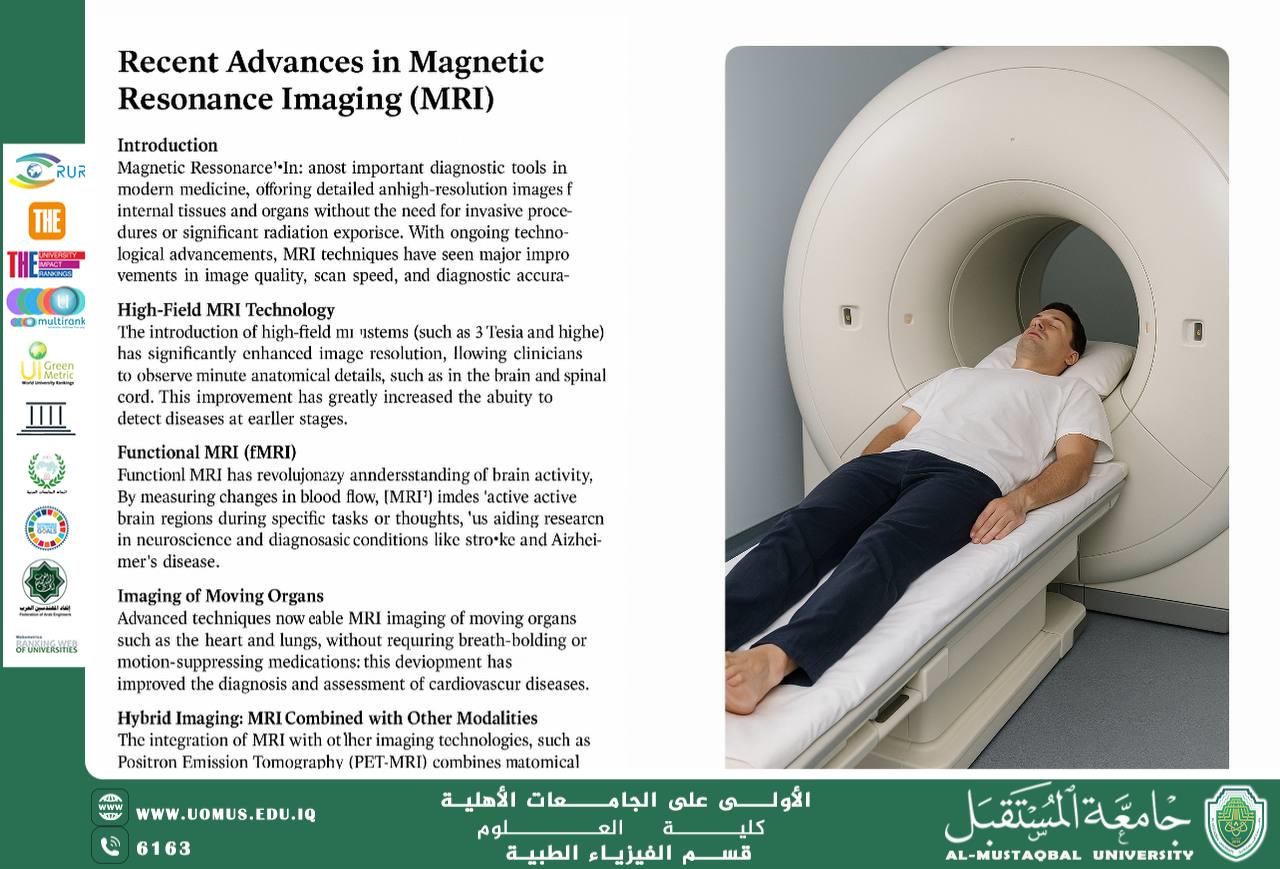
A scientific article by the teaching assistant (Maryam Reda Al-Sharaa) entitled “Recent developments in magnetic resonance imaging (MRI)”
27/04/2025 Share :
Introduction<br /><br />Magnetic Resonance Imaging (MRI) is one of the most important diagnostic tools in modern medicine, offering detailed and high-resolution images of internal tissues and organs without the need for invasive procedures or significant radiation exposure. With ongoing technological advancements, MRI techniques have seen major improvements in image quality, scan speed, and diagnostic accuracy.<br /><br />High-Field MRI Technology<br /><br />The introduction of high-field MRI systems (such as 3 Tesla and higher) has significantly enhanced image resolution, allowing clinicians to observe minute anatomical details, such as in the brain and spinal cord. This improvement has greatly increased the ability to detect diseases at earlier stages.<br /><br />Functional MRI (fMRI)<br /><br />Functional MRI has revolutionized our understanding of brain activity. By measuring changes in blood flow, fMRI identifies active brain regions during specific tasks or thoughts, aiding research in neuroscience and the diagnosis of conditions like stroke and Alzheimer’s disease.<br /><br />Fast MRI Techniques<br /><br />New methods, including compressed sensing technology, have dramatically reduced scanning times. Fast MRI techniques make procedures more comfortable, especially for pediatric and elderly patients who may struggle to remain still during long scans.<br /><br />Imaging of Moving Organs<br /><br />Advanced techniques now enable MRI imaging of moving organs, such as the heart and lungs, without requiring breath-holding or motion-suppressing medications. This development has improved the diagnosis and assessment of cardiovascular diseases.<br /><br />Hybrid Imaging: MRI Combined with Other Modalities<br /><br />The integration of MRI with other imaging technologies, such as Positron Emission Tomography (PET-MRI), combines anatomical and functional information into a single scan, offering more comprehensive and accurate diagnostic capabilities.<br /><br />Conclusion<br /><br />Recent advances in MRI technology have marked a significant leap in diagnostic medicine by improving healthcare quality and reducing unnecessary invasive procedures. As artificial intelligence and machine learning continue to evolve, even greater innovations in MRI are anticipated, shaping the future of medical imaging.<br /><br /><br /><br />"AL_mustaqbal University is the first university in Iraq"<br/><br/><a href=https://uomus.edu.iq/Default.aspx target=_blank>al-mustaqbal University Website</a>