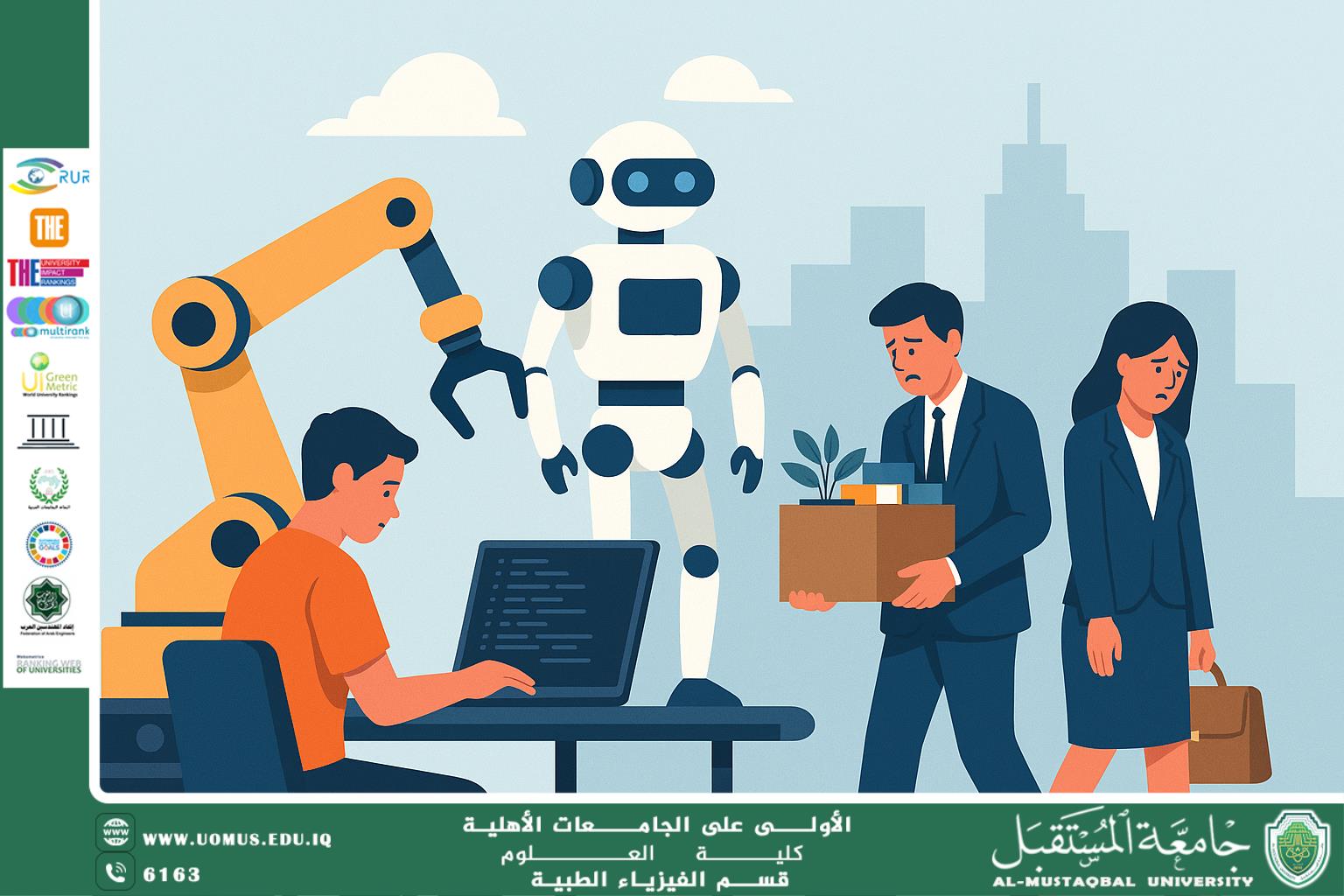
A scientific article by the lecturer (Dr. Duaa Jaafar Diaa) entitled "The Impact of Technological Innovation on the Labor Market: New Opportunities or Digital Unemployment?"
27/04/2025 Share :
Introduction<br />The world is witnessing rapid technological advancement that has transformed everyday life, with the labor market being significantly affected. While some view technological innovation as a gateway to new job opportunities, others warn of an increasing wave of digital unemployment. Which perspective is closer to reality?<br /><br />Opportunities Provided by Technological Innovation<br />New and Specialized Jobs: Professions that did not exist before have emerged, such as Data Analyst, Artificial Intelligence Engineer, Software Developer, and User Experience Designer.<br /><br />Flexible Work Models: Technology has enabled remote work and freelancing, offering millions of people opportunities worldwide.<br /><br />Boost to Entrepreneurship: Technology has facilitated the creation of startups, especially in fields like e-commerce, fintech, and digital services.<br /><br />Challenges Posed by Innovation<br />Human Replacement by Machines: Automation in factories and the reliance on robots have reduced the need for traditional jobs, particularly in the industrial and service sectors.<br /><br />Emergence of Technological Unemployment: Individuals lacking adequate digital skills are increasingly at risk of losing their jobs.<br /><br />Widening the Skills Gap: As technology advances, a clear gap has emerged between the skills required and those possessed by many current workers.<br /><br />How Can We Address These Changes?<br />Continuous Training: Developing technological skills to keep up with changes in the labor market.<br /><br />Adopting Digital Education: Integrating digital skills into various stages of education.<br /><br />Supportive Government Policies: Developing strategies to train the workforce and provide social protection for affected workers.<br /><br />Technological Innovation and Job Loss<br />Technological innovation can lead to unemployment for some workers across different companies and sectors, a phenomenon known as "technological unemployment."<br /><br />When companies rely on machines or smart software (such as robots or AI systems), they often reduce their workforce, especially in repetitive or manual jobs.<br /><br />Example: Automotive factories that introduced robots have significantly reduced the need for manual labor.<br /><br />Similarly, in the banking sector, the rise of online banking applications has led to the closure of some branches and the layoff of employees.<br /><br />When is Unemployment More Likely?<br />When workers are not qualified to use modern technologies.<br /><br />Or when there are no training programs available to help them transition into new roles.<br /><br />However, at the same time:<br /><br />Innovation also creates new jobs, such as Robot Supervisors, System Programmers, and Data Analysts.<br /><br />Thus, the situation is not merely about job loss but rather a transformation in the nature of jobs.<br /><br />Conclusion<br />Technological innovation brings with it both tremendous opportunities and serious challenges for the labor market. Smart adaptation to these changes is the key to leveraging the opportunities while minimizing the risks. The future will not wait, and those who prepare well will be the first to reap its rewards.<br /><br /><br />"AL_mustaqbal University is the first university in Iraq"<br/><br/><a href=https://uomus.edu.iq/Default.aspx target=_blank>al-mustaqbal University Website</a>