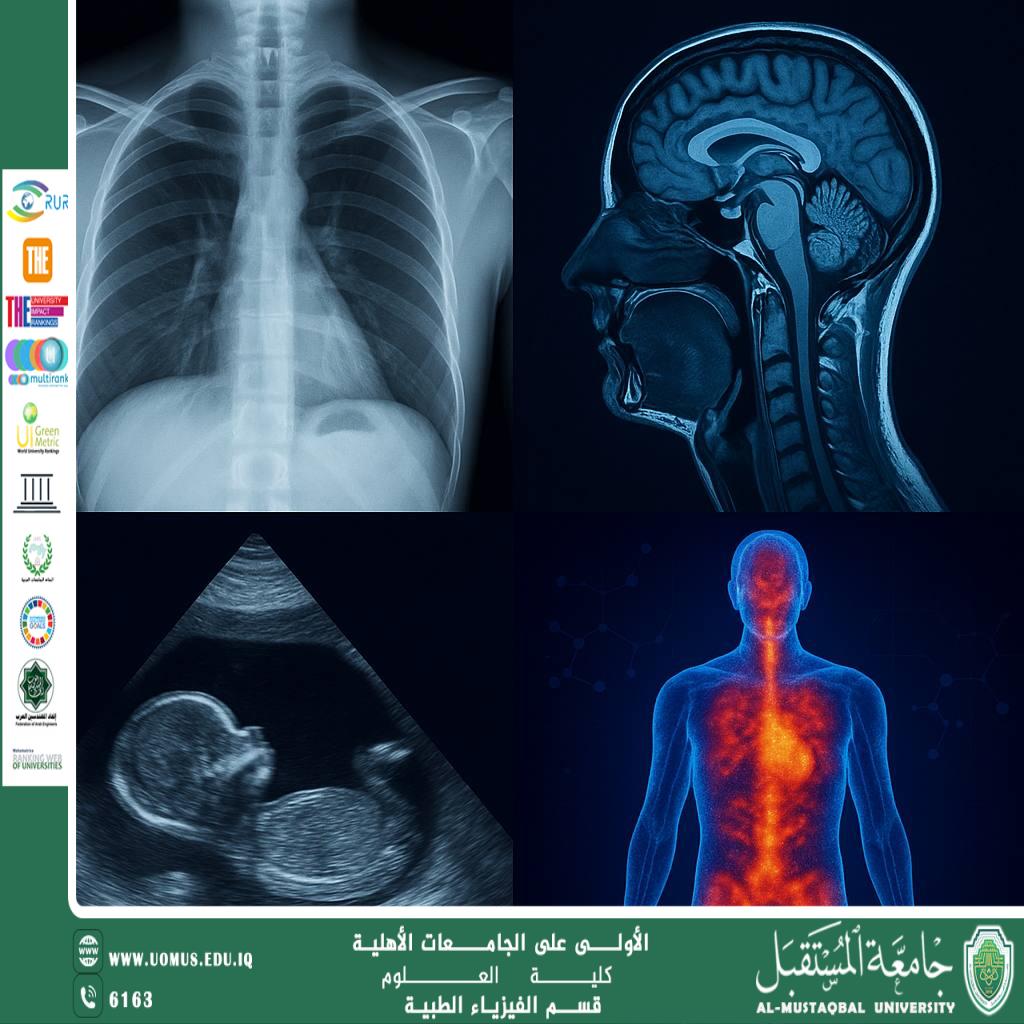
A scientific article by the lecturer (Assistant Lecturer Ammar Karim) entitled “Medical Imaging Techniques: How Does Physics Help See the Unseen?”
30/04/2025 Share :
Introduction<br /><br />In modern medicine, the ability to see inside the human body without surgery is one of the greatest achievements of our time. Physics stands at the heart of this advancement, enabling the development of medical imaging technologies that rely on complex physical principles. From X-rays to magnetic resonance imaging (MRI), physics plays a key role in producing accurate images that aid physicians in diagnosis and treatment without the need for invasive procedures.<br /><br />⸻<br /><br />1. X-rays: The First Window Into the Body<br /><br />X-rays were the first medical imaging technique used clinically, discovered in 1895 by physicist Wilhelm Röntgen. This technique involves passing high-energy electromagnetic waves through the body. Different tissues absorb these rays to varying degrees, creating images that clearly show bones. X-rays are widely used in diagnosing fractures, lung diseases, and dental issues.<br /><br />⸻<br /><br />2. Computed Tomography (CT): Layered Precision<br /><br />CT scans are an advanced form of X-ray imaging. They take multiple images from different angles and use computer processing to reconstruct 3D images of the body. This technology provides highly detailed information and is essential for detecting tumors, internal bleeding, and diseases affecting internal organs.<br /><br />⸻<br /><br />3. Magnetic Resonance Imaging (MRI): Imaging Without Radiation<br /><br />MRI relies on the physical principles of magnetic fields and radio waves. By stimulating hydrogen atoms in the body, MRI creates highly detailed images of soft tissues such as the brain, spinal cord, and muscles—without using ionizing radiation—making it safer in many situations.<br /><br />⸻<br /><br />4. Ultrasound Imaging: Seeing with Sound<br /><br />Ultrasound uses high-frequency sound waves that travel through the body and reflect off tissues. These echoes are converted into real-time images. It is commonly used for monitoring pregnancies and diagnosing heart, liver, and kidney conditions.<br /><br />⸻<br /><br />5. Nuclear Medicine Imaging: Nuclear Physics in Diagnosis<br /><br />This technique uses radioactive isotopes introduced into the body through injection, ingestion, or inhalation. These isotopes emit radiation that is detected by special cameras to visualize the function of organs and tissues. Nuclear medicine is used in diagnosing cancer, heart disease, and thyroid disorders.<br /><br />⸻<br /><br />Conclusion<br /><br />Medical imaging technologies are a remarkable example of how physics enhances human life. Thanks to physics, doctors can “see the unseen,” leading to more accurate diagnoses, faster treatments, and reduced risk to patients. As research progresses, these technologies are expected to become even more precise and safer, with new methods emerging through artificial intelligence and quantum technologies.<br /><br /><br /><br />"AL_mustaqbal University is the first university in Iraq"<br/><br/><a href=https://uomus.edu.iq/Default.aspx target=_blank>al-mustaqbal University Website</a>