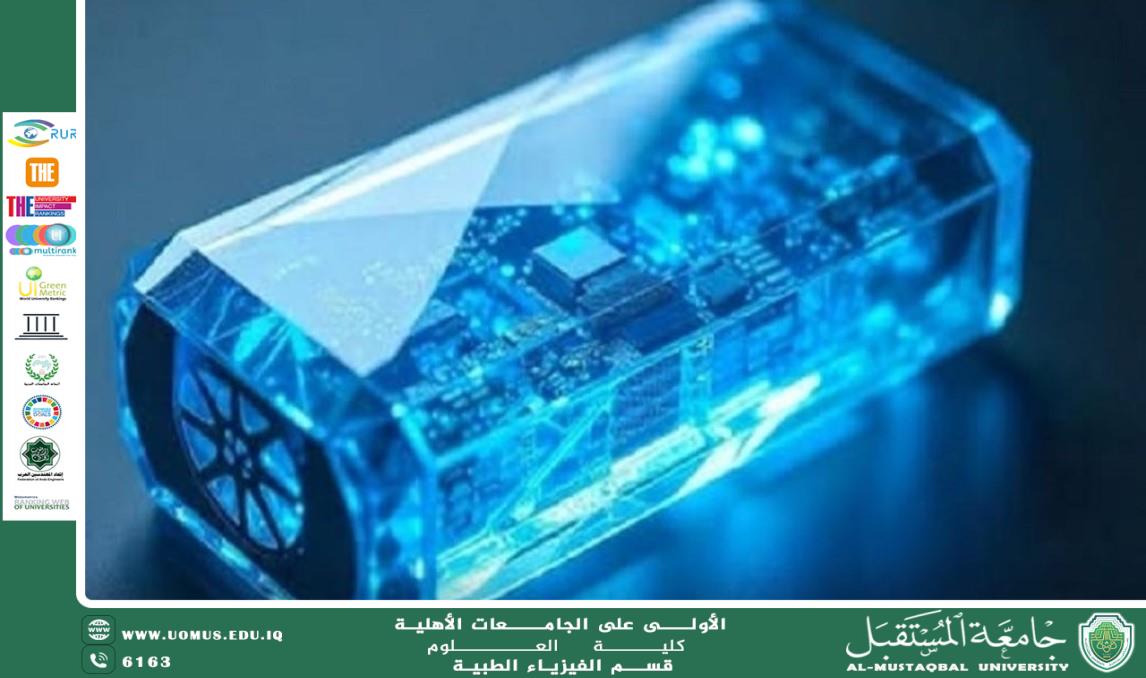
A scientific article by the lecturer (Dr. Karim Abis Handoul) entitled “Radioactive Diamond Batteries: A Revolution in Energy Storage That Lasts for Thousands of Years”
30/04/2025 Share :
In a groundbreaking scientific achievement, researchers from the University of Bristol in the UK, in collaboration with the Atomic Energy Authority, have succeeded in developing the world’s first diamond battery made from carbon-14. This new type of battery has a unique ability to power devices for thousands of years, making it an unprecedented long-term energy source.<br /><br />How does this unique battery work?<br />The battery relies on a small amount of carbon-14, a radioactive isotope of regular carbon that contains two extra neutrons in its nucleus, making it unstable and radioactive. This material is placed inside the battery and then encased in layers of lab-grown synthetic diamond.<br /><br />Diamond is an ideal choice for this casing—not only because of its extreme hardness but also due to its excellent thermal conductivity and ability to withstand radiation. When the carbon-14 undergoes radioactive decay (beta decay), it emits subatomic particles, which the diamond converts directly into electrical current.<br /><br />A Near-Perpetual Power Source<br />Carbon-14 is typically extracted from graphite blocks used in nuclear reactors, adding an environmental dimension to this technology by recycling nuclear waste in a safe and efficient way.<br /><br />Thanks to the half-life of carbon-14—around 5,700 years—the battery can provide a stable and consistent energy output for thousands of years without needing maintenance or recharging. The diamond layers surrounding the radioactive core act as a full barrier that prevents radiation leakage, making the battery completely safe for human use—unlike traditional nuclear batteries that use more hazardous materials like plutonium.<br /><br />Promising Applications Without Limits<br />The prototype battery is designed to be about the size of a small coin, making it ideal for devices that require low power and long-term stability. Some of the most promising potential applications for this revolutionary technology include:<br /><br />Pacemakers and other medical implants inside the human body, eliminating the need for repeated surgeries to replace batteries.<br /><br />Satellites and space probes that require reliable power sources far from the Sun.<br /><br />Sensors in extreme environments such as deep-sea or polar regions, where maintenance or battery replacement is difficult.<br /><br />Defense and security systems that need sensors to operate for long periods without human intervention.<br /><br />Despite these incredible prospects, the battery is not currently designed to provide large amounts of energy, making it unsuitable for use in electric vehicles or laptops for now. However, researchers hope that in the future, the technology can be developed further to power small electronic devices like smartphones or watches for decades without needing to be recharged.<br /><br />Conclusion<br />The development of carbon-14 diamond batteries represents a revolutionary leap in the world of energy storage, combining exceptional safety, environmental sustainability, and astonishing operational lifespan. If progress in this field continues, we may witness a future where the need for frequent charging or battery replacement disappears entirely.<br /><br /><br /><br />"AL_mustaqbal University is the first university in Iraq"<br/><br/><a href=https://uomus.edu.iq/Default.aspx target=_blank>al-mustaqbal University Website</a>