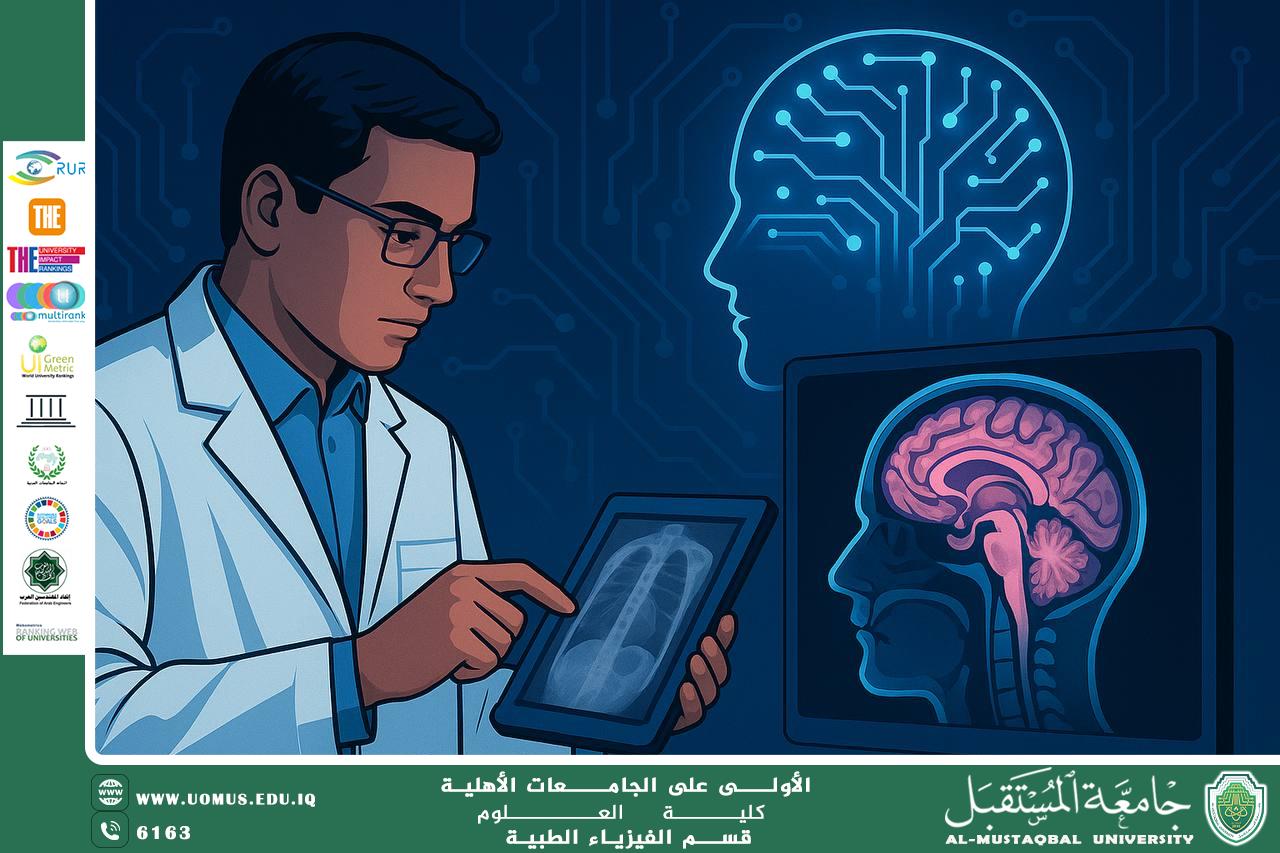
A scientific article by the lecturer (Assistant Lecturer Ali Jaafar) entitled “Artificial Intelligence in Medical Physics: Improving the Quality of Medical Images and Diagnostic Accuracy”
30/04/2025 Share :
Introduction<br /><br />In recent decades, the integration of Artificial Intelligence (AI) into the medical field has grown rapidly, particularly in medical physics, which deals with diagnostic imaging and therapeutic technologies based on physical principles. AI offers revolutionary capabilities in analyzing vast amounts of medical data with speed and precision far beyond human abilities. This results in improved medical image quality and significantly enhanced diagnostic accuracy.<br /><br />⸻<br /><br />1. What is Artificial Intelligence?<br /><br />Artificial Intelligence is a branch of computer science that aims to develop systems capable of learning, reasoning, and decision-making in a human-like manner. It includes technologies like Machine Learning (ML) and Deep Learning (DL), which use neural networks to analyze data and recognize patterns.<br /><br />⸻<br /><br />2. Enhancing Medical Image Quality with AI<br /><br />Imaging techniques such as MRI and CT rely heavily on image clarity and detail for accurate diagnosis. AI plays a critical role in enhancing this quality through:<br /> • Noise reduction: AI can significantly improve image clarity by reducing digital noise while preserving essential structural information.<br /> • Low-dose imaging: AI allows for accurate imaging even with lower radiation exposure, reducing health risks to patients.<br /> • Faster imaging processes: AI reduces the time needed to capture high-quality images, increasing patient throughput and comfort.<br /><br />⸻<br /><br />3. Improving Diagnostic Accuracy with AI<br /><br />Beyond enhancing image quality, AI is also used to analyze medical images and identify pathological features with remarkable precision. Its applications include:<br /> • Early tumor detection: AI systems can detect subtle anomalies in imaging data, enabling the early diagnosis of cancers and other diseases.<br /> • Disease classification: Trained models can distinguish between healthy and diseased tissues or identify specific types of conditions, such as brain tumors or breast cancer.<br /> • Predictive analytics: By analyzing historical data, AI can help predict the progression of diseases and propose personalized treatment plans.<br /><br />⸻<br /><br />4. Challenges and Ethical Considerations<br /><br />Despite its advantages, implementing AI in medical physics comes with several challenges:<br /> • Data privacy and security: AI requires access to sensitive medical data, necessitating strict data protection and ethical standards.<br /> • Over-reliance on automation: AI should act as an aid, not a replacement for medical professionals. Human expertise remains vital for clinical context and decision-making.<br /> • Model validation: AI systems must be rigorously tested for accuracy and bias to ensure reliable results in diverse patient populations.<br /><br />⸻<br /><br />Conclusion<br /><br />Artificial Intelligence is rapidly becoming a cornerstone in the advancement of medical physics. Its contributions to image enhancement and diagnostic precision are transforming healthcare practices. As AI technologies continue to evolve, they are expected to become more integrated into medical systems, ultimately improving patient care and saving lives.<br /><br /><br /><br />"AL_mustaqbal University is the first university in Iraq"<br/><br/><a href=https://uomus.edu.iq/Default.aspx target=_blank>al-mustaqbal University Website</a>