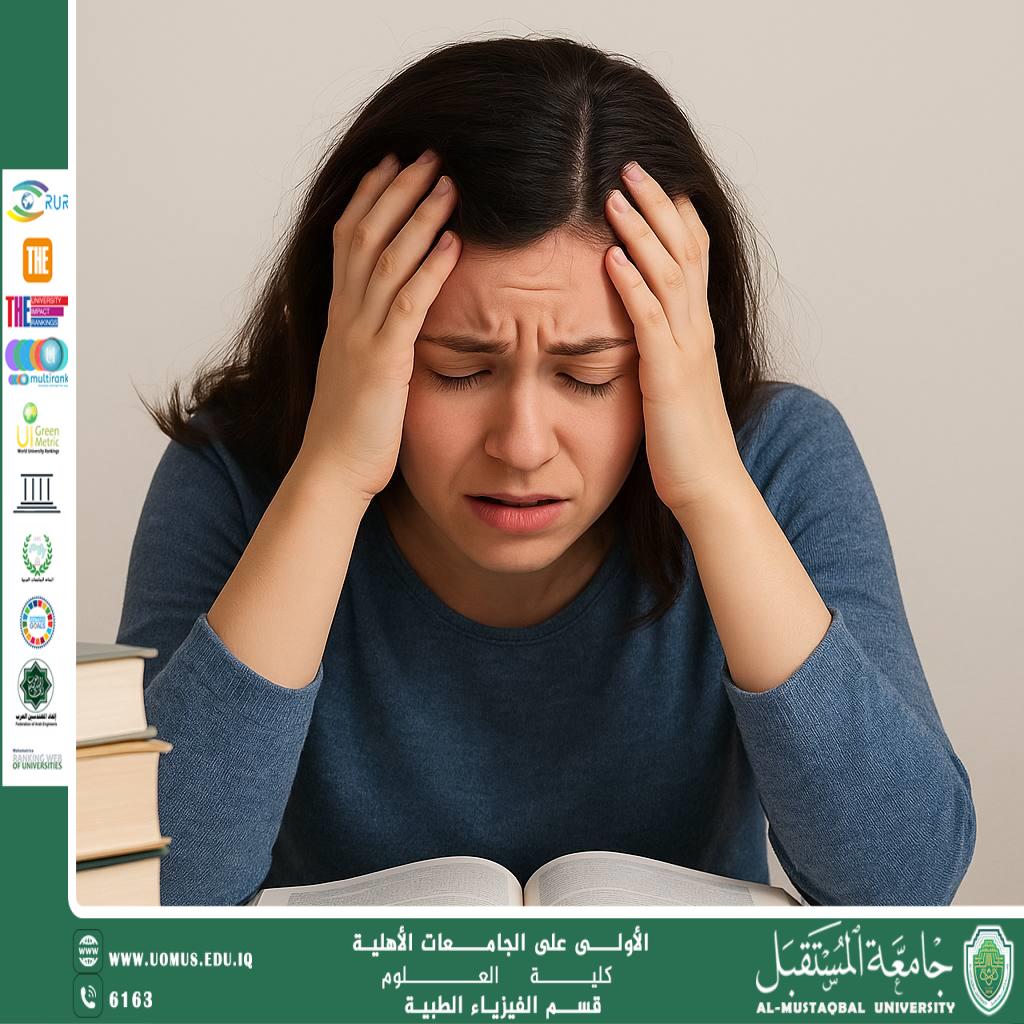
A scientific article by the teaching assistant (Maryam Reda Al-Sharaa) entitled “The relationship between academic anxiety and academic achievement among university students”
03/05/2025 Share :
Introduction<br /><br />Academic anxiety is one of the most prominent psychological challenges faced by university students. It is defined as a state of tension or worry associated with academic situations such as exams, assignments, or high academic expectations. There is ongoing debate about the extent to which this form of anxiety affects academic performance—whether it is purely negative or potentially beneficial at moderate levels.<br /><br />⸻<br /><br />Problem Statement<br /><br />The central question of this study is: What is the relationship between academic anxiety and academic achievement among university students? Does anxiety negatively impact academic performance, or can a certain level of anxiety serve as a motivator for achievement?<br /><br />⸻<br /><br />Study Objectives<br /> 1. To measure the level of academic anxiety among a sample of university students.<br /> 2. To examine differences in academic achievement based on levels of academic anxiety.<br /> 3. To provide psychological and educational recommendations for managing anxiety and enhancing academic performance.<br /><br />⸻<br /><br />Significance of the Study<br /><br />This study is significant in light of the rising rates of anxiety among university students, especially under increasing academic, financial, and social pressures. These factors can negatively affect the quality of education and student outcomes.<br /><br />⸻<br /><br />Methodology<br /><br />The study adopted a descriptive-analytical approach. A standardized Academic Anxiety Scale was used, and academic performance data were collected from university records for a sample of 100–200 students from various majors.<br /><br />⸻<br /><br />Expected Results<br /><br />Previous research suggests a negative correlation between high academic anxiety and academic performance. Excessive anxiety may lead to distraction, difficulty concentrating, and poor exam performance. However, moderate levels of anxiety may have a positive motivational effect, encouraging students to study and prepare more effectively.<br /><br />⸻<br /><br />Recommendations<br /> 1. Implement psychological counseling programs within universities to help students cope with academic pressure.<br /> 2. Train faculty members to identify signs of anxiety among students and refer them to appropriate support services.<br /> 3. Integrate time management and mental relaxation techniques into university curricula.<br /><br />⸻<br /><br />Conclusion<br /><br />This study confirms that academic anxiety is a real phenomenon that directly affects academic achievement. Recognizing and managing its levels is key to university success. Therefore, developing a psychologically supportive university environment is a necessity, not a luxury<br /><br /><br /><br /><br />"AL_mustaqbal University is the first university in Iraq"<br/><br/><a href=https://uomus.edu.iq/Default.aspx target=_blank>al-mustaqbal University Website</a>