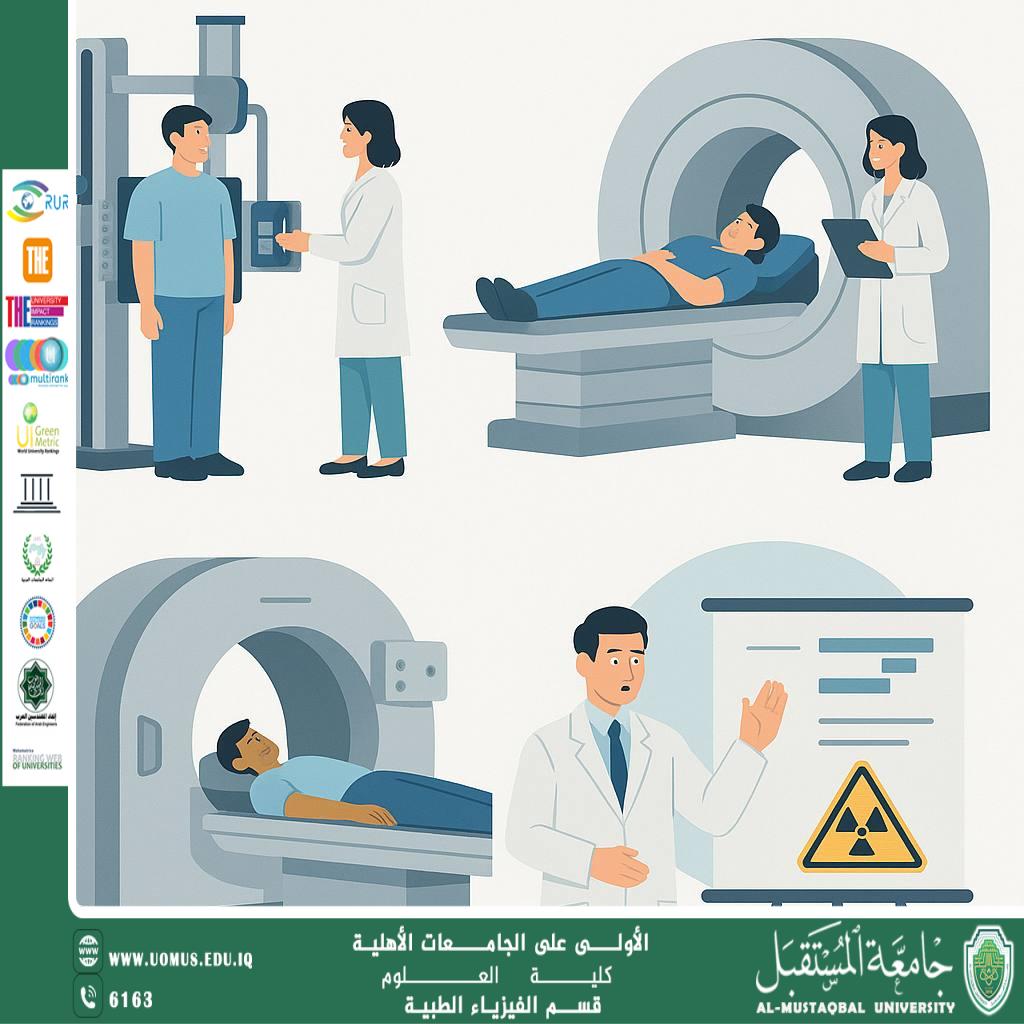
A scientific article by the administrator (Nargis Jassim) entitled “Radiation doses in medical imaging and their impact on patients”
05/05/2025 Share :
Introduction<br /><br />Medical imaging using ionizing radiation is one of the most important diagnostic tools in modern medicine. Techniques such as X-rays, computed tomography (CT), and nuclear medicine imaging (e.g., PET and SPECT) play a vital role in diagnosing a wide range of conditions. While generally considered safe, repeated exposure or high doses of radiation can have effects on patients’ health.<br /><br />⸻<br /><br />What is Radiation Dose?<br /><br />Radiation dose refers to the amount of ionizing radiation absorbed by body tissues. It is commonly measured in millisieverts (mSv). The dose varies depending on the type of imaging procedure:<br /> • Chest X-ray: approximately 0.1 mSv<br /> • Head CT scan: about 2 mSv<br /> • Full-body CT scan: can exceed 10 mSv<br /><br />⸻<br /><br />Effects of Radiation Doses<br /><br />Radiation effects can be categorized into two main types:<br /> 1. Deterministic Effects:<br />These occur when a high dose is delivered over a short period. Effects include tissue damage, burns, or bone marrow suppression. However, such effects are rare in diagnostic imaging.<br /> 2. Stochastic Effects:<br />These are probabilistic and more relevant to medical imaging. Repeated or cumulative exposure to radiation may increase the long-term risk of developing cancer, particularly in sensitive groups such as children and pregnant women.<br /><br />⸻<br /><br />Strategies for Dose Reduction<br /><br />To minimize radiation risks, several radiation protection principles are applied:<br /> • ALARA Principle (As Low As Reasonably Achievable): Minimizing dose without compromising image quality.<br /> • Appropriate Exam Justification: Imaging should only be performed when medically necessary.<br /> • Use of Modern Technology: Digital equipment and advanced software help reduce radiation doses.<br /> • Education and Training: Ensuring healthcare professionals are aware of radiation risks and safety practices.<br /><br />⸻<br /><br />Conclusion<br /><br />While the benefits of medical imaging with ionizing radiation are substantial, it is crucial to use these techniques responsibly. By balancing diagnostic benefits with potential risks and applying proper radiation protection practices, patient safety can be maintained without compromising diagnostic accuracy.<br /><br /><br /><br />"AL_mustaqbal University is the first university in Iraq"<br/><br/><a href=https://uomus.edu.iq/Default.aspx target=_blank>al-mustaqbal University Website</a>