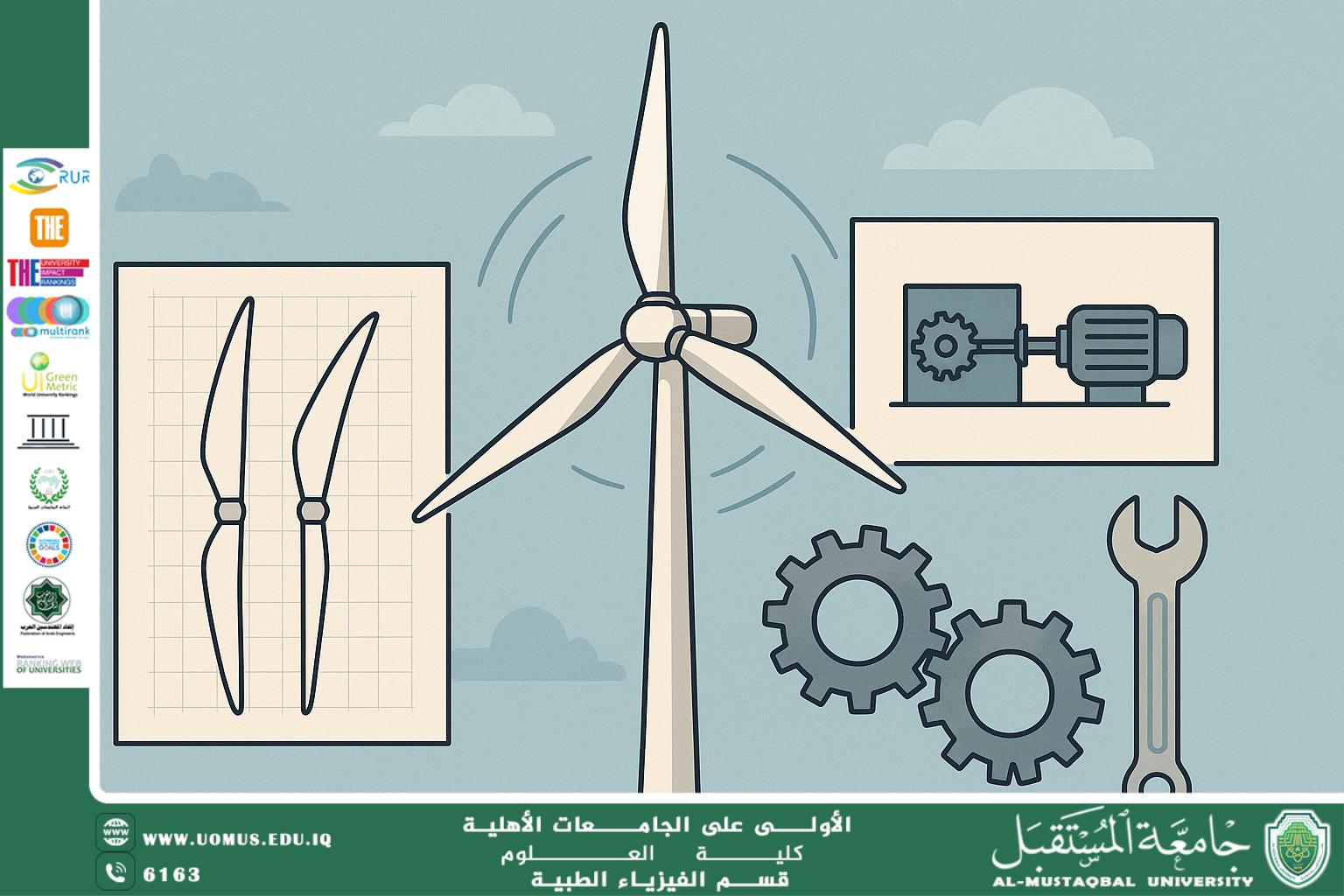
A scientific article by the teaching assistant (Amir Sobhi Ismail) entitled “Design of Sustainable Mechanical Power Systems: A Case Study on Wind Turbines”
06/05/2025 Share :
Abstract<br />Amid increasing environmental challenges and the urgent need to reduce carbon emissions, sustainable energy systems have become a key option to balance global energy demands with environmental preservation. Wind turbines stand out as one of the most prominent applications of renewable energy, converting the kinetic energy of wind into electrical power with high efficiency. This study aims to analyze the design principles of wind turbines and their main components, focusing on the mechanical aspects that enhance system sustainability and operational efficiency.<br /><br />1. Introduction<br />Over the past decades, the world has seen a remarkable shift toward renewable energy sources. Among these, wind energy has emerged as one of the fastest-growing and most cost-effective technologies. The success of wind turbines relies on precise mechanical design that ensures continuous operation under varying environmental conditions while maximizing the efficiency of the produced energy.<br /><br />2. Main Components of Wind Turbines<br />The mechanical system of a wind turbine consists of several key components:<br /><br />Blades: Aerodynamically shaped to reduce drag and increase lift.<br /><br />Gearbox: Responsible for increasing the rotational speed to the required level for electricity generation.<br /><br />Generator: Converts mechanical energy into electrical energy.<br /><br />Yaw System: Adjusts the turbine’s orientation to face the wind direction.<br /><br />Tower: Supports the system and raises it to an optimal height for capturing wind energy.<br /><br />3. Sustainable Design Criteria<br />To ensure system sustainability, the following design factors should be considered:<br /><br />Use of lightweight, durable materials that reduce weight and increase service life.<br /><br />Optimized aerodynamics to minimize energy losses.<br /><br />Implementation of smart maintenance technologies to detect faults early and reduce downtimes.<br /><br />Consideration of environmental impacts such as noise and effects on local wildlife.<br /><br />4. Case Study: Improving Wind Turbine Efficiency<br />A 2-megawatt wind turbine system located in a medium-wind-speed region was studied. Improvements in blade design using composite materials led to a 12% increase in efficiency, while the implementation of smart control systems reduced mechanical failures by 18%. These results demonstrate how thoughtful mechanical design can significantly enhance system sustainability and performance.<br /><br />5. Conclusion<br />The sustainable mechanical design of wind turbines plays a critical role in supporting the global transition to clean energy. By improving materials, design, and maintenance strategies, system efficiency can be boosted, and environmental impact minimized. This study recommends continued research and development in this field to achieve further advancements in wind energy technologies.<br /><br /><br /><br /><br />"AL_mustaqbal University is the first university in Iraq"<br/><br/><a href=https://uomus.edu.iq/Default.aspx target=_blank>al-mustaqbal University Website</a>