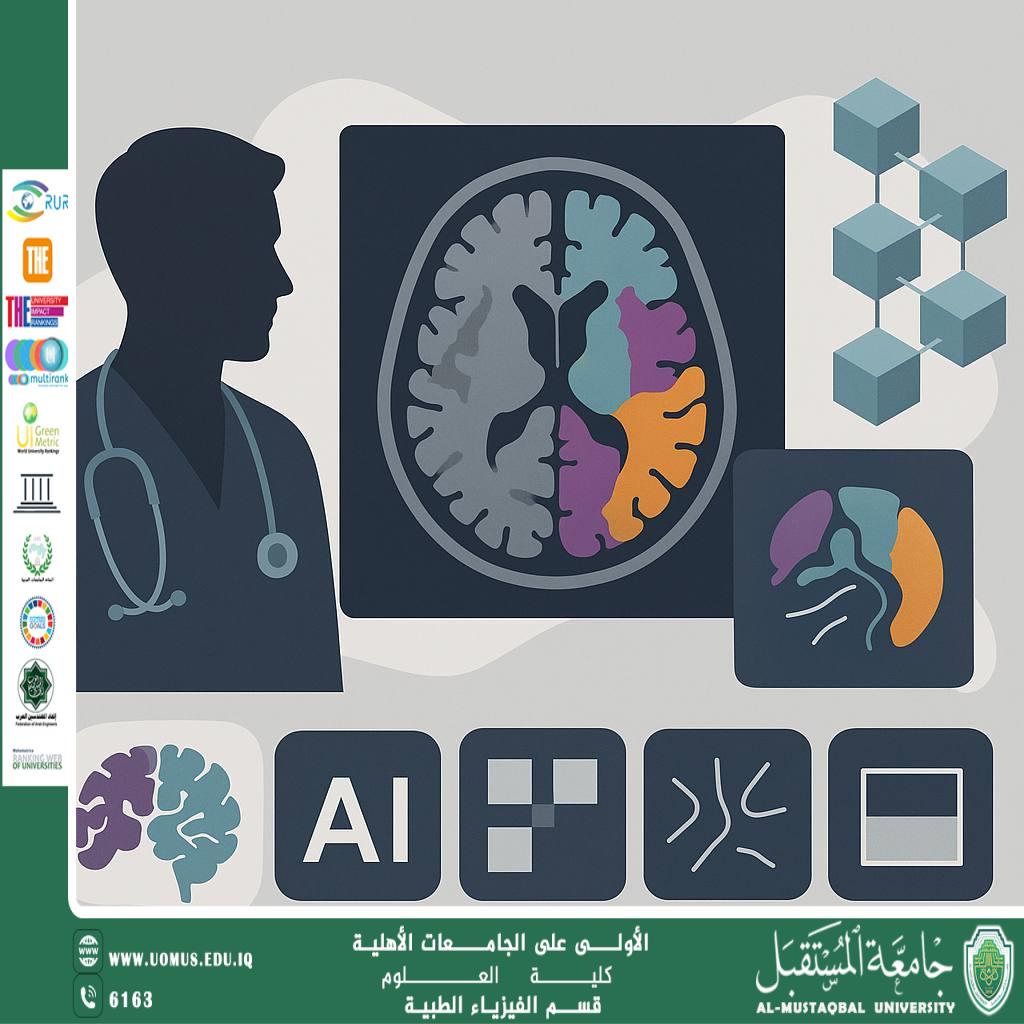
A scientific article by the lecturer ( Assistant Lecturer Lubna Ali) entitled “Developing algorithms for high-precision medical image segmentation”
06/05/2025 Share :
Medical image segmentation is a fundamental process in medical image analysis, aimed at distinguishing different tissues within an image to facilitate diagnosis and treatment. This process relies on advanced algorithms capable of accurately defining boundaries between tissues, enhancing diagnostic precision, and minimizing human errors. With the rapid advancement of artificial intelligence and deep learning, segmentation techniques have become more efficient and reliable, opening new frontiers in medical imaging. <br /><br /> Importance of Medical Image Segmentation <br />Medical image segmentation is a crucial step in several medical applications, such as: <br />- Disease Diagnosis: Helps identify affected areas within medical images, such as tumors or calcifications. <br />- Surgical Planning: Provides precise information about tissues and organs, assisting surgeons in making accurate decisions. <br />- Treatment Monitoring: Can be used to track disease progression or the body's response to treatment. <br /><br /> Modern Techniques in Medical Image Segmentation <br />Contemporary segmentation algorithms rely on several advanced techniques, including: <br />1. Convolutional Neural Networks (CNNs): Used in medical image analysis to extract critical features for tissue differentiation. <br />2. Deep Learning: Provides robust models like U-Net and Mask R-CNN that achieve high segmentation accuracy. <br />3. Machine Learning-Based Segmentation: Utilizes techniques such as SVM and Random Forest to classify pixels within an image. <br />4. Edge-Based Segmentation: Used to detect boundaries between different tissues. <br />5. Thresholding-Based Segmentation: Relies on predefined values to separate tissues within an image. <br /><br /> Challenges in Developing Segmentation Algorithms <br />Despite significant progress in this field, several challenges remain, such as: <br />- Handling Low-Quality Images: Some medical images suffer from noise or low contrast, affecting segmentation accuracy. <br />- Diversity in Medical Image Types: Medical images vary based on the imaging device used (MRI, CT, X-ray), requiring adaptable algorithms. <br />- Need for Large Training Data: Deep learning models rely on massive datasets to achieve optimal performance. <br />- Integration with Medical Systems: Algorithms must be applicable in hospital and clinical environments. <br /><br /> Future Trends in Medical Image Segmentation <br />With continuous advancements in AI, segmentation techniques are expected to see substantial improvements, such as: <br />- Enhanced Deep Neural Networks for Higher Precision Segmentation <br />- Integration of AI with 3D Medical Imaging for More Detailed Tissue Analysis <br />- Improvement in Noise-Reduction Techniques for Sharper and More Accurate Medical Images <br />- Development of Self-Learning Segmentation Systems Based on New Data to Continuously Improve Performance <br /><br />Developing high-precision medical image segmentation algorithms is a vital field that contributes to improving the quality of diagnosis and medical treatment. By leveraging AI and deep learning techniques, significant advancements can be achieved in this domain, helping doctors and researchers provide more accurate healthcare solutions.<br /><br /><br /><br />"AL_mustaqbal University is the first university in Iraq"<br/><br/><a href=https://uomus.edu.iq/Default.aspx target=_blank>al-mustaqbal University Website</a>