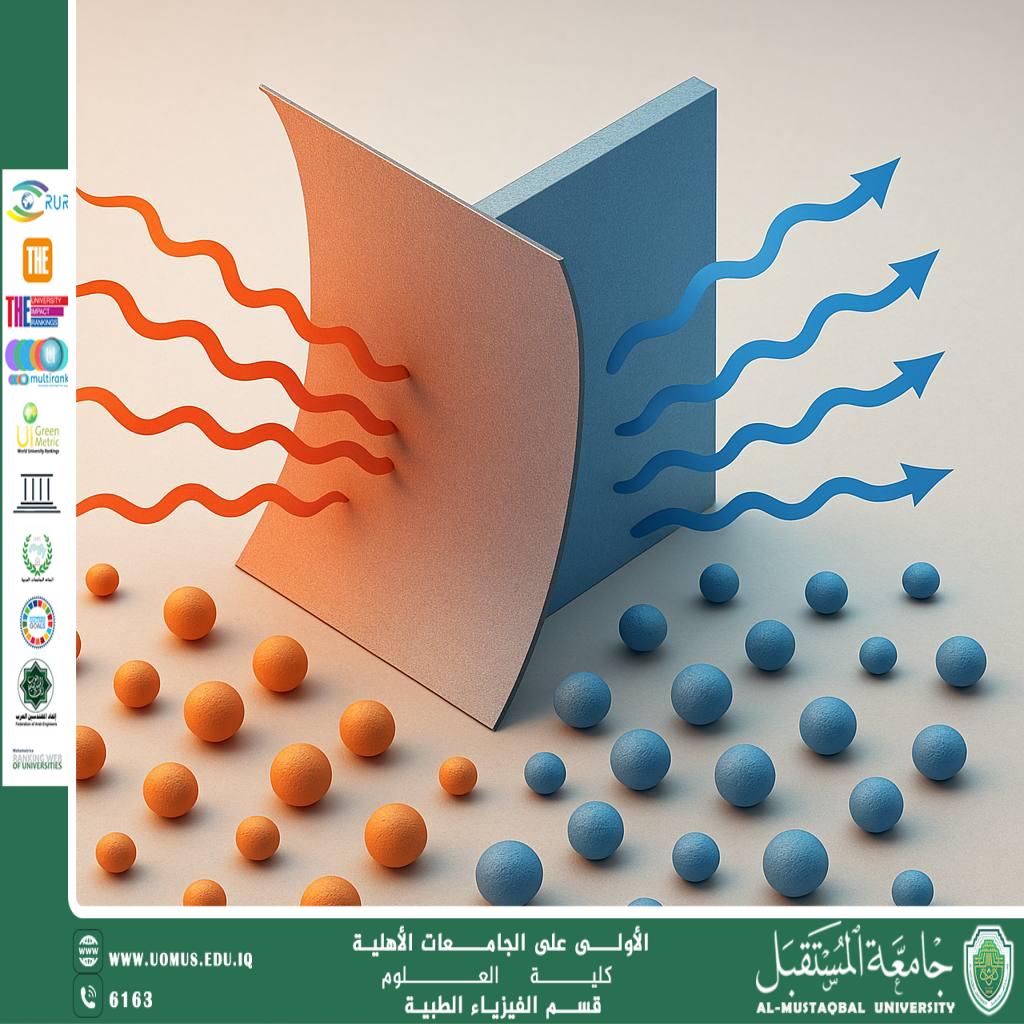
A scientific article by the lecturer (Assistant Lecturer Ammar Karim) entitled "Study of heat transfer in nanosystems"
07/05/2025 Share :
Introduction: <br />In recent years, nano systems have gained significant attention in science and engineering, particularly in heat transfer applications. Due to their small dimensions and unique properties, nanomaterials provide new possibilities for controlling thermal flow, improving the performance of various industrial and technological applications. <br /><br />Fundamental Concepts of Heat Transfer in Nano Systems: <br />Heat transfer at the nanoscale differs from traditional thermal phenomena due to size effects and strong interactions between nanoparticles. Some fundamental concepts include: <br />- Nano-scale Thermal Conductivity: Depends on heat transfer within nanomaterials, where material boundaries significantly affect phonon movement. <br />- Nano-scale Thermal Radiation: Involves quantum effects and high-frequency electromagnetic waves within nanomaterials. <br />- Nano-scale Convective Heat Transfer: Relates to the interaction of nanofluids with surfaces and various thermal fields. <br /><br />Practical Applications of Nano Systems in Heat Transfer: <br />Nano heat transfer technologies can be applied in several fields, including: <br />- Microelectronics: Nanomaterials help dissipate heat inside processors and electronic circuits. <br />- Renewable Energy: Nanoparticles improve the efficiency of thermal energy conversion systems, such as solar cells and heat exchangers. <br />- Medical Industry: Nanomaterials provide innovative solutions for heat delivery within tissues to treat diseases like cancer. <br /><br />Challenges and Future Directions: <br />Despite the many benefits, nano systems face challenges such as: <br />- Difficulty in manufacturing nanomaterials with consistent thermal properties. <br />- The need for precise measurement tools to determine heat transfer performance at the nanoscale. <br />- Complexities in integrating nano systems with traditional industrial applications. <br /><br />In the future, researchers expect to develop more advanced nanomaterials with precise control over their thermal properties, enhancing efficiency across various applications. <br /><br />Conclusion: <br />Heat transfer in nano systems is an advanced field combining physics, materials science, and engineering, opening new opportunities in modern technology. With continuous research and development, this area will witness significant progress, improving the performance of many thermal systems in the future. <br /><br /><br /><br /><br />"AL_mustaqbal University is the first university in Iraq"<br/><br/><a href=https://uomus.edu.iq/Default.aspx target=_blank>al-mustaqbal University Website</a>