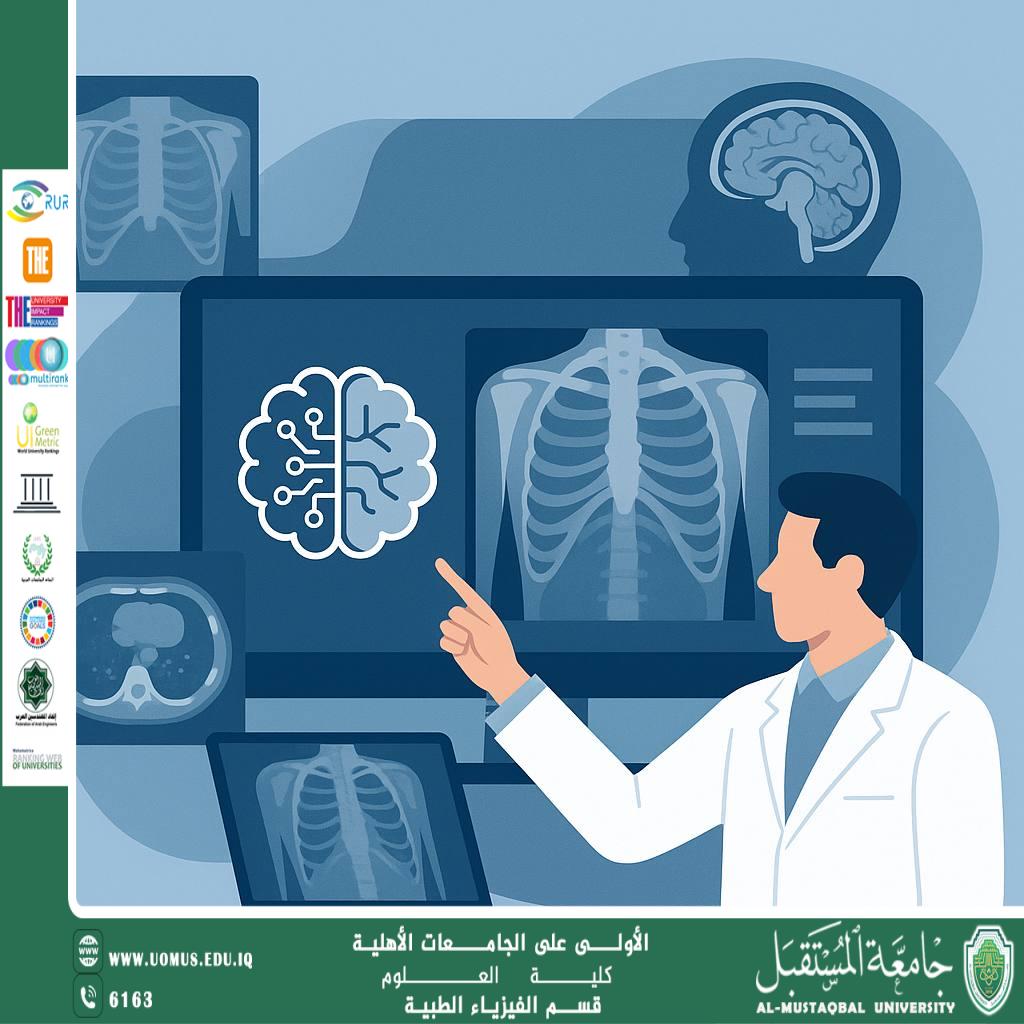
A scientific article by programmer (Noor Faras) entitled "Artificial Intelligence in Medical Radiology Image Analysis"
07/05/2025 Share :
Introduction<br /><br />In recent years, artificial intelligence (AI) has revolutionized various aspects of healthcare, particularly in the analysis of medical imaging such as X-rays, Magnetic Resonance Imaging (MRI), and Computed Tomography (CT) scans. AI has demonstrated its ability to improve diagnostic accuracy, reduce analysis time, and minimize human error, making it an essential tool in modern medicine.<br /><br />The Role of AI in Medical Image Analysis<br /><br />AI—especially deep learning techniques—relies on artificial neural networks that can recognize complex patterns in visual data. These systems are trained on large datasets of labeled medical images, enabling them to differentiate between normal and abnormal findings with high precision. By learning from thousands or millions of examples, AI can detect subtle features that might be missed by human eyes.<br /><br />Practical Applications<br /> 1. Breast Cancer Detection: AI algorithms are used to analyze mammograms and detect tumors, with accuracy levels that can match or exceed those of expert radiologists.<br /> 2. Chest X-ray Analysis: AI can identify early signs of conditions such as pneumonia, tuberculosis, and COVID-19, often improving early diagnosis rates.<br /> 3. Stroke Detection: AI systems analyzing brain CT scans can rapidly identify signs of stroke, helping clinicians initiate treatment more quickly.<br /><br />Benefits and Challenges<br /> • Benefits:<br /> • Faster diagnosis and decision-making.<br /> • Enhanced diagnostic accuracy.<br /> • Support for healthcare systems in resource-limited areas.<br /> • Challenges:<br /> • The need for large, high-quality datasets for model training.<br /> • Ethical concerns and the protection of patient privacy.<br /> • The requirement for human oversight to avoid misinterpretation of AI results.<br /><br />Conclusion and Recommendations<br /><br />AI represents a transformative advancement in medical imaging, offering improved accuracy and efficiency in diagnostics. However, the optimal approach is to integrate AI tools with expert clinical judgment. Future research should focus on fostering interdisciplinary collaboration between engineers and healthcare professionals, as well as expanding access to diverse and high-quality medical datasets for AI development.<br /><br /><br /><br />"AL_mustaqbal University is the first university in Iraq"<br/><br/><a href=https://uomus.edu.iq/Default.aspx target=_blank>al-mustaqbal University Website</a>