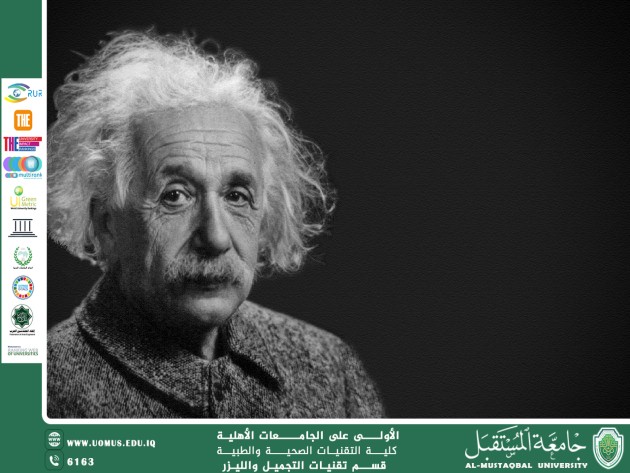
How Einstein Changed Our View of the Universe
11/05/2025 Share :
Introduction<br />In 1915, Albert Einstein introduced the theory of general relativity, which wasn't just a simple modification of Newton's laws. It was a scientific revolution that changed our view of gravity, time, space, and the entire universe. What does this theory say? And how did it affect our understanding of reality?<br />Before General Relativity: Gravity according to Newton<br />Before Einstein, gravity was thought to be an invisible force that attracted objects to each other, as described by Isaac Newton. This idea accurately explained the motion of planets, but it didn't answer the question: How does this force travel through space?<br />Einstein Changes the Rules<br />Einstein introduced a new idea: gravity isn't a force, but a curvature in the fabric of spacetime (time + space).<br />Imagine the universe like a piece of stretchy fabric. If you place a heavy ball (such as the Sun) on it, it creates a curvature. Any object passing by this curvature (such as the Earth) travels in a circular path, as if it were "pulled" by gravity, but in reality, it is simply following the curvature of spacetime.<br /> Key Ideas of General Relativity<br />Time and space are interconnected: they cannot be separated from each other, and their physical properties can change.<br />Mass and energy affect spacetime: heavy objects distort spacetime and alter the motion of other objects.<br />Time is not constant: time passes more slowly near massive objects (such as black holes), a phenomenon called "time dilation."<br />Experiments Confirm the Theory<br />In 1919, starlight was observed bending around the sun during an eclipse, proving that light follows the curvature of spacetime.<br />Satellites (such as GPS) take the effect of relativity into account; otherwise, location predictions would be inaccurate.<br />Stunning Effects of General Relativity<br />Black holes: Regions in the universe where gravity is so strong that light cannot escape.<br />Gravitational lenses: Massive objects (such as galaxies) distort the light of objects behind them, making them appear distorted or duplicated.<br />The Expansion of the Universe: The theory opened the door to understanding the expansion of the universe and the Big Bang.<br /> Conclusion<br />The theory of general relativity not only changed the laws of physics, but also our understanding of the universe itself. We now know that time and space are not static arenas of events, but rather dynamic elements interacting with matter and energy. Thanks to Einstein, the universe has become more profound, more mysterious, and more inspiring.<br /><br /><br />Al _ Mustaqbal University, the first university in Iraq<br />Prepared by: Shahad Nawras Abbas<br />