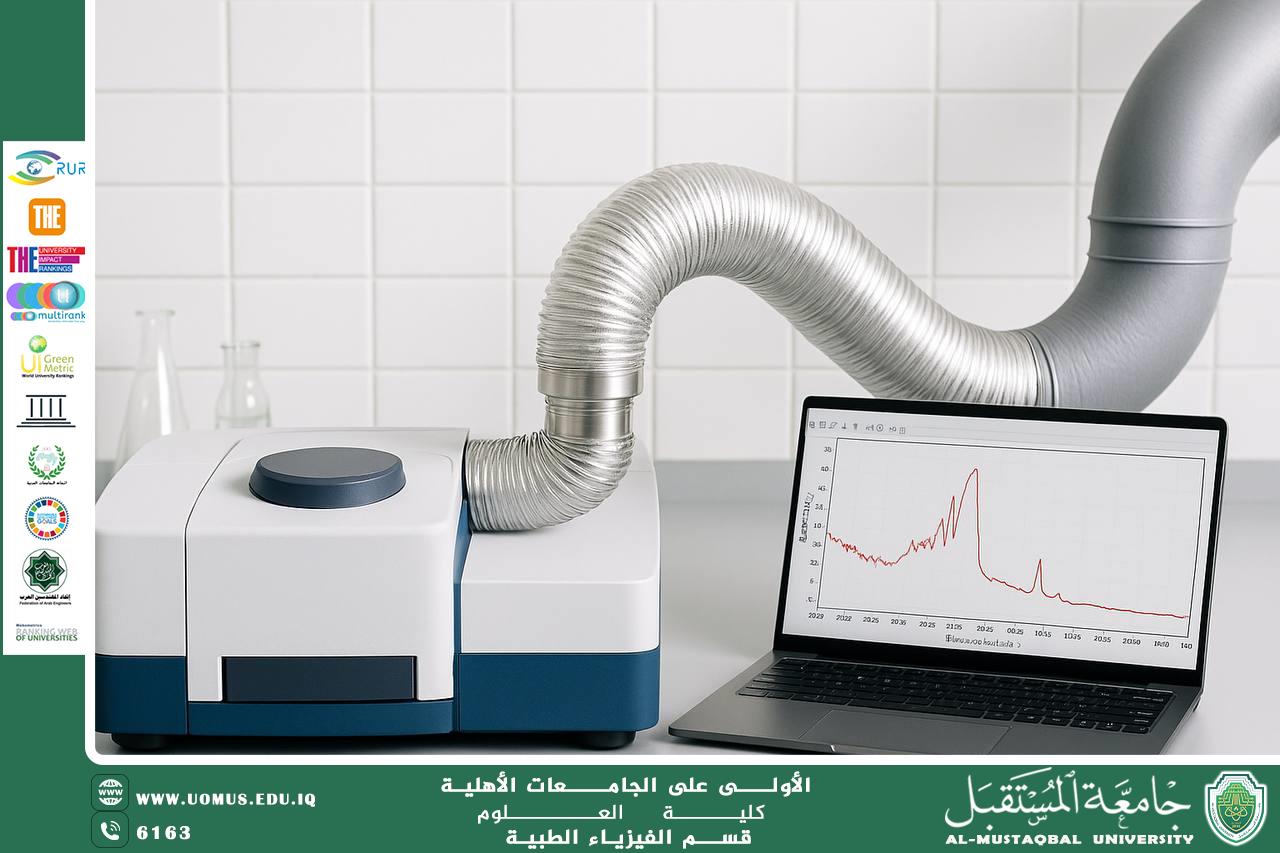
A scientific article by the teaching assistant (Hanin Hani) entitled “Stability analysis of the laser spectrum generated from laboratory ventilation systems using FTIR techniques.”
12/05/2025 Share :
Introduction:<br />In modern laboratories, lasers are widely used in various applications such as precision measurements, medical treatments, and physical experiments. However, during laser operation, secondary byproducts may be generated in the form of gases or fine particles due to the interaction of the laser beam with different materials—whether biological, chemical, or even components of the equipment itself. These byproducts are usually carried through the laboratory ventilation systems and may pose health risks or affect indoor air quality.<br /><br />This highlights the importance of analyzing the air emitted from the ventilation system using Fourier Transform Infrared Spectroscopy (FTIR)—a precise technique for identifying airborne chemical components, even at very low concentrations.<br /><br />⸻<br /><br />What is FTIR?<br />FTIR, or Fourier Transform Infrared Spectroscopy, is a technique based on measuring the absorption of infrared light by gas molecules. Each type of molecule absorbs light at specific wavelengths, creating a unique “spectral fingerprint.” With FTIR, it’s possible to detect gases such as carbon monoxide (CO), carbon dioxide (CO₂), ozone (O₃), and various volatile organic compounds (VOCs) that may result from laser-related processes.<br /><br />⸻<br /><br />Why Use FTIR in Laser Laboratories?<br /> • Early detection of harmful gases: Helps avoid exposure to toxic or irritating substances.<br /> • Improving laboratory air quality: Through regular monitoring of ventilation emissions.<br /> • Compliance with environmental safety standards: Especially in educational and industrial laser labs.<br /><br />⸻<br /><br />Practical Application:<br />During the operation of a CO₂ laser in a closed lab, an air sample was collected from the ventilation duct and analyzed using an FTIR device. The analysis revealed trace amounts of formaldehyde and some incomplete combustion byproducts, likely due to the laser beam interacting with plastic components. Ventilation settings were then improved and workspace insulation was enhanced accordingly.<br /><br />⸻<br /><br />Conclusion:<br />FTIR-based spectral analysis of emissions from laboratory ventilation systems is a vital step toward ensuring a safe and healthy working environment. It provides accurate data that can help optimize equipment performance and prevent exposure to hazardous materials.<br /><br /><br /><br />"AL_mustaqbal University is the first university in Iraq"<br/><br/><a href=https://uomus.edu.iq/Default.aspx target=_blank>al-mustaqbal University Website</a>