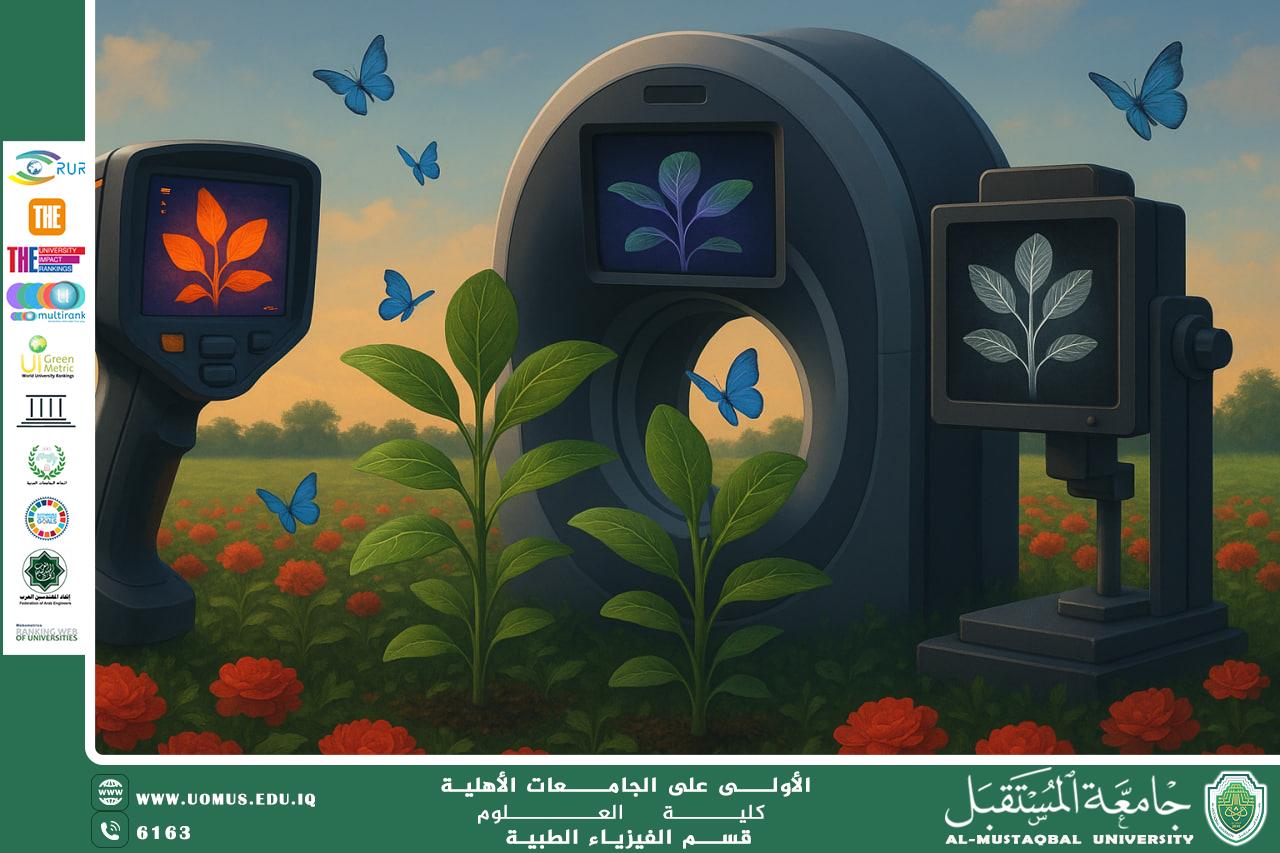
A scientific article by the administrator (Nour Issa) entitled “Physical Medical Techniques in Early Detection of Plant Diseases”
12/05/2025 Share :
Introduction<br />Plant health plays a vital role in ensuring global food security and preserving biodiversity. Despite advancements in agriculture, plant diseases remain a major challenge for farmers and researchers. Since early detection is crucial to prevent the spread and minimize damage, scientists have recently begun adopting techniques from medical physics—traditionally used in human diagnostics and therapy—and applying them in the field of plant health.<br /><br />1. What is Medical Physics?<br />Medical physics involves the application of physical principles, particularly in imaging and treatment, to the human body for diagnostic and therapeutic purposes. Prominent technologies in this field include:<br /><br />Magnetic Resonance Imaging (MRI)<br /><br />Infrared Imaging (IR)<br /><br />Thermal Imaging<br /><br />Ultrasound Imaging<br /><br />X-ray and CT Scanning<br /><br />While originally developed for human medicine, these technologies are now being explored to detect environmental stress and pathogenic infections in plants at early stages.<br /><br />2. Applying Medical Physics to Plant Health<br />A. Infrared Thermal Imaging<br />This technique measures temperature changes on the surface of plant leaves. When plants are infected or under stress (e.g., due to water deficiency), the transpiration process is disrupted, causing variations in leaf temperature. Thermal cameras can detect these changes before visual symptoms appear.<br /><br />B. Near-Infrared Spectroscopy (NIR)<br />This method detects chemical changes in plant tissues, such as reduced chlorophyll or increased defense compounds, helping identify fungal or bacterial infections in their early phases.<br /><br />C. Nuclear Magnetic Resonance Imaging (MRI)<br />Some studies have adapted MRI to examine internal plant structures, such as vascular tissues, and monitor the flow of water and nutrients. This technique can reveal blockages caused by pathogens like fungi or bacteria.<br /><br />D. X-ray and CT Scanning for Plants<br />These are used to examine internal damage in stems or roots without cutting the plant. They show great promise, especially in detecting internal diseases in woody plants and trees.<br /><br />E. Fluorescence Imaging<br />This technique evaluates chlorophyll activity and photosynthesis efficiency. It can identify disruptions caused by pathogens affecting chloroplasts before visible yellowing or wilting occurs.<br /><br />3. Benefits of Early Detection with Medical Physics<br />Higher treatment success rates: Early interventions can limit disease spread.<br /><br />Reduced economic losses: By protecting crop yield and quality.<br /><br />Minimized pesticide use: Targeted treatment of infected areas only.<br /><br />Support for precision agriculture: When integrated with smart monitoring systems and drones.<br /><br />4. Current Challenges<br />Despite the promising results, several challenges remain:<br /><br />High cost of advanced imaging equipment<br /><br />Need for skilled specialists to interpret the data<br /><br />Difficulty in large-scale field deployment without supporting tools like drones or robots<br /><br />5. A Promising Future<br />With the rise of Artificial Intelligence (AI) and the Internet of Things (IoT), these physical imaging techniques can be integrated into smart agricultural systems for real-time plant health monitoring, paving the way for what may be called “Smart Plant Clinics.”<br /><br />Conclusion<br />Integrating medical physics into agriculture represents a revolutionary step toward more sustainable and intelligent farming. Just as these technologies have saved human lives, they are now being adapted to save plant life—the cornerstone of food, energy, and ecological balance.<br /><br /><br /><br />"AL_mustaqbal University is the first university in Iraq"<br/><br/><a href=https://uomus.edu.iq/Default.aspx target=_blank>al-mustaqbal University Website</a>