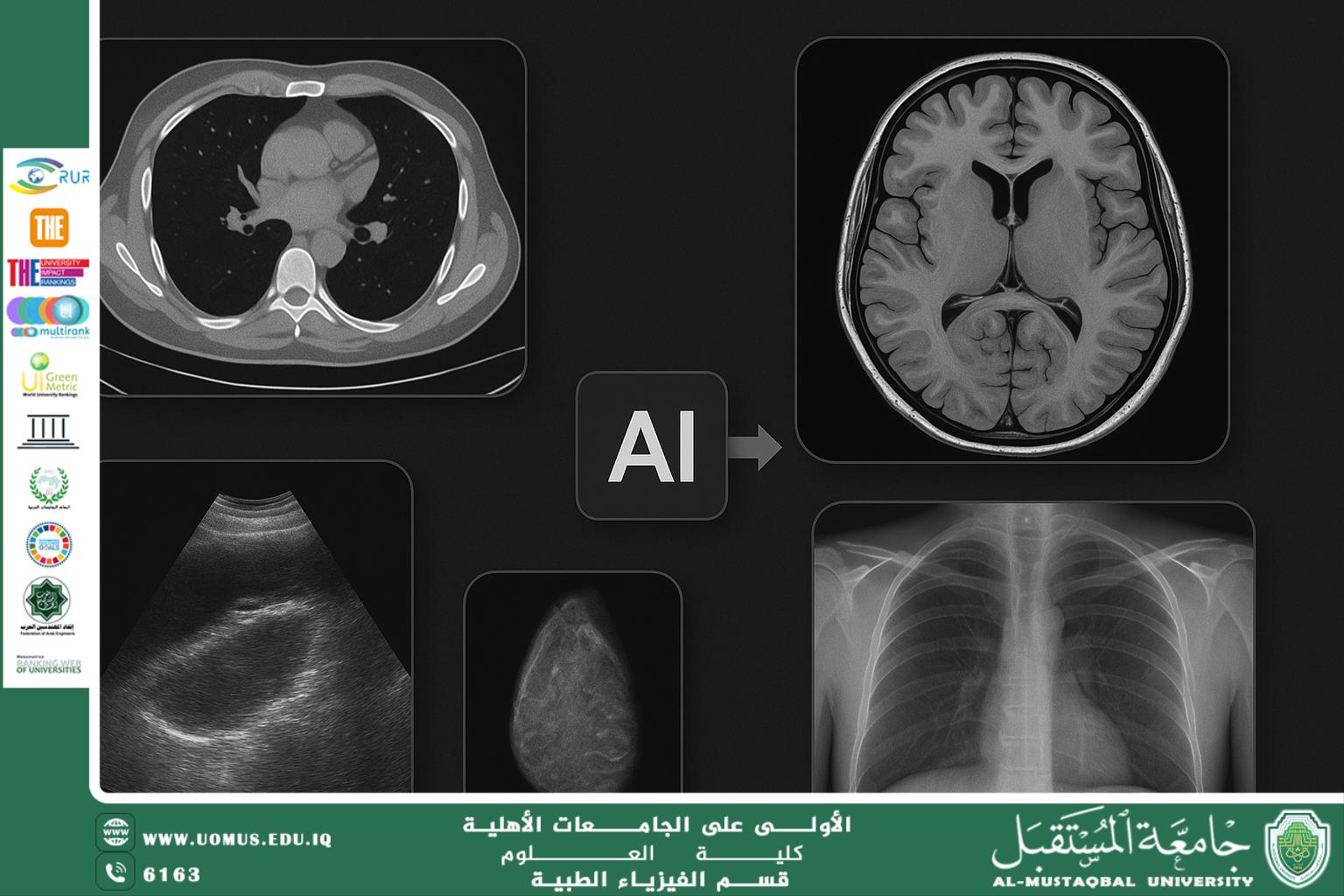
A scientific article by the administrator (Nargis Jassim) entitled “Improving the quality of medical images using reconstruction techniques”
12/05/2025 Share :
Introduction<br />Medical imaging is a cornerstone of modern healthcare, playing a vital role in diagnosis and treatment planning. With the advancement of imaging technologies such as Computed Tomography (CT), Magnetic Resonance Imaging (MRI), and X-ray imaging, the demand for high-resolution and accurate images has increased significantly. However, these images are often compromised by factors such as noise, limited resolution, or patient movement. This has led to the growing importance of image reconstruction techniques, which aim to enhance image quality and recover lost or degraded information.<br /><br />1. What Are Image Reconstruction Techniques in Medical Imaging?<br />Image reconstruction is the process of transforming raw data collected by imaging devices into a clear, usable image. This process relies on mathematical and physical models to interpret the signals and reconstruct a high-quality visual representation of the internal structures of the body.<br /><br />Common types of reconstruction techniques include:<br /><br />Linear Reconstruction Methods: e.g., Filtered Back Projection (FBP) used in early CT scanners.<br /><br />Iterative Reconstruction: Gradually refines the image using statistical and physical models.<br /><br />AI-Based Reconstruction: Uses deep learning algorithms (such as neural networks) to predict higher-quality images from raw or low-quality data.<br /><br />2. Challenges to Medical Image Quality<br />Several factors can degrade medical image quality, including:<br /><br />Noise: Especially in low-dose imaging, resulting in grainy or unclear images.<br /><br />Motion Artifacts: Caused by patient movement or breathing during scanning.<br /><br />Low Resolution: Due to fast scanning protocols or hardware limitations.<br /><br />Tissue Overlap: When different tissues appear similar, making them hard to distinguish.<br /><br />3. How Do Reconstruction Techniques Improve Image Quality?<br />A. Noise Reduction<br />Iterative and AI-based algorithms use advanced statistical models to distinguish and eliminate noise without blurring critical anatomical details.<br /><br />B. Contrast Enhancement<br />Reconstruction methods can improve contrast between similar tissues, making it easier to identify abnormalities such as tumors or infections.<br /><br />C. Recovery of Lost Details<br />Some techniques restore fine structures and edges that may have been lost due to motion or low resolution, improving diagnostic confidence.<br /><br />D. Radiation Dose Reduction<br />By enhancing image quality from low-dose scans, reconstruction methods allow for reduced patient exposure to radiation without compromising diagnostic value.<br /><br />4. Artificial Intelligence and Image Reconstruction<br />Recent years have seen remarkable progress in AI-driven image reconstruction, particularly using Convolutional Neural Networks (CNNs). These networks are trained on high-quality datasets to learn how to enhance low-quality images. Advantages include:<br /><br />Faster processing than traditional iterative methods.<br /><br />Continuous learning from data to improve accuracy.<br /><br />Preservation of anatomical structure while removing unwanted artifacts.<br /><br />5. Practical Applications<br />Low-Dose CT Scans: Reconstruction techniques help maintain image quality even with reduced radiation exposure.<br /><br />Fast MRI Scans: Used to reduce scan time while preserving diagnostic image quality.<br /><br />Functional Imaging (e.g., PET, fMRI): Improves clarity and signal interpretation in studies with inherently low signal strength.<br /><br />Conclusion<br />Image reconstruction techniques represent a major advancement in the field of medical imaging. They allow clinicians to obtain sharper, safer, and more accurate images, which improves diagnostic capabilities and patient outcomes. As artificial intelligence and computational power continue to evolve, reconstruction methods will become even more powerful and integrated into real-time imaging systems—paving the way for more personalized and precise medicine.<br /><br /><br /><br />"AL_mustaqbal University is the first university in Iraq"<br/><br/><a href=https://uomus.edu.iq/Default.aspx target=_blank>al-mustaqbal University Website</a>