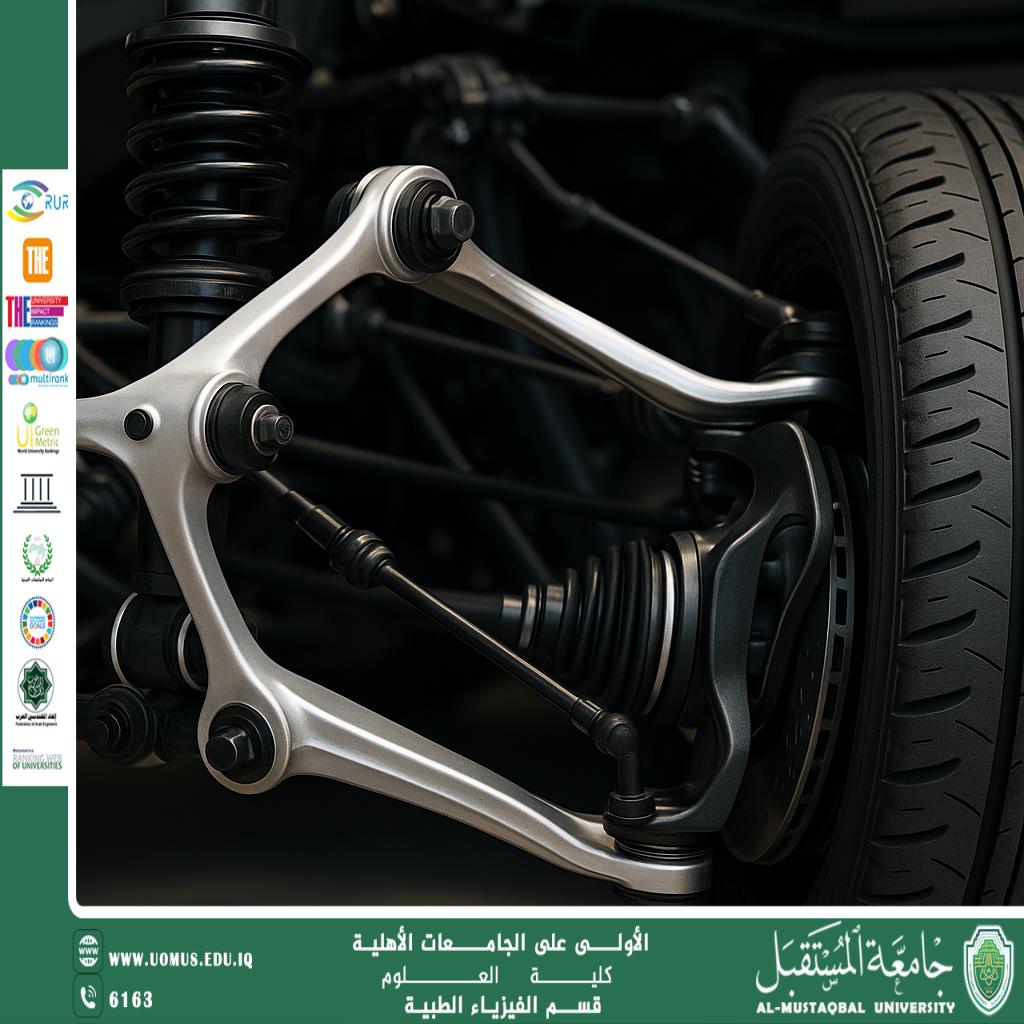
A scientific article by the teaching assistant (Amir Sobhi Ismail) entitled “Designing suspension systems in cars using the principles of analytical mechanics.”
12/05/2025 Share :
Introduction<br />Suspension systems are critical components in modern vehicles, playing a central role in ensuring ride comfort, vehicle stability, and handling performance. These systems rely heavily on the principles of analytical mechanics, which provide a rigorous framework for understanding and modeling the dynamic behavior of vehicle components under various road and driving conditions.<br /><br />By applying methods such as Lagrangian mechanics, engineers can design suspension systems that effectively manage vibrations, loads, and motion, resulting in optimized performance, safety, and comfort.<br /><br />1. What Is a Suspension System?<br />An automotive suspension system consists of a combination of springs, dampers (shock absorbers), and linkages that connect the vehicle’s chassis to its wheels. The primary functions of a suspension system are:<br /><br />Absorbing shocks and vibrations from road irregularities.<br /><br />Maintaining consistent tire contact with the road surface.<br /><br />Enhancing stability and control during cornering, acceleration, and braking.<br /><br />2. Overview of Analytical Mechanics<br />Analytical mechanics is a branch of physics that uses mathematical formalisms to describe the motion of systems. Key approaches include:<br /><br />Lagrangian Mechanics: Focuses on energy (kinetic and potential) to derive equations of motion using generalized coordinates.<br /><br />Hamiltonian Mechanics: Extends the analysis to more complex dynamic systems and provides a foundation for stability and control analysis.<br /><br />These principles are particularly effective in analyzing multi-body systems, such as automotive suspension setups.<br /><br />3. Applying Analytical Mechanics in Suspension Design<br />A. Dynamic Modeling<br />The suspension is modeled as a multi-degree-of-freedom system, where each component (arms, springs, dampers) is represented as a rigid body with specific kinematic constraints.<br /><br />Generalized coordinates are defined to capture the motion of the system.<br /><br />Lagrange's equations are derived to describe the dynamic behavior in response to forces such as road input or vehicle maneuvering.<br /><br />B. Vibration Analysis<br />An essential goal of suspension systems is vibration isolation. Through analytical mechanics, engineers can:<br /><br />Determine the natural frequencies and mode shapes of the suspension system.<br /><br />Study how the system responds to road-induced excitations.<br /><br />Optimize parameters (spring stiffness, damping coefficient) for better comfort and stability.<br /><br />C. Enhancing Dynamic Performance<br />Detailed analysis enables fine-tuning of suspension performance to achieve:<br /><br />Improved high-speed stability and cornering control.<br /><br />Reduced body roll and pitch during dynamic events.<br /><br />A balance between ride comfort and handling performance, a common engineering trade-off.<br /><br />4. Advanced Technologies in Suspension Design<br />Using analytical modeling and modern computing tools, advanced suspension technologies have emerged:<br /><br />Active Suspension Systems: Use sensors and actuators to adjust the suspension response in real-time.<br /><br />Semi-Active Systems: Modify damper characteristics without fully actuating mechanical components.<br /><br />Computer-Aided Engineering (CAE): Incorporates Finite Element Methods (FEM) and Multi-Body Dynamics (MBD) simulations for design optimization.<br /><br />5. Case Study: Double Wishbone Suspension<br />The double wishbone suspension is commonly used in sports and performance vehicles due to its precise control over wheel alignment.<br /><br />Using analytical mechanics:<br /><br />Engineers model the upper and lower control arms and their motion.<br /><br />They analyze camber changes during vertical movement to ensure optimal tire contact.<br /><br />Geometric parameters are optimized to minimize unwanted toe and caster variations during suspension travel.<br />Conclusion<br />Applying analytical mechanics to the design of automotive suspension systems provides a deep understanding of system dynamics and allows for highly precise, efficient, and intelligent designs. It bridges theoretical physics with practical engineering, enabling the development of systems that enhance driving comfort, safety, and road performance. As simulation technologies and intelligent systems advance, future suspension designs will become increasingly adaptive and responsive to the demands of modern mobility.<br /><br /><br /><br /><br />"AL_mustaqbal University is the first university in Iraq"<br/><br/><a href=https://uomus.edu.iq/Default.aspx target=_blank>al-mustaqbal University Website</a>