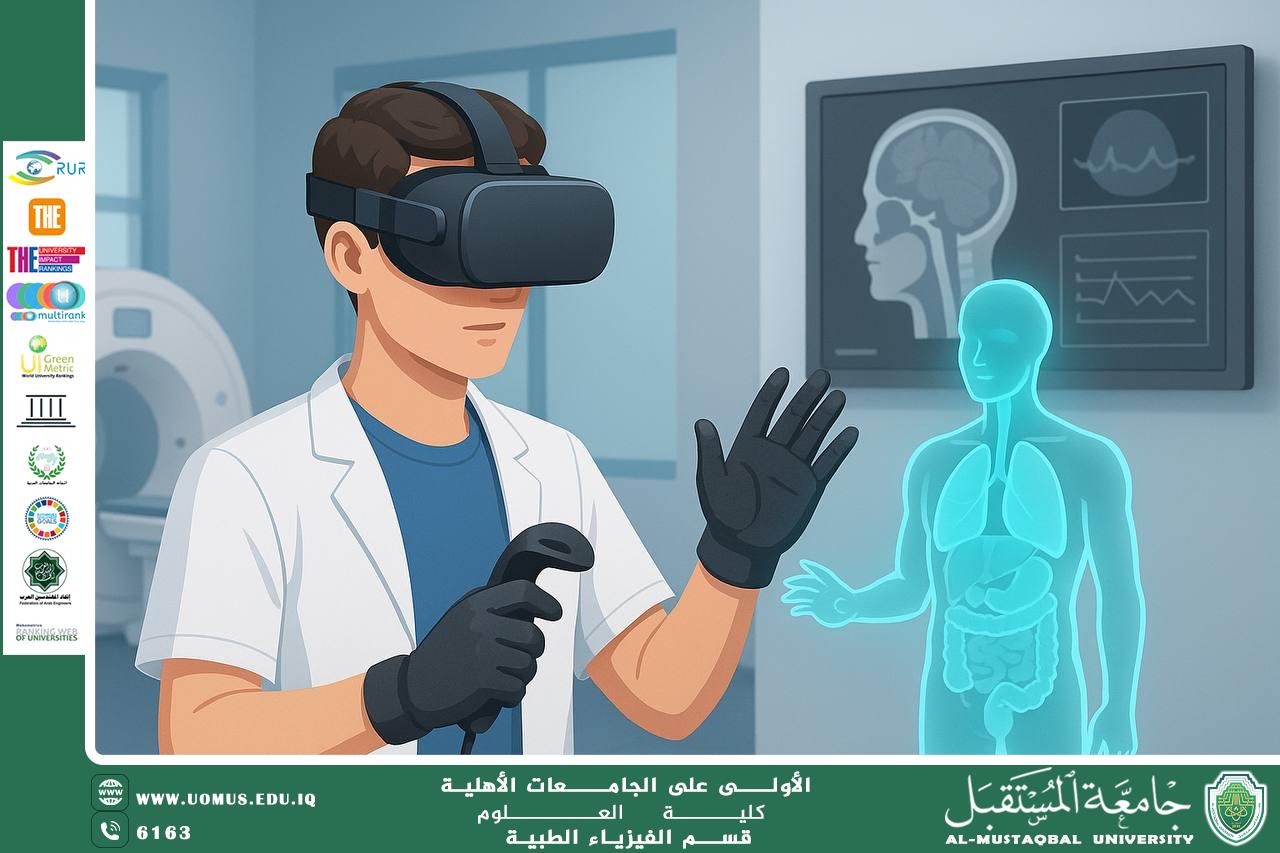
A scientific article by the teaching assistant (Mohamed Abdel Zahra) entitled “Virtual and Augmented Reality in Training Medical Physics Students: A Realistic Interactive Experience”
18/05/2025 Share :
Abstract:<br /><br />Medical education has witnessed significant advancements in recent years, particularly with the integration of Virtual Reality (VR) and Augmented Reality (AR) as innovative educational tools. These technologies aim to provide safe and interactive learning environments that enhance students’ understanding of theoretical concepts and practical skills, especially in complex and sensitive fields such as medical physics. This article explores the role of VR and AR in training medical physics students, highlighting their benefits, implementation challenges, and real-world applications in academic and clinical settings.<br /><br />⸻<br /><br />Introduction:<br /><br />As technology continues to evolve rapidly, traditional teaching methods in higher education are being re-evaluated to better meet the needs of students and the demands of modern healthcare systems. Medical physics, a highly specialized and technical field, requires precise practical training using advanced equipment such as imaging devices (CT, MRI) and radiotherapy systems. Due to the high cost and complexity of these tools, there is a growing need for alternative training approaches. VR and AR have emerged as promising solutions to bridge this gap.<br /><br />⸻<br /><br />Definition of VR and AR:<br /> • Virtual Reality (VR): A fully immersive digital simulation of a 3D environment that allows users to interact using special headsets and motion controllers. VR can replicate clinical settings for training without real-world risks.<br /> • Augmented Reality (AR): A technology that overlays digital information—such as models or instructions—onto the real world, often using tablets, smartphones, or AR glasses, enhancing the learning experience during hands-on practice.<br /><br />⸻<br /><br />The Importance of VR/AR in Medical Physics Education:<br /> 1. Enhancing Practical Training: VR/AR can simulate complex clinical scenarios that are otherwise difficult or costly to reproduce.<br /> 2. Safety and Risk Management: Students can safely learn to handle hazardous equipment and radiation-based technologies in a virtual environment.<br /> 3. Increased Engagement: Interactive learning increases retention and student motivation.<br /> 4. Self-Paced Learning: Students can repeat procedures as many times as needed, enhancing mastery of skills.<br /><br />⸻<br /><br />Practical Applications:<br /> • Stanford University has implemented VR-based training to teach radiotherapy planning and dose distribution techniques.<br /> • In the United Kingdom, AR applications are used in medical physics education to teach MRI scanning protocols via 3D interactive models.<br /> • Teaching hospitals in Germany have introduced VR modules to simulate nuclear medicine procedures and patient preparation steps.<br /><br />⸻<br /><br />Challenges and Limitations:<br /> 1. High Costs: Initial setup for VR/AR labs requires significant investment in hardware, software, and training.<br /> 2. Need for Accurate Content: Scientific accuracy is crucial in creating realistic and effective simulations.<br /> 3. Resistance to Change: Some educators may be reluctant to shift from traditional teaching methods.<br /> 4. Technical Limitations: Issues such as low-resolution graphics, lag, and motion sickness can hinder learning.<br /><br />⸻<br /><br />Conclusion:<br /><br />Virtual and augmented reality represent a transformative advancement in the education of medical physics students. By providing immersive, interactive, and safe environments, these technologies can greatly improve the quality of practical training and help bridge the gap between theoretical knowledge and clinical application. While challenges remain—particularly regarding cost and adoption—ongoing technological advancements are likely to expand the accessibility and effectiveness of VR/AR in the near future.<br /><br /><br /><br /><br />"AL_mustaqbal University is the first university in Iraq"<br/><br/><a href=https://uomus.edu.iq/Default.aspx target=_blank>al-mustaqbal University Website</a>