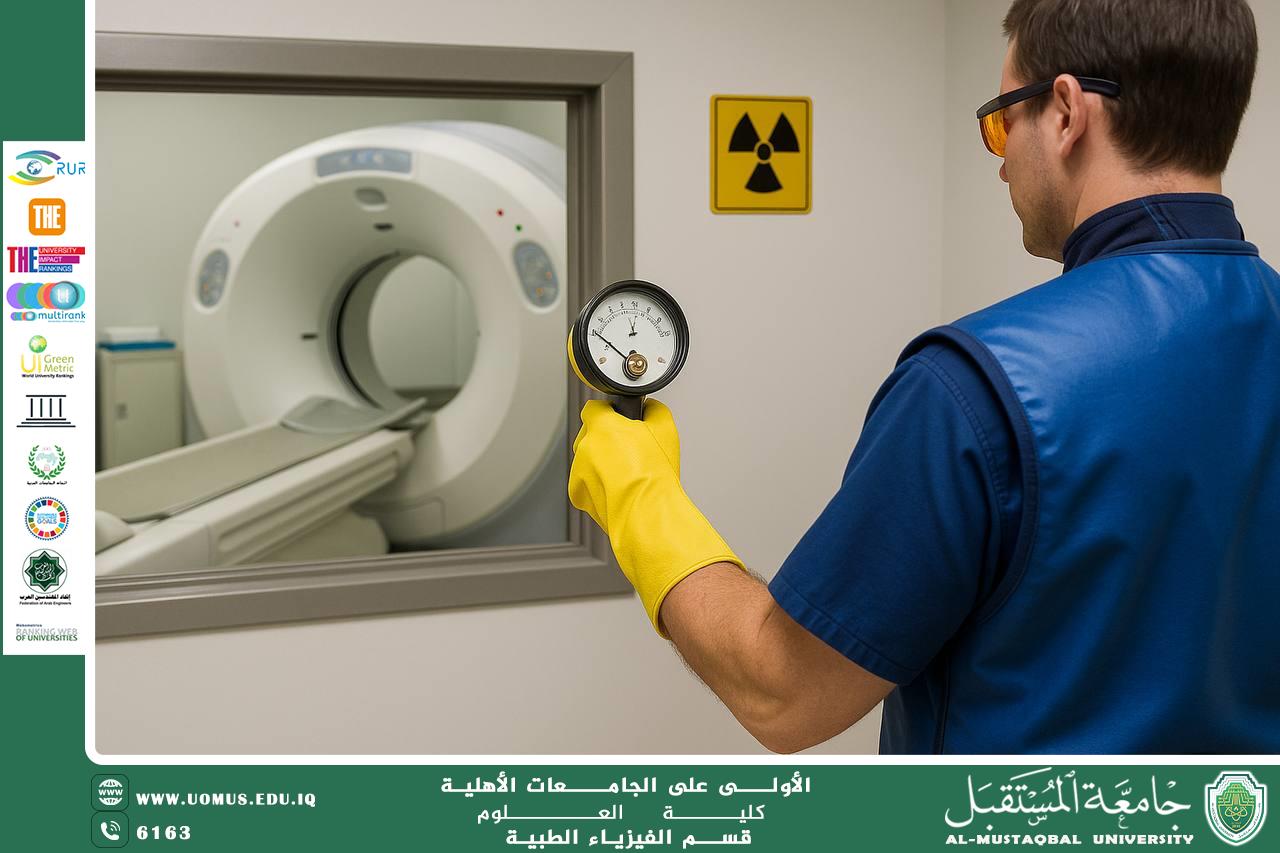
A scientific article by the teaching assistant (Ahmed Abdel Salam) entitled “Radiation protection techniques for hospital workers”
18/05/2025 Share :
Introduction<br /><br />Ionizing radiation is one of the most essential tools used in modern medicine, particularly in diagnostic imaging and cancer treatment. Modalities such as X-rays, CT scans, and nuclear medicine rely heavily on ionizing radiation to visualize and manage various medical conditions. However, medical personnel working in these environments face continuous exposure risks, making radiation protection a critical component of occupational safety. This article aims to outline the key techniques and strategies for minimizing radiation exposure among healthcare workers.<br /><br />⸻<br /><br />Types of Radiation in Medical Settings<br /><br />Medical applications often involve the following forms of ionizing radiation:<br /> • X-rays: Widely used in diagnostic radiology.<br /> • Gamma rays (γ): Emitted from radioactive isotopes used in nuclear medicine and radiotherapy.<br /> • Beta and Alpha particles: Less commonly used clinically but relevant in certain therapeutic procedures and radiopharmaceuticals.<br /><br />⸻<br /><br />Biological Effects of Radiation Exposure<br /><br />Exposure to ionizing radiation can result in:<br /> • Cellular and tissue damage due to ionization of biological molecules.<br /> • Increased long-term cancer risk.<br /> • Genetic mutations and potential hereditary effects.<br /><br />The International Commission on Radiological Protection (ICRP) recommends an average occupational dose limit of 20 millisieverts (mSv) per year over five years, with no single year exceeding 50 mSv.<br /><br />⸻<br /><br />Radiation Protection Techniques<br /><br />1. Engineering Controls<br /> • Lead shielding: Walls, doors, and observation windows lined with lead to absorb radiation.<br /> • Room design: Incorporating automatic lead-lined doors and shielded control areas for operators.<br /><br />2. Personal Protective Equipment (PPE)<br /> • Lead aprons and thyroid shields: Protect vital organs from scattered radiation.<br /> • Lead gloves and protective eyewear: Used during interventional procedures and handling of radioactive materials.<br /><br />3. Time, Distance, and Shielding Principles<br /> • Time: Reducing the duration of exposure during procedures.<br /> • Distance: Increasing the distance from the radiation source, following the inverse square law.<br /> • Shielding: Using appropriate barriers or equipment to block radiation transmission.<br /><br />4. Radiation Monitoring Devices<br /> • Personal dosimeters: Worn by staff to measure cumulative radiation doses.<br /> • Survey meters and area monitors: Used to assess real-time radiation levels in workspaces.<br /> • Routine environmental assessments: Ensuring safe working conditions and detecting leaks or unsafe radiation levels.<br /><br />⸻<br /><br />Training and Awareness<br /> • Mandatory training programs for newly hired radiological staff.<br /> • Continuous professional development and refresher courses.<br /> • Signage and visual warnings in radiation areas to enforce safety compliance.<br /> • Promotion of a safety-first culture within medical institutions.<br /><br />⸻<br /><br />Regulations and Guidelines<br /><br />Radiation protection is governed by global and national frameworks:<br /> • ICRP (International Commission on Radiological Protection)<br /> • IAEA (International Atomic Energy Agency)<br /> • The foundational safety principle is ALARA (As Low As Reasonably Achievable), which urges minimizing exposure by all practical means.<br /><br />⸻<br /><br />Conclusion<br /><br />Protecting hospital workers from radiation hazards is a shared responsibility involving institutional planning, individual awareness, and technological application. By employing effective shielding, personal protection, monitoring, and rigorous training, medical professionals can perform their duties safely. Advances in radiation safety continue to make the workplace safer, while policies such as ALARA ensure that exposure remains within acceptable limits. Ensuring a safe radiological environment is essential for both worker well-being and the quality of patient care.<br /><br /><br /><br /><br />"AL_mustaqbal University is the first university in Iraq"<br/><br/><a href=https://uomus.edu.iq/Default.aspx target=_blank>al-mustaqbal University Website</a>