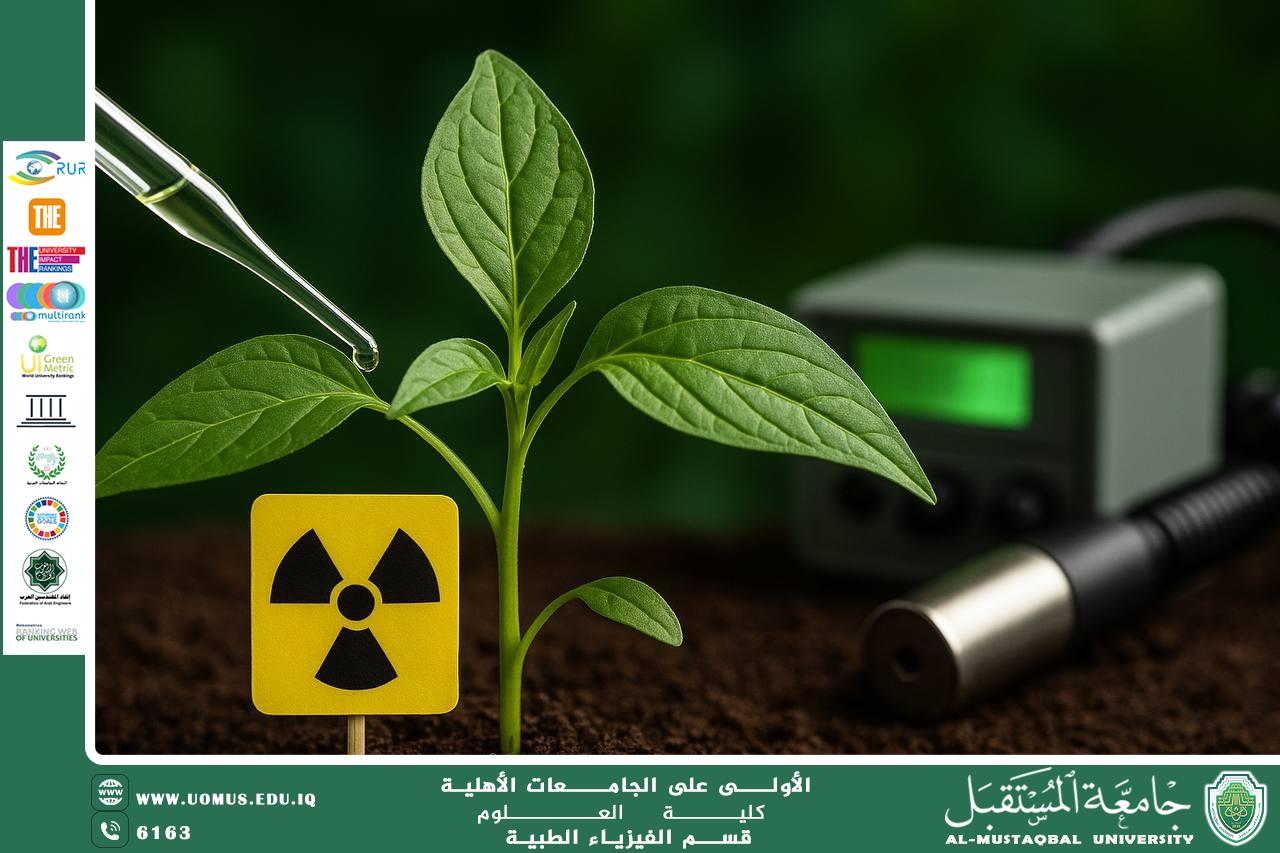
A scientific article by the administrator (Nour Issa) entitled “Using radioactive isotopes to track the absorption of nutrients in plants”
23/05/2025 Share :
Introduction<br /><br />Nutrients are fundamental to the growth and development of plants. Understanding how plants absorb and distribute these nutrients is crucial for enhancing agricultural productivity, optimizing fertilizer use, and minimizing environmental impact. Among the advanced techniques available for studying nutrient dynamics in plants, radioisotope tracing stands out as a powerful and precise method.<br /><br />⸻<br /><br />What Are Radioisotopes?<br /><br />Radioisotopes are unstable isotopes of chemical elements. They have the same number of protons but a different number of neutrons, which causes their nuclei to be unstable and emit radiation. This emitted radiation can be tracked, making radioisotopes excellent tracers in biological systems. Common radioisotopes used in plant studies include:<br /> • Phosphorus-32 (³²P)<br /> • Carbon-14 (¹⁴C)<br /> • Nitrogen-15 (¹⁵N) (technically stable, but used as a tracer)<br /> • Potassium-42 (⁴²K)<br /><br />⸻<br /><br />How Are Radioisotopes Used in Plants?<br /><br />Radioisotopes are introduced into the plant system through soil or nutrient solutions. The plant absorbs the isotope just like the normal element. Researchers then use radiation detectors, such as:<br /> • Geiger counters<br /> • Scintillation counters<br /> • Spectrometers<br /><br />These tools allow scientists to:<br /> • Measure the rate of nutrient uptake<br /> • Track the internal movement and localization of nutrients<br /> • Monitor the timing and storage of nutrients in plant tissues<br /><br />⸻<br /><br />Benefits of Using Radioisotopes in Plant Nutrition Research<br /> 1. High Precision: Enables nutrient tracking down to cellular levels.<br /> 2. Source Differentiation: Helps distinguish between nutrient uptake from soil and fertilizer.<br /> 3. Accurate Nutrient Requirement Assessment: Supports better fertilization strategies.<br /> 4. Understanding Transport Mechanisms: Clarifies nutrient movement from roots to shoots or other tissues.<br /><br />⸻<br /><br />Practical Applications<br /> • Developing efficient fertilization schedules.<br /> • Improving crop yields with optimized nutrient management.<br /> • Reducing environmental pollution due to fertilizer overuse.<br /> • Studying plant responses to different environmental stresses.<br /><br />⸻<br /><br />Risks and Challenges<br /><br />Despite its advantages, radioisotope use comes with several challenges:<br /> • Strict safety protocols are needed to prevent radiation exposure.<br /> • Legal regulations and permits are required in most countries.<br /> • High costs of radioactive materials and specialized equipment.<br /><br />⸻<br /><br />Conclusion<br /><br />The use of radioisotopes offers a valuable tool in advancing our understanding of nutrient uptake and transport in plants. Though associated with safety and cost concerns, this technique delivers unmatched accuracy and insights. It plays a vital role in developing sustainable agricultural practices and improving global food security.<br /><br /><br /><br /><br />"AL_mustaqbal University is the first university in Iraq"<br/><br/><a href=https://uomus.edu.iq/Default.aspx target=_blank>al-mustaqbal University Website</a>