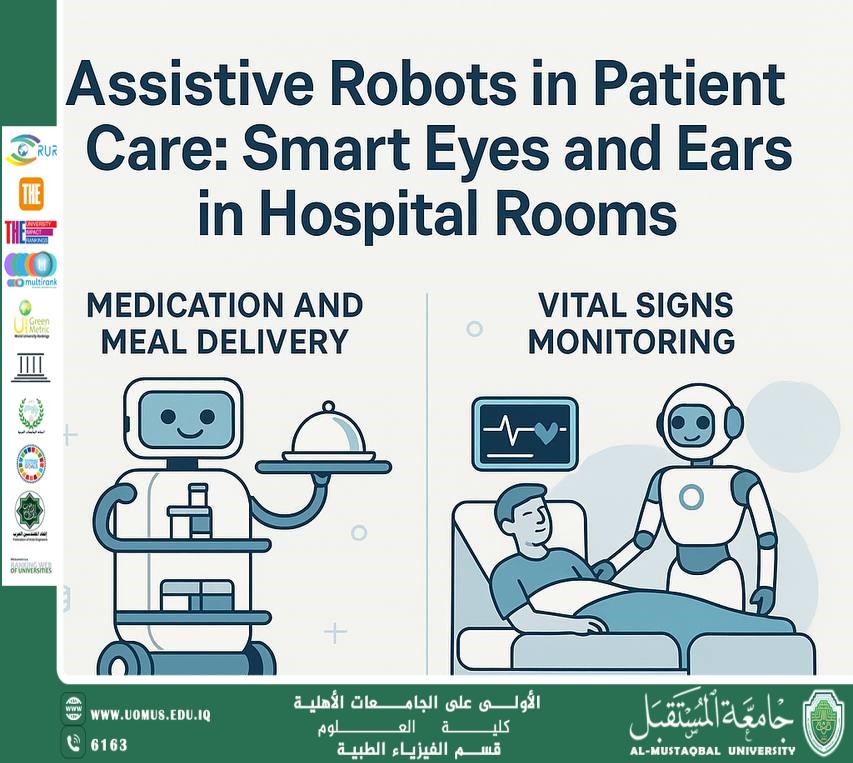
A scientific article by the teaching assistant (Hassan Hadi) entitled “Robots assisting in patient care: smart eyes and ears in hospital rooms”
29/05/2025 Share :
With rapid advancements in artificial intelligence and robotics, assistive robots have become an essential part of the modern healthcare environment. These machines are no longer limited to operating rooms or laboratories—they are now performing vital tasks alongside medical staff to improve patient care and reduce the workload on doctors and nurses.<br /><br />⸻<br /><br />What Are Assistive Robots in Healthcare?<br /><br />Assistive robots are intelligent machines programmed to perform a variety of tasks within a hospital setting, from monitoring patient conditions and delivering medications to interacting with patients with special needs. These robots rely on AI, machine learning, and sensors to provide accurate and safe care.<br /><br />⸻<br /><br />Key Applications of Robots in Patient Care<br /> 1. Medication and Meal Delivery:<br />Mobile robots deliver medications and meals directly to patient rooms, reducing unnecessary contact and minimizing infection risks—especially critical during outbreaks.<br /> 2. Mobility Assistance:<br />Robots designed to help elderly patients or those with physical disabilities move safely around the hospital.<br /> 3. Vital Signs Monitoring:<br />Robots equipped with sensors can monitor heart rate, blood pressure, and temperature in real time, and alert the medical staff if any abnormalities occur.<br /> 4. Remote Patient Interaction:<br />Equipped with cameras and screens, these robots enable doctors to communicate with patients remotely—useful for infectious disease cases or patients in isolation.<br /> 5. Emotional and Recreational Support:<br />Some robots are designed to offer emotional support, especially for children or long-term patients, by providing entertainment, music, or simple conversations.<br /><br />⸻<br /><br />Benefits of Using Assistive Robots<br /> • Reduce the burden on healthcare workers.<br /> • Improve the speed and efficiency of patient care.<br /> • Minimize infection risk through reduced human contact.<br /> • Provide reliable, around-the-clock support to patients.<br /><br />⸻<br /><br />Challenges in Implementing Robotic Care<br /> • High initial cost of purchase and maintenance.<br /> • Need for staff training on new technologies.<br /> • Risk of over-reliance on machines, reducing human interaction.<br /> • Privacy concerns related to sensitive health data collected by robots.<br /><br />⸻<br /><br />Conclusion<br /><br />Assistive robots have become the smart eyes and ears of the hospital room—enhancing the precision of care, reducing human error, and supporting medical staff in delivering efficient and compassionate service. As technology continues to evolve, the role of robots in healthcare is set to become even more integrated and impactful in the near future.<br /><br /><br /><br /><br />"AL_mustaqbal University is the first university in Iraq"<br/><br/><a href=https://uomus.edu.iq/Default.aspx target=_blank>al-mustaqbal University Website</a>