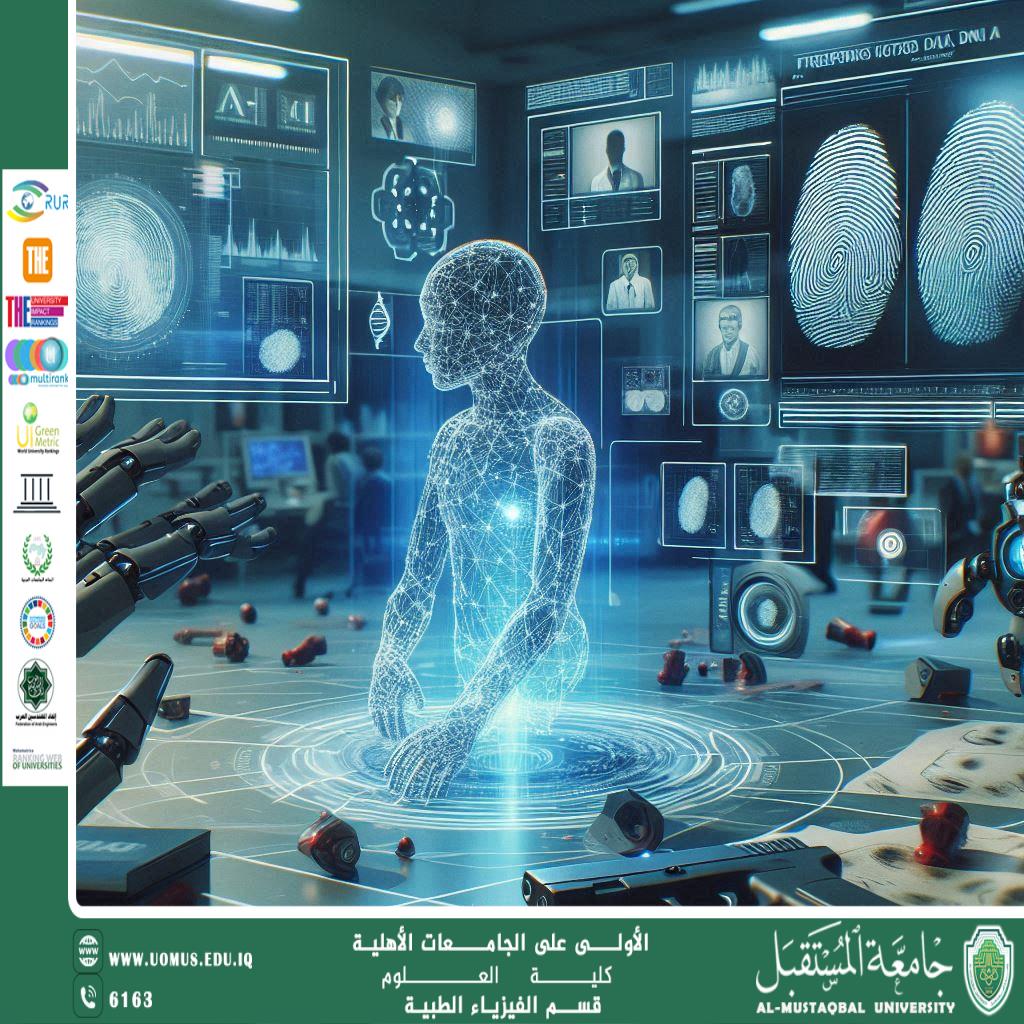
A scientific article by the lecturer (Dr. Feryal Ibrahim Al-Dhafiri) entitled "Applications of artificial intelligence at the crime scene: a revolution in criminal investigations."
30/05/2025 Share :
Introduction<br />In the modern digital age, the field of criminal investigations is witnessing an unprecedented evolution thanks to the integration of artificial intelligence (AI) technologies in crime scene analysis. AI has become a vital tool in assisting security agencies in solving crimes, analyzing evidence, and predicting criminal behavior, contributing to the acceleration and efficiency of justice.<br />Understanding the Crime Scene<br />A crime scene is the location where a crime occurred or where physical evidence supporting an investigation can be found, such as fingerprints, footprints, blood stains, weapons, or even surveillance cameras. Traditionally, crime scene analysis relies on manually collecting and analyzing evidence by experts, which can be time-consuming and prone to human error.<br />How is AI Used in Crime Scene Analysis?<br />- Image and Video Analysis<br />AI-powered facial recognition and video analysis techniques are used to extract precise details from surveillance footage. AI can:<br />- Track suspects' movements.<br />- Identify individuals present at the scene.<br />- Enhance the quality of blurred or distorted images.<br />- Fingerprint and DNA Analysis<br />Machine learning algorithms can quickly and accurately compare fingerprints or DNA samples with criminal databases, speeding up the identification process for suspects or victims.<br />- 3D Crime Scene Modeling<br />Computer vision technologies are used to create accurate 3D models of crime scenes using images or laser scanning. These models allow investigators to reconstruct the crime and understand events from various angles.<br />- Crime Pattern Prediction<br />Through big data analysis, AI can predict future crime locations or identify patterns of a serial offender, known as “criminal profiling.”<br />Advantages of Using AI in Crime Scene Analysis<br />- Speed and Accuracy: AI reduces the time required for evidence analysis.<br />- Minimization of Human Bias: AI operates with standardized criteria, reducing the likelihood of errors or bias.<br />- Assistance in Complex Cases: AI can analyze vast amounts of data that would be difficult for humans to process manually.<br />Ethical and Legal Challenges<br />Despite the benefits of AI, significant legal and ethical questions arise, such as:<br />- Privacy: The use of surveillance systems and data analysis may infringe on individuals’ privacy.<br />- Algorithm Bias: If algorithms are trained on unbalanced data, they may produce unfair results.<br />- Legal Responsibility: Who is accountable if an error occurs due to AI?<br />AI applications in crime scene investigations represent a true revolution in the field of forensic analysis. While these technologies enhance the quality and efficiency of justice, it remains essential to balance technological advancements with ethical and legal safeguards to ensure their fair and safe use.<br /><br /><br /><br />"AL_mustaqbal University is the first university in Iraq"<br/><br/><a href=https://uomus.edu.iq/Default.aspx target=_blank>al-mustaqbal University Website</a>