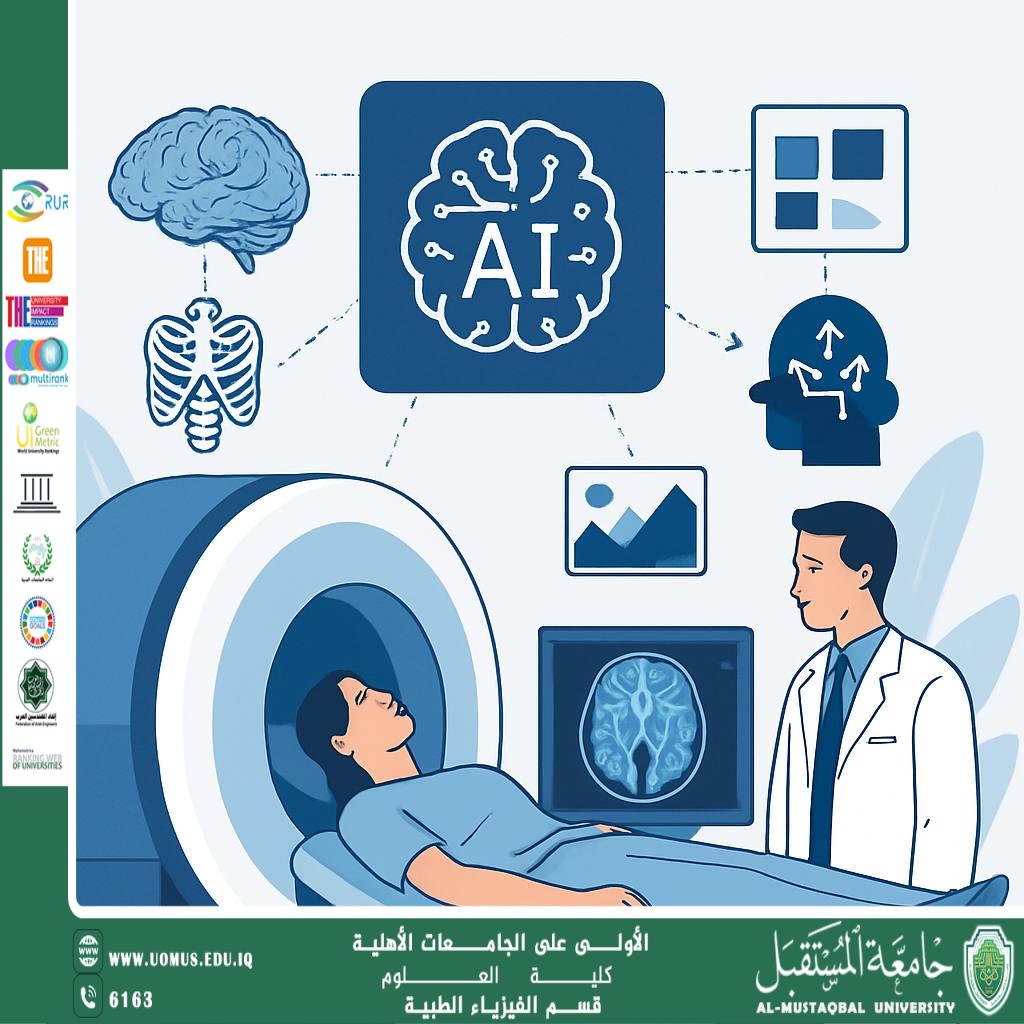
A scientific article by the teaching assistant (Ahmed Abdel Salam) entitled “Artificial Intelligence in Interpreting Magnetic Resonance Images: Towards a Safe Automated Diagnosis”
21/06/2025 Share :
Introduction:<br />Magnetic Resonance Imaging (MRI) is considered one of the most accurate medical imaging techniques, providing high-quality images of soft tissues, the brain, and the spinal cord. However, with the increasing volume and complexity of the resulting images, the need for more efficient analysis tools has emerged. This is where Artificial Intelligence (AI) comes into play, becoming a promising partner in supporting physicians to improve disease diagnosis, speed up analysis, and reduce error rates.<br /><br />First: How does AI analyze MRI images?<br />AI relies on learning algorithms, particularly Deep Learning, to interpret medical images. These models are trained on thousands or even millions of patient images, learning patterns associated with specific diseases such as:<br /> • Brain tumors<br /> • Multiple sclerosis (MS)<br /> • Stroke<br /> • Spinal cord abnormalities<br /><br />Over time, the system becomes capable of detecting subtle pathological changes that may be difficult for humans to identify in early stages.<br /><br />Second: Applications of AI in MRI<br /> • Automatic disease classification:<br />Determining whether the image shows normal or abnormal tissue.<br /> • Segmentation:<br />Separating affected areas such as tumors or hemorrhages from surrounding tissues.<br /> • Image quality enhancement:<br />Removing noise and improving contrast without the need for retaking images.<br /> • Treatment outcome prediction:<br />By analyzing image changes over time.<br /><br />Third: Benefits of integrating AI with MRI<br /> • Reducing the time required to read and analyze images.<br /> • Improving diagnostic accuracy, especially in complex cases.<br /> • Supporting less experienced doctors in clinical decision-making.<br /> • Providing real-time diagnosis in regions lacking radiology specialists.<br /><br />Fourth: Challenges and concerns<br /> • Algorithm reliability: Does it perform equally well across different populations?<br /> • Privacy and data protection: Especially when using patient images for model training.<br /> • Over-reliance on technology: Potential neglect of essential human oversight.<br /> • AI decision explainability: The so-called “black box” problem.<br /><br />Conclusion:<br />Artificial Intelligence represents a major leap forward in the development of medical imaging tools, particularly MRI, promising faster and more accurate diagnoses in the near future. However, there remains a vital need to balance technological reliance with the physician’s role, ensuring that the human remains at the heart of medical decision-making.<br /><br /><br /><br />"AL_mustaqbal University is the first university in Iraq"<br/><br/><a href=https://uomus.edu.iq/Default.aspx target=_blank>al-mustaqbal University Website</a>