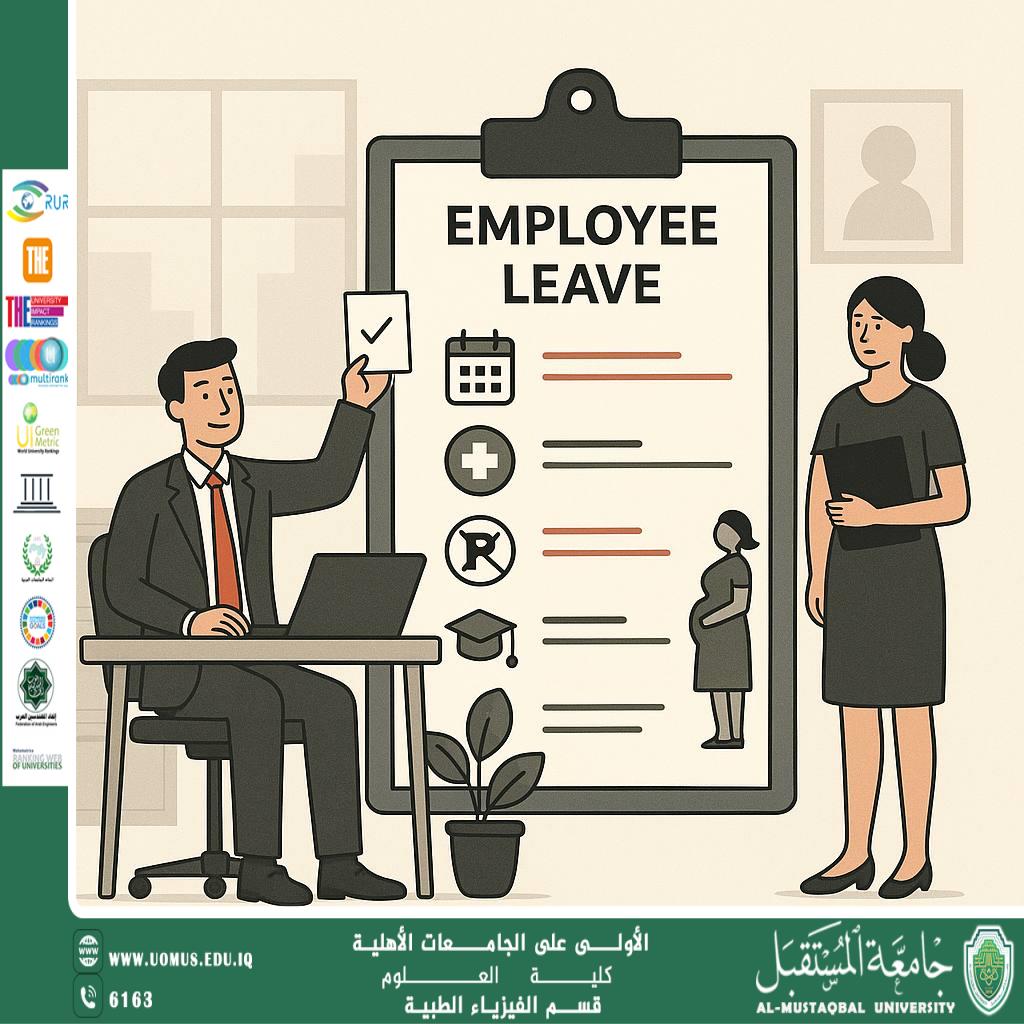
A scientific article by the lecturer (Assistant Professor Fatima Makki Shaalan) entitled “Employee Leave Law in Iraq”
25/06/2025 Share :
Introduction<br />Leaves are among the fundamental rights granted to public employees within the framework of public service. They represent a form of social and health care guaranteed by the state to its employees. In Iraq, the legislator has regulated this right through a set of laws and regulations, most notably Civil Service Law No. (24) of 1960 (as amended) and the instructions of the Federal Civil Service Bureau, aiming to strike a balance between job requirements and the psychological and health well-being of employees.<br /><br />First: The Legal Framework of Employee Leave<br />The Iraqi Civil Service Law outlines the types of leave an employee is entitled to, which can be categorized into the following main types:<br /><br />1. Annual Leave<br />Granted annually at a rate of 30 days.<br /><br />A portion may be carried over to the following years, provided it does not exceed the legally allowed accumulation cap.<br /><br />2. Sick Leave<br />Granted based on an approved medical report.<br /><br />Not to exceed 6 months at full salary, after which it may be reduced to half or quarter pay depending on the duration and the recommendation of the medical committee.<br /><br />3. Unpaid Leave<br />Granted for exceptional circumstances such as study, accompaniment, or family-related cases.<br /><br />Requires approval from the competent minister and is often counted for promotion and allowance purposes only if the decision explicitly states so.<br /><br />4. Maternity Leave<br />Granted to pregnant employees for a period of 72 days, extendable based on a medical recommendation.<br /><br />Fully paid and counted as actual service.<br /><br />5. Study Leave<br />Granted for the purpose of obtaining an academic degree.<br /><br />Must align with the department’s needs and may be paid or unpaid based on ministerial decisions.<br /><br />Second: Legal Principles Governing Leave<br />The right to leave is non-negotiable:<br />Administrative bodies may not deny legally entitled leave except for reasons related to work interest.<br /><br />No abuse of authority:<br />Unjustified denial or delay of leave is considered a violation that warrants administrative accountability.<br /><br />Accumulation of leave:<br />Employees have the right to carry over unused leave within a legally defined period.<br /><br />Third: Practical Challenges in Applying the Leave System in Iraq<br />Despite the clarity of legal texts, several practical challenges hinder effective implementation, such as:<br /><br />Administrative red tape and approval bureaucracy.<br /><br />Lack of employee awareness of their legal rights.<br /><br />Absence of a unified electronic leave database.<br /><br />Misinterpretation or unfair application of rules by legal and administrative departments.<br /><br />Fourth: Recommendations to Improve the Leave System<br />Amend outdated legal provisions to match the modern administrative reality.<br /><br />Implement a unified electronic system for managing leave.<br /><br />Increase legal awareness among employees through workshops and training.<br /><br />Ensure that requesting leave does not negatively impact employee evaluations or promotions.<br /><br />Conclusion<br />The leave system in Iraq is one of the key safeguards that ensures a balance between the interests of public service and the rights of employees. However, the effectiveness of this system depends on the extent to which administrative bodies implement it with fairness and transparency. The Iraqi legislator must continue reviewing these laws to keep up with administrative and professional developments and to ensure a healthy and productive work environment.<br /><br /><br /><br /><br />"AL_mustaqbal University is the first university in Iraq"<br/><br/><a href=https://uomus.edu.iq/Default.aspx target=_blank>al-mustaqbal University Website</a>