
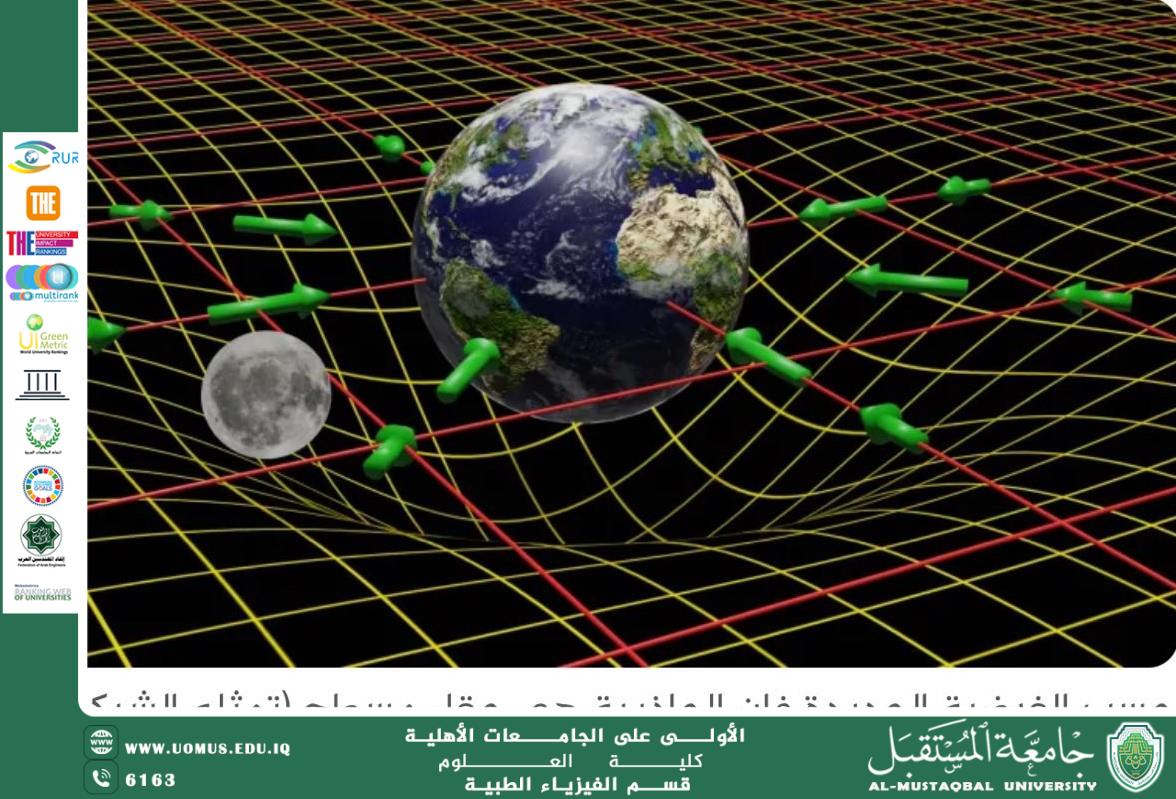
A scientific article by the lecturer (Dr. Karim Abis Handoul) entitled "Quantum Gravity Brings Physicists Closer to the Theory of Everything"
25/06/2025 Share :
A New Quantum Theory of Gravity May Bring Us Closer to Understanding the Origin of the Universe<br />Researchers at Aalto University in Finland have developed a new quantum theory of gravity that aligns with the Standard Model of particle physics, opening the door to a better understanding of how the universe originated.<br /><br />Quantum gravity is a theoretical framework that aims to describe gravity using the principles of quantum mechanics. To grasp this idea, we begin with Einstein’s general relativity, which explains gravity and the behavior of massive objects—such as planets and stars—on very large scales (nearly the entire universe).<br /><br />In contrast, quantum mechanics explains the behavior of extremely small particles—like electrons, photons, and quarks—on subatomic scales.<br /><br />Each theory functions well within its own domain, but problems arise when scientists try to describe objects that are both extremely massive and extremely small at the same time, such as the centers of black holes or the moment of the Big Bang. At these points, a unification of general relativity and quantum mechanics becomes necessary, but the mathematics of one fails under the principles of the other.<br /><br />A Gauge Theory Perspective<br />In this context, physicist Jussi Lindgren and his team at Aalto University proposed a novel approach that brings scientists closer to a unified theory, attempting to formulate gravity as a gauge theory. This class of theories describes how particles and forces behave in nature. Their work was published in Reports in Progress in Physics.<br /><br />The fundamental idea behind gauge theories is that the laws of physics must remain valid even if you change how you describe things locally. For example, length can be measured in meters or feet without changing the actual length. In physics, certain properties (such as electric phase) can be altered without affecting the real physical behavior of particles.<br /><br />In the model developed by the Aalto researchers, gravity is treated as a quantum field that exists in a flat spacetime. The curved spacetime familiar from general relativity emerges as an average behavior—or expectation value—of this quantum field.<br /><br />Put more simply, in this new hypothesis, gravity is not just the curvature of spacetime as Einstein proposed, but rather a quantum field living in a flat space. In quantum field theory, a particle is not just a tiny point, but a vibration or ripple in an invisible field that permeates space.<br /><br />To visualize this, imagine a calm pond: the water itself represents the field, and any wave or ripple is a particle. According to this view, curved spacetime (as described by Einstein) is not fundamental, but rather an emergent property resulting from the average effect of the underlying quantum field.<br /><br />Toward a Quantum Theory of Gravity<br />This perspective offers a more coherent understanding of how gravity operates on quantum scales and may resolve the long-standing contradictions between general relativity and quantum mechanics.<br /><br />While the theory is promising, the research team notes that it is still under development. The current formulation uses a technique that works to a certain level—called “first order” in technical terms—but the team needs to confirm that calculations can be reliably extended throughout the entire process.<br /><br />Developing a successful quantum theory of gravity is critical for understanding phenomena where both quantum and gravitational effects are significant—such as black holes and the Big Bang, and ultimately for understanding the origin of the universe.<br /><br />A successful theory in this domain could also shed light on dark matter and dark energy, which make up the majority of the universe’s mass and energy content but remain poorly understood.<br /><br /><br /><br />"AL_mustaqbal University is the first university in Iraq"<br/><br/><a href=https://uomus.edu.iq/Default.aspx target=_blank>al-mustaqbal University Website</a>