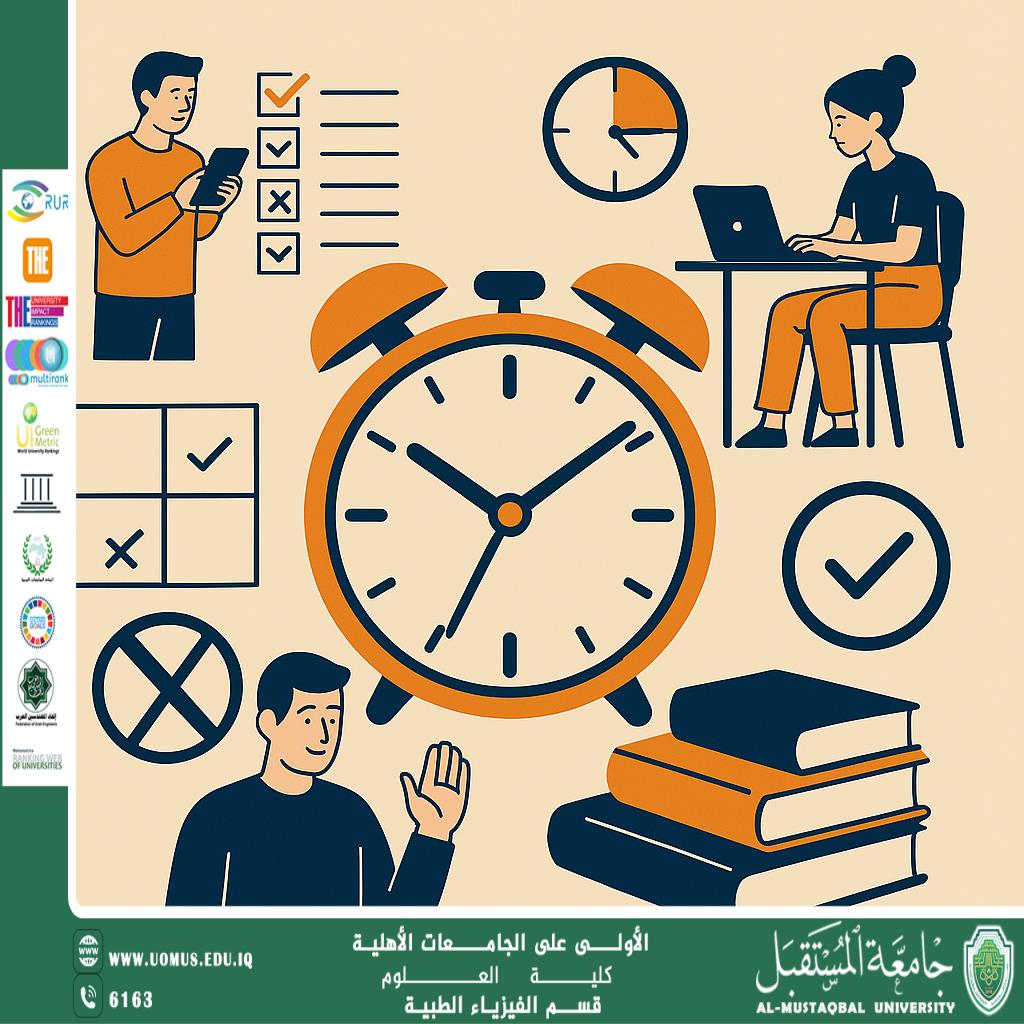
A scientific article by the teaching assistant (Nour Al-Huda Ahmed) entitled “Time management methods to achieve success in personal and professional life.”
26/06/2025 Share :
Introduction<br />In a fast-paced and competitive world, time management has become an essential skill for achieving balance between personal and professional life. Individuals who can manage their time effectively tend to be more productive, experience less stress, and enjoy greater mental and career stability. Recent studies suggest that time management directly contributes to improved performance, productivity, and even stronger social relationships.<br /><br /> Definition of Time Management<br />Time management is the process of organizing and planning how to divide your time among specific tasks to achieve maximum efficiency and effectiveness. It’s not only about getting things done—it’s about doing the right things with the greatest impact.<br /><br /> Key Time Management Techniques<br />1. Prioritization<br />One must distinguish between urgent and important tasks. The Eisenhower Matrix helps categorize activities to determine what needs to be done immediately, what can be postponed, and what should be delegated.<br /><br />2. Planning the Day in Advance<br />Writing a daily or weekly plan helps minimize wasted time and increases focus. It's best to allocate specific time blocks for high-priority tasks and avoid multitasking.<br /><br />3. The Pomodoro Technique<br />This method involves working for 25 minutes followed by a 5-minute break. It helps maintain mental focus and reduces fatigue.<br /><br />4. Avoiding Distractions<br />Such as phones, notifications, or random internet browsing. It’s helpful to create “distraction-free” zones or periods, especially for tasks that require deep thinking.<br /><br />5. Learning to Say “No”<br />It's important to decline unnecessary tasks or unproductive meetings that disrupt personal plans and waste time without adding real value.<br /><br /> Impact of Time Management on Success<br />Professionally: Time management increases efficiency, reduces delays in project completion, and enhances career advancement opportunities.<br /><br />Personally: It allows time for family, hobbies, and quality rest—leading to a balanced and stable life.<br /><br />Research shows that individuals who plan their time regularly report lower levels of stress and higher life satisfaction.<br /><br /> Conclusion<br />Time management is not just a technical skill; it’s a way of life that reflects an individual’s self-awareness and commitment to their goals. Through simple tools and consistent habits, anyone can move from distraction to focus, and from disorder to structure—paving the way for both professional success and personal well-being.<br /><br /><br /><br />"AL_mustaqbal University is the first university in Iraq"<br/><br/><a href=https://uomus.edu.iq/Default.aspx target=_blank>al-mustaqbal University Website</a>