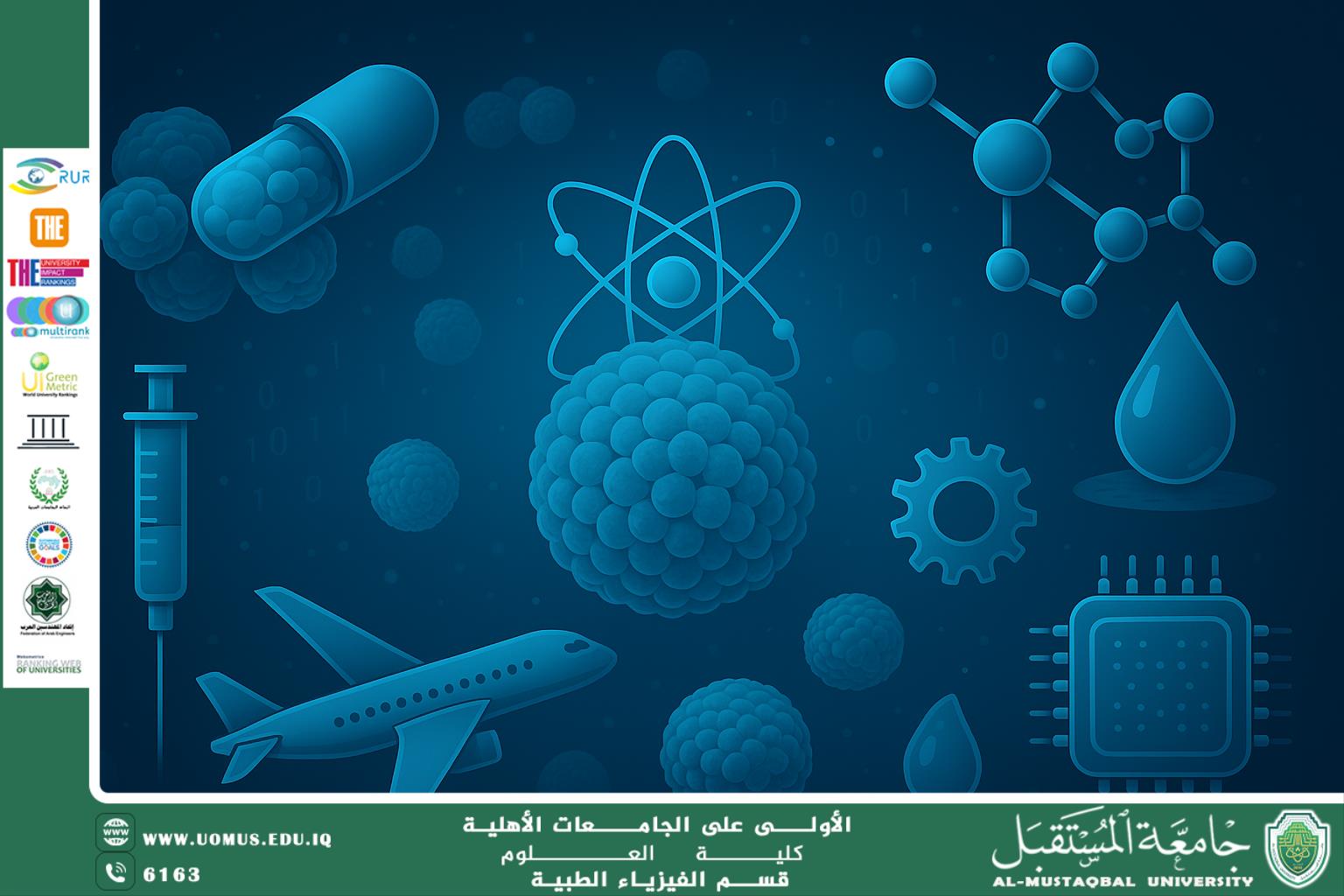
A scientific article by the teaching assistant (Noor Al-Huda Ahmed) entitled “Nanotechnology: An unseen world that works miracles.”
27/06/2025 Share :
Introduction<br />Deep within matter, at a scale invisible to the human eye, a fascinating world is at play—nanotechnology. It is the science that manipulates molecules and atoms on a scale of mere billionths of a meter, crafting tools, altering properties, and opening horizons once thought impossible. Despite its minuscule scale, its impact on human life is immense, revolutionizing fields such as medicine, industry, energy, and the environment.<br /><br /> 1. What Is Nanotechnology?<br />Nanotechnology is a branch of science concerned with designing, producing, and applying materials, devices, and systems at the nanoscale (1 nanometer = 1/1,000,000,000 meter).<br />At this ultra-small scale, materials exhibit unique properties—such as color, strength, thermal and electrical conductivity—that differ significantly from their behavior at larger scales, enabling unprecedented applications.<br /><br /> 2. Miracles in Medicine<br />Nanotechnology has reshaped healthcare in remarkable ways, including:<br /><br />Targeted cancer therapy: Medications are delivered directly to cancerous cells using “nano-carriers,” minimizing damage to healthy tissue.<br /><br />Nano-diagnostic tools: Capable of detecting diseases like cancer and Alzheimer’s at very early stages with incredible precision.<br /><br />Smart drug delivery systems: These release medication at the right place and time inside the body.<br /><br />Synthetic tissues: Used in regenerating skin and repairing damaged organs.<br /><br /> 3. Unprecedented Industrial Applications<br />In industry, nanotechnology has opened new frontiers:<br /><br />Stronger, lighter materials: Used in aerospace, automotive, and high-performance sports equipment.<br /><br />Antibacterial and water-repellent fabrics: Applied in medical and athletic clothing.<br /><br />Nano-electronic chips: Allowing for faster, smaller processors and devices.<br /><br />Nano-coatings: Offering corrosion resistance and extended equipment lifespan.<br /><br /> 4. Innovative Environmental Solutions<br />Nanotechnology contributes significantly to environmental protection:<br /><br />Water purification: Using nanoparticles to capture pollutants and heavy metals.<br /><br />Pollution sensors: Detecting toxic gases with high accuracy.<br /><br />Nano-batteries: Offering better efficiency and lower environmental impact.<br /><br /> 5. Challenges and Ethical Considerations<br />Despite its immense benefits, nanotechnology comes with concerns:<br /><br />Health safety: Scientists are still investigating the effects of prolonged exposure to nanoparticles on the human body.<br /><br />Privacy risks: Some applications could be misused for surveillance or unethical purposes.<br /><br />Regulatory gaps: Legislation often lags behind the rapid advancement of this technology.<br /><br /> Conclusion<br />Nanotechnology is not just futuristic science—it’s a current reality transforming the way we diagnose diseases, enhance industrial performance, and protect our environment. It is truly an invisible world creating miracles.<br />More importantly, universities and research centers in the Arab world must keep pace with this evolving field and develop expertise capable of leveraging it to serve humanity and the planet.<br /><br /><br /><br /><br />"AL_mustaqbal University is the first university in Iraq"<br/><br/><a href=https://uomus.edu.iq/Default.aspx target=_blank>al-mustaqbal University Website</a>