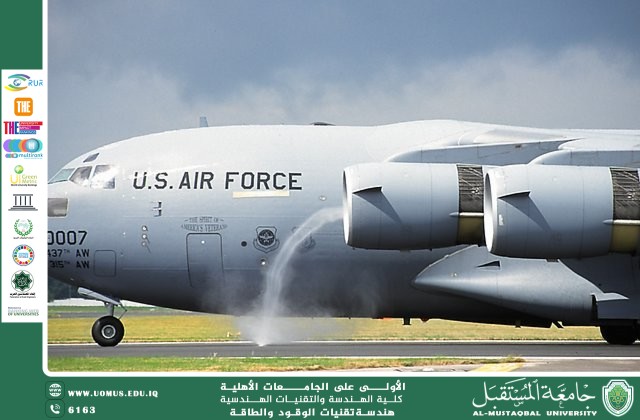
Airflow Disturbance: The Impact of Crosswinds on Jet Engine Air Intakes
01/07/2025 Share :
Airflow Disturbance: The Impact of Crosswinds on Jet Engine Air Intakes<br />Eng. Nourhan Thamer Assi<br /><br />Sustainable Development Goals (SDGs)<br />This topic relates directly to the following SDGs:<br />Goal 9: Industry, Innovation, and Infrastructure – Enhancing the performance and safety of aerospace propulsion systems.<br />Goal 13: Climate Action – Designing efficient systems resilient to changing weather conditions.<br />Goal 12: Responsible Consumption and Production – Improving fuel efficiency and reducing mechanical strain.<br /><br />Introduction<br />Jet engines depend on a smooth, steady airflow through their air intakes to function efficiently. However, crosswinds—winds that strike the aircraft from the side—can disrupt this delicate balance, especially during low-speed operations such as takeoff, landing, or taxiing. These disturbances can lead to asymmetric flow, pressure loss, and even instabilities inside the engine, making crosswinds a serious aerodynamic concern for modern aviation.<br />The Role of Air Intakes in Jet Engines<br />Air intakes are designed to:<br />Capture and direct ambient air into the engine’s compressor.<br />Minimize total pressure loss during airflow transition.<br />Ensure uniform distribution of air across the engine face.<br />For optimal performance, the incoming air must be aligned with the engine axis and enter with minimal turbulence. Crosswinds, however, distort this ideal flow.<br />How Crosswinds Disrupt Airflow<br />When an aircraft encounters crosswinds, the wind strikes the intake at an angle. This causes:<br />Non-uniform airflow distribution – One side of the intake receives more airflow than the other.<br />Pressure asymmetry – The intake experiences uneven dynamic pressure across its surface.<br />Flow separation – Air may detach from intake surfaces, creating vortices and turbulence.<br />Compressor instabilities – Unsteady or distorted flow increases the risk of compressor stall or surge.<br />These effects are especially critical in subsonic intakes, which are more sensitive to changes in inflow angle and velocity compared to supersonic designs.<br />Engineering Solutions and Simulation Tools<br />To combat these issues, aerospace engineers use:<br />Computational Fluid Dynamics (CFD) to model and analyze intake performance under various crosswind angles.<br />Wind tunnel experiments with yawed flow conditions to validate intake designs.<br />Flow control technologies, such as vortex generators or diverter lips, to stabilize airflow.<br />Variable geometry intakes capable of adapting to non-uniform inflow.<br />Modern aircraft also integrate real-time airflow sensors and advanced control systems to monitor engine intake conditions during flight.<br /><br />Conclusion<br />Crosswinds pose a hidden but serious challenge to the stability and efficiency of jet engine air intakes. Disrupted airflow caused by side winds can compromise engine performance, fuel efficiency, and even flight safety. Through advanced simulation tools, smarter intake designs, and aerodynamic innovations, engineers are continually working to ensure that even when the wind comes from the side, the engine keeps breathing steady and strong.<br /><br />"Al-Mustaqbal University – The No. 1 Private University in Iraq"<br />