Wind Turbine Design: Engineering Challenges and Solutions
01/07/2025 Share :
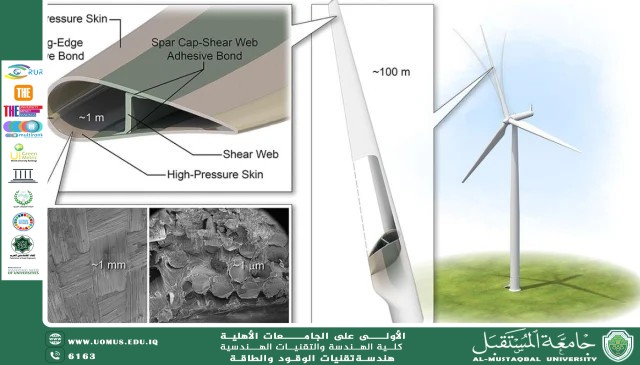
Wind Turbine Design: Engineering Challenges and Solutions<br />Eng. Nourhan Thamer Assi<br /><br />Sustainable Development Goals (SDGs)<br />This topic contributes to:<br />Goal 7: Affordable and Clean Energy – Supporting the growth of renewable energy through better turbine design.<br />Goal 9: Industry, Innovation, and Infrastructure – Encouraging innovation in energy systems.<br />Goal 13: Climate Action – Accelerating the shift toward low-emission technologies.<br /><br /><br />Introduction<br />Wind turbines are at the heart of clean energy production, converting wind into electricity efficiently and sustainably. However, designing effective and reliable turbines is a complex task. Engineers face numerous technical and environmental challenges that must be overcome to ensure optimal performance, longevity, and safety of wind energy systems. Through innovation and multidisciplinary collaboration, these challenges are being met with creative and practical solutions.<br /><br />1. Structural and Mechanical Challenges<br />Wind turbines operate in harsh, dynamic environments with constantly changing wind conditions. This creates structural challenges such as:<br />Fatigue loads on blades and towers due to cyclic wind forces.<br />Vibration and noise caused by unsteady flow and mechanical components.<br />Material degradation from UV exposure, moisture, and temperature extremes.<br />Solutions:<br />Use of advanced composite materials for lightweight, high-strength blades.<br />Implementation of damping systems to reduce vibrations.<br />Regular monitoring and maintenance using sensors and smart diagnostics.<br /><br />2. Aerodynamic Optimization<br />The efficiency of a wind turbine largely depends on the aerodynamic design of its blades. Challenges include:<br />Maximizing energy capture across a wide range of wind speeds.<br />Reducing aerodynamic drag and turbulence.<br />Avoiding blade stall, especially at low wind speeds or during gusts.<br />Solutions:<br />Use of computational fluid dynamics (CFD) to simulate and optimize blade shapes.<br />Incorporation of pitch control systems to adjust blade angle dynamically.<br />Application of winglet designs to reduce tip vortices and noise.<br /><br />3. Energy Storage and Grid Integration<br />Wind energy is intermittent and variable, which complicates integration into electrical grids.<br />Challenges:<br />Fluctuating output that can affect grid stability.<br />Overproduction during high wind periods and underproduction during calm conditions.<br />Solutions:<br />Development of energy storage systems (e.g., batteries, flywheels, hydrogen storage).<br />Use of smart grids and forecasting tools to manage supply and demand.<br />Hybrid systems combining wind with solar or conventional power.<br /><br />4. Site-Specific Design Considerations<br />Each wind farm location presents unique challenges, including:<br />Turbulence from terrain or nearby structures.<br />Icing in cold climates affecting blade performance.<br />Corrosion from salt in offshore environments.<br />Solutions:<br />Customizing turbine design based on site-specific wind studies.<br />Applying anti-icing coatings and heating elements.<br />Using corrosion-resistant materials for offshore turbines.<br /><br />5. Cost and Scalability<br />Scaling up wind energy requires cost-effective, reliable turbines that can operate for decades.<br />Challenges:<br />High initial investment costs.<br />Transportation and installation of large turbine components.<br />Solutions:<br />Modular and lightweight design to ease logistics.<br />Standardization and mass production to reduce costs.<br />Innovations in floating wind turbines for deep-sea deployment.<br /><br />Conclusion<br />Designing wind turbines is a sophisticated engineering challenge that spans mechanics, aerodynamics, materials science, and electrical systems. By addressing these challenges through smart design and continuous innovation, engineers are making wind power more reliable, efficient, and accessible—paving the way for a cleaner, more sustainable energy future.<br /><br /><br /><br />Al-Mustaqbal University – The No. 1 Private University in Iraq<br />