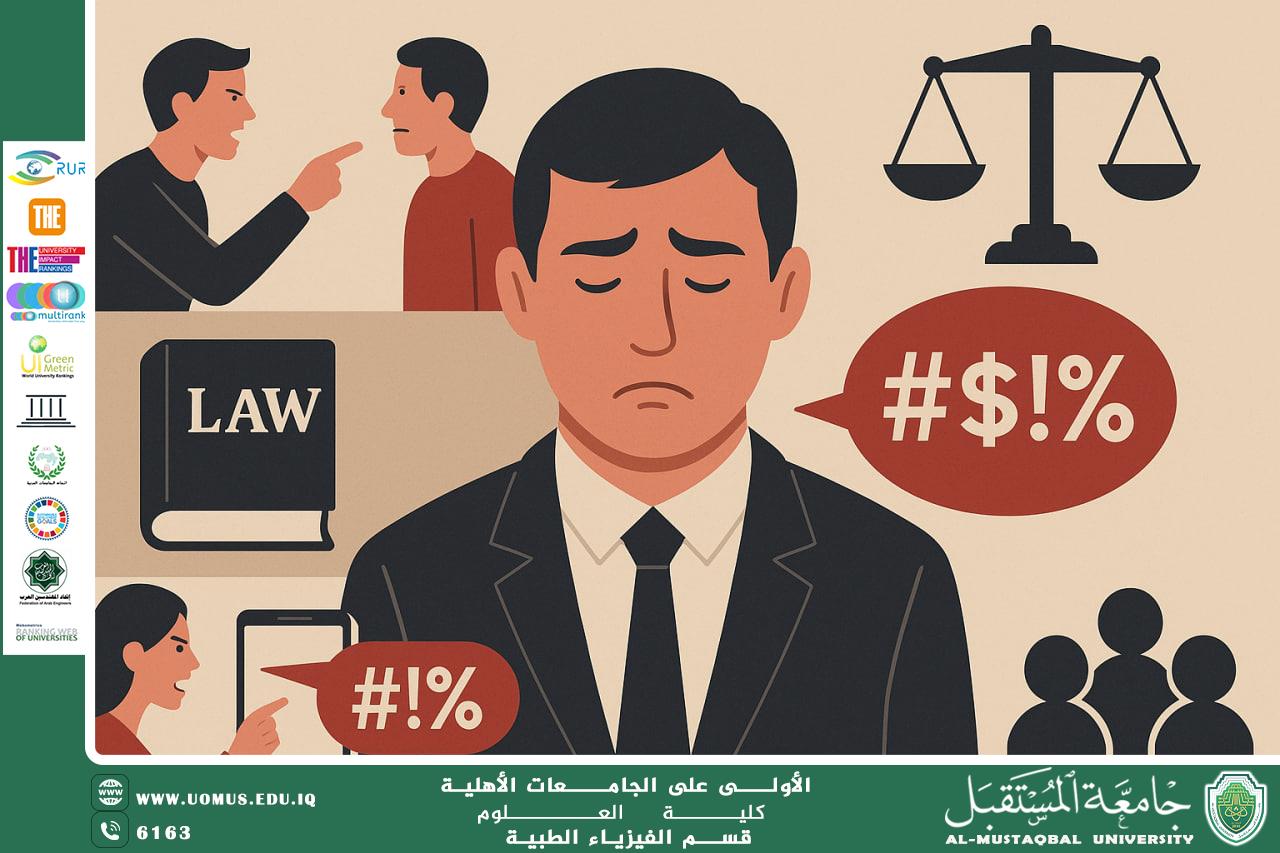
A scientific article by the lecturer (Assistant Professor Fatima Makki Shaalan) entitled “Crimes of Insult and Cursing in Iraqi Law: An Analytical Study”
08/07/2025 Share :
Introduction<br />Defamation and insult crimes are considered serious offenses that violate an individual's dignity and reputation, constituting an attack on a person's moral and social standing. With the rapid advancement of communication tools and the widespread use of social media, such offenses have increased both in real life and in cyberspace. This growing trend has necessitated legal regulation to protect individuals from verbal and moral abuse.<br /><br />This article aims to explain the concept of defamation and insult crimes, distinguish them from similar offenses, review the legal texts that govern them in Iraq, and discuss some procedural and practical aspects related to these offenses.<br /><br />First: Definitions of Defamation and Insult<br />Defamation (Sabb)<br />Defamation is the act of attributing a fact or using an expression that constitutes an insult or humiliation toward a specific person, whether the attributed fact is true or false, in a manner that affects their honor and dignity.<br /><br />Insult (Shatm)<br />Insult refers to the use of vulgar or offensive language without attributing a specific act, and is considered an expression of contempt or disrespect, often said in moments of anger or agitation.<br /><br />Second: Legal Classification of Defamation and Insult in Iraq<br />These crimes are regulated under Iraqi Penal Code No. 111 of 1969, specifically in Part Three – Crimes Against Reputation:<br /><br />Article 433 – Libel (Qadhf):<br />Punishes anyone who defames another by attributing a specific act using public means with imprisonment of up to one year, or a fine, or both.<br /><br />Article 434 – Defamation (Sabb):<br />Punishes with imprisonment of up to six months, or a fine, or both, anyone who defames another in a way that harms their honor or reputation, without attributing a specific act.<br /><br />Article 435 – Insult (Shatm):<br />Specifies that if the defamation or insult occurs in the presence of the victim, in a public gathering, or through media, the penalty shall be more severe.<br /><br />Third: Elements of the Crime<br />There are three main elements for defamation or insult crimes:<br /><br />Material Element:<br /><br />The act of insult (e.g., saying an offensive word, posting a harmful comment, or using vulgar expressions).<br /><br />This may occur orally, in writing, or electronically.<br /><br />Moral Element:<br /><br />Requires criminal intent, meaning the offender must be aware that their behavior constitutes intentional harm.<br /><br />Legal Element:<br /><br />There must be a legal provision that criminalizes the act (as stated in the articles above).<br /><br />Fourth: Online Defamation and Insult<br />With the widespread use of social media platforms, electronic defamation has emerged as a more harmful form due to its broad reach.<br /><br />Iraq currently lacks a formally enacted cybercrime law, though a draft Cybercrime Bill has been proposed and discussed multiple times, including provisions punishing online defamation and insult.<br /><br />In the absence of a specific law, the Penal Code is applied by analogy, and offensive posts on platforms like Facebook, WhatsApp, or others are subject to the same legal penalties.<br /><br />Fifth: Legal Defenses in Defamation and Insult Cases<br />Legitimate Defense:<br />If the accused can prove the act was a response to a previous offense.<br /><br />Good Faith:<br />In certain cases, such as constructive criticism or statements made in the public interest.<br /><br />Lack of Criminal Intent:<br />If the language used was spontaneous and not intentionally harmful.<br /><br />Sixth: Social Impact of the Crime<br />Damage to personal reputation<br /><br />Breakdown of social relationships<br /><br />Increase in violence and revenge<br /><br />Overburdening courts with civil and criminal cases related to verbal abuse<br /><br />Conclusion<br />Defamation and insult crimes represent a significant violation of personal moral integrity and must be addressed through both legal and cultural measures.<br />There is a need to intensify legal and media oversight of digital content and promote a culture of tolerance and mutual respect. Moreover, it is essential to expedite the enactment of a comprehensive Cybercrime Law to safeguard human dignity in the digital age.<br /><br /><br />"AL_mustaqbal University is the first university in Iraq"<br/><br/><a href=https://uomus.edu.iq/Default.aspx target=_blank>al-mustaqbal University Website</a>