A scientific article by the teaching assistant (Amir Sobhi Ismail) entitled “Mechanics in Automotive Engineering: From Principles to Application”
16/07/2025 Share :
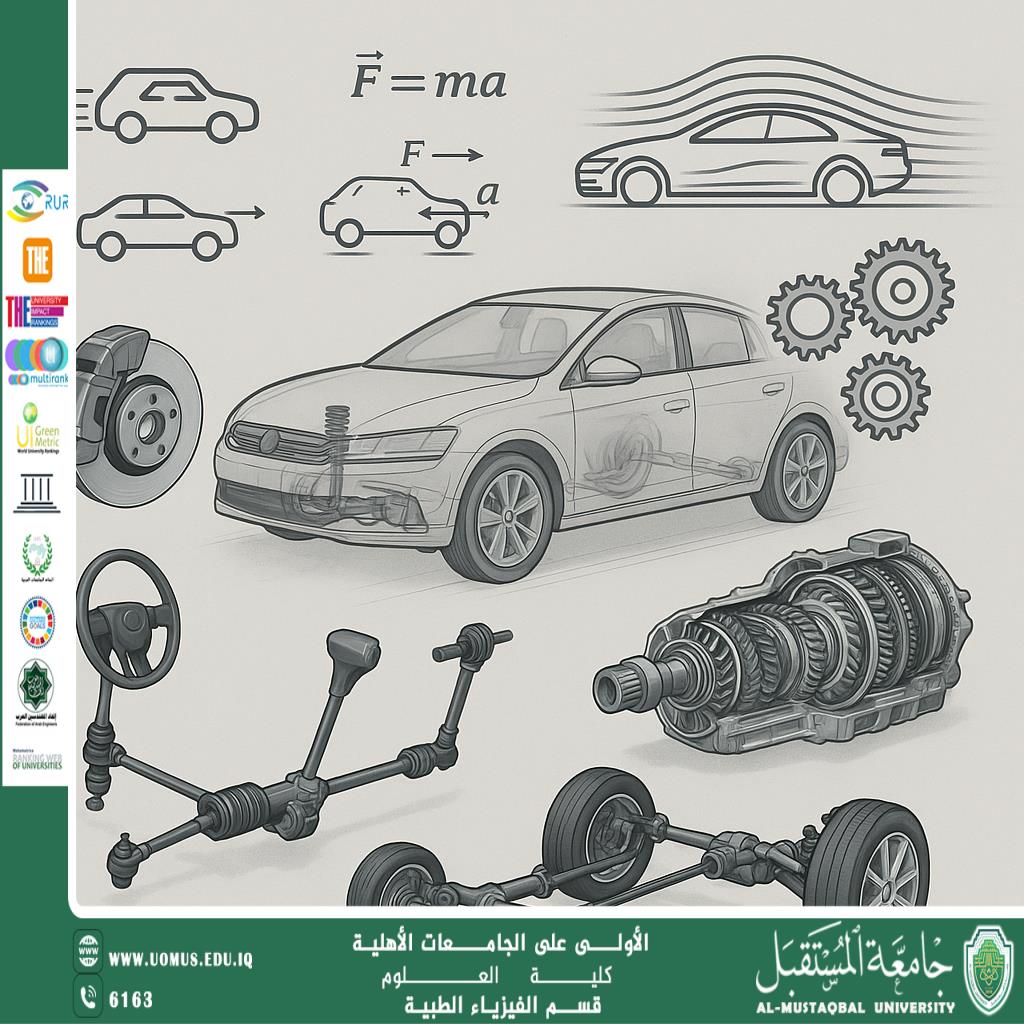
Introduction:<br />Mechanics is one of the fundamental pillars in the design and operation of vehicles, as it involves understanding the motion of objects and the forces acting upon them. In automotive engineering, mechanical principles are translated into practical applications that directly impact vehicle performance, fuel efficiency, safety, and control. With technological advancement, mechanics has become increasingly integrated with electronics and software, leading to a revolution in the automotive world.<br /><br /> First: Basic Principles of Mechanics in Automobiles<br />1. Newton's Laws of Motion:<br />These form the foundation for understanding vehicle behavior during acceleration, deceleration, or turning. For example:<br /><br />The first law explains how a vehicle continues moving unless acted upon by an external force (like braking).<br /><br />The second law relates force to the vehicle's mass and acceleration.<br /><br />The third law is used to understand the interaction between tires and the road surface.<br /><br />2. Friction and Traction Forces:<br />A vehicle's performance, especially maneuverability, depends on tire-road friction. Friction is essential for:<br /><br />Steering control.<br /><br />Braking.<br /><br />Acceleration on different surfaces.<br /><br />3. Energy and Momentum:<br />Energy is converted from fuel or electricity into kinetic energy.<br /><br />Momentum principles are used to design safety systems like airbags and braking systems.<br /><br />Second: Applications of Mechanics in Vehicle Systems<br />1. Suspension System:<br />Designed to absorb shocks from the road and maintain vehicle stability. It relies on mechanical laws to analyze forces from obstacles and turns.<br /><br />2. Braking System:<br />Relies on frictional forces to convert kinetic energy into heat. Mechanical equations determine:<br /><br />Stopping distance.<br /><br />Brake efficiency.<br /><br />The impact of vehicle weight on braking performance.<br /><br />3. Steering System:<br />Utilizes torque and angle concepts to accurately turn the wheels. Dynamic analysis helps relate steering wheel motion to vehicle response.<br /><br />4. Transmission System:<br />Helps convert engine power to wheel movement with maximum efficiency. It involves gear ratios, torque, and rotational speed calculations.<br /><br /> Third: Modern Mechanical Innovations in Automobiles<br />Electronic Stability and Brake Systems (ESP and ABS): Use real-time mechanical data to prevent skidding.<br /><br />Aerodynamic Design: Reduces air resistance to enhance performance.<br /><br />3D Printing for Mechanical Parts: Reduces weight and increases precision.<br /><br />Electric and Hybrid Vehicles: Replace traditional mechanical components with electrical ones while still applying fundamental motion principles.<br /><br /> Conclusion:<br />Mechanics is not just a set of theoretical equations—it's the backbone of automotive engineering. From force and motion analysis to designing complex control and braking systems, mechanical principles play a vital role in ensuring high performance and safety in modern vehicles. With the rapid pace of technological development, mechanics will continue to be a key component in the future of intelligent and sustainable mobility.<br /><br /><br /><br />"AL_mustaqbal University is the first university in Iraq"<br/><br/><a href=https://uomus.edu.iq/Default.aspx target=_blank>al-mustaqbal University Website</a>