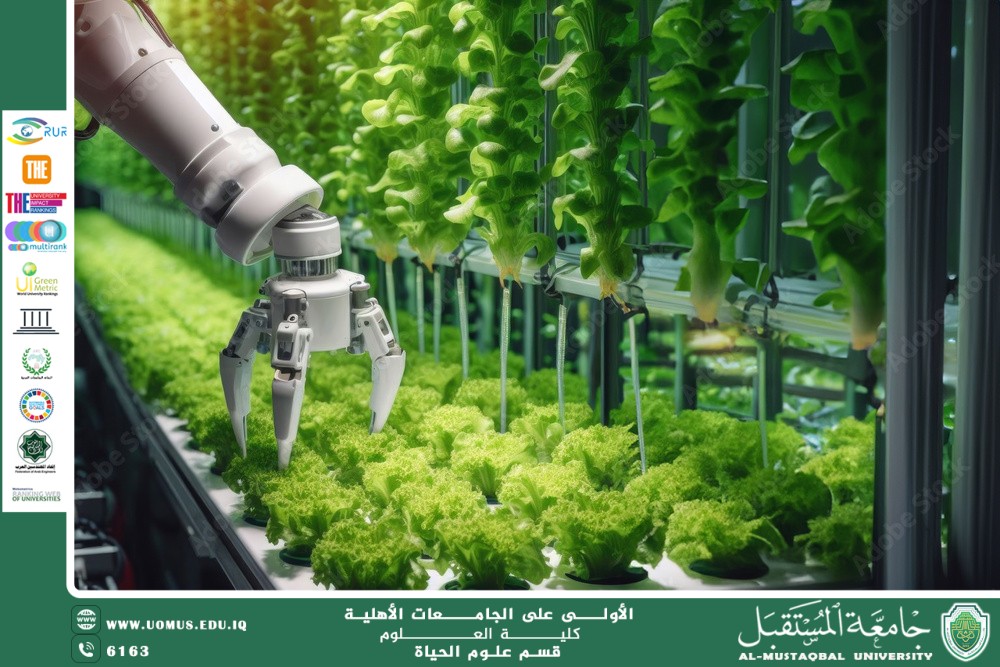
A scientific article by lecturer Msc. Zainab Nazim Aziz entitled "Artificial Intelligence in Diagnosing Plant Diseases"
20/07/2025 Share :
With the advancement of technology and the increasing challenges in the agricultural sector, artificial intelligence (AI) has become one of the modern tools revolutionizing crop management and plant disease diagnosis. AI technologies provide farmers with accurate and rapid means of detecting plant diseases, contributing to reducing losses, increasing production, and achieving sustainability.<br />The Importance of Accurate Plant Disease Diagnosis<br /><br />Plant diseases are one of the most significant causes of reduced agricultural production, and delayed diagnosis can lead to widespread disease spread. Traditional methods rely on human observation and expertise, but they are:<br /><br />Time-consuming<br /><br />Prone to human error<br /><br />Ineffective with diseases that are not visually apparent<br /><br />Therefore, AI has emerged as a practical and early solution for diagnosis.<br /><br />How does AI work in diagnosis?<br /><br />It relies on:<br /><br />1. Image Analysis<br /><br />Taking pictures of plant leaves or infected parts.<br /><br />Using computer vision techniques to analyze symptoms.<br /><br />2. Machine Learning<br /><br />Training AI models on thousands of images of various diseases.<br /><br />The more data, the more accurate the models become.<br /><br />3. Sensory Data<br /><br />Connecting sensors to humidity, temperature, and soil to analyze ambient conditions.<br /><br />Linking them to disease diagnoses associated with those conditions.<br /><br />4. Smart Applications<br /><br />Farmers can use phone applications that capture an image and provide a real-time disease diagnosis.<br /><br />Real-world examples of AI applications<br /><br />PlantVillage Project (in collaboration with Pennsylvania State University):<br /><br />An application that uses AI to diagnose diseases in more than 40 crop species, and works in multiple languages.<br /><br />Google AI's Deep Learning System:<br /><br />Uses deep networks to analyze plant images and identify disease with up to 98% accuracy.<br /><br />Commercial platforms such as PEAT and Plantix:<br /><br />Provide immediate treatment recommendations after analyzing the plant image.<br /><br />Benefits of Using Artificial Intelligence in Agriculture<br /><br />Rapid and accurate diagnosis reduces reliance on manual diagnosis.<br />Cost reduction reduces pesticide use through accurate disease identification.<br />Environmental preservation prevents the indiscriminate use of chemicals.<br />Increased production. Early treatment maintains plant and crop health.<br />Continuous learning. Each use of AI adds new data.<br /><br />Challenges of Using Artificial Intelligence<br /><br />Lack of data in some agricultural areas.<br /><br />Need for digital infrastructure.<br /><br />Initial cost of technology.<br /><br />Limited access in rural areas.<br /><br />Artificial intelligence is no longer just a futuristic tool; it has become a vital tool in modern agriculture, especially in diagnosing plant diseases. By developing smart and affordable technologies, farmers can be empowered to control diseases faster and more accurately, thereby achieving food security and enhancing agricultural sustainability.<br /><br /><br />Al-Mustaqbal University is the first university in Iraq.