A scientific article by the lecturer, Prof. Dr. Munthir Sameen Shaker (Methods for Correcting Lens Decentration Issues)
22/07/2025 Share :
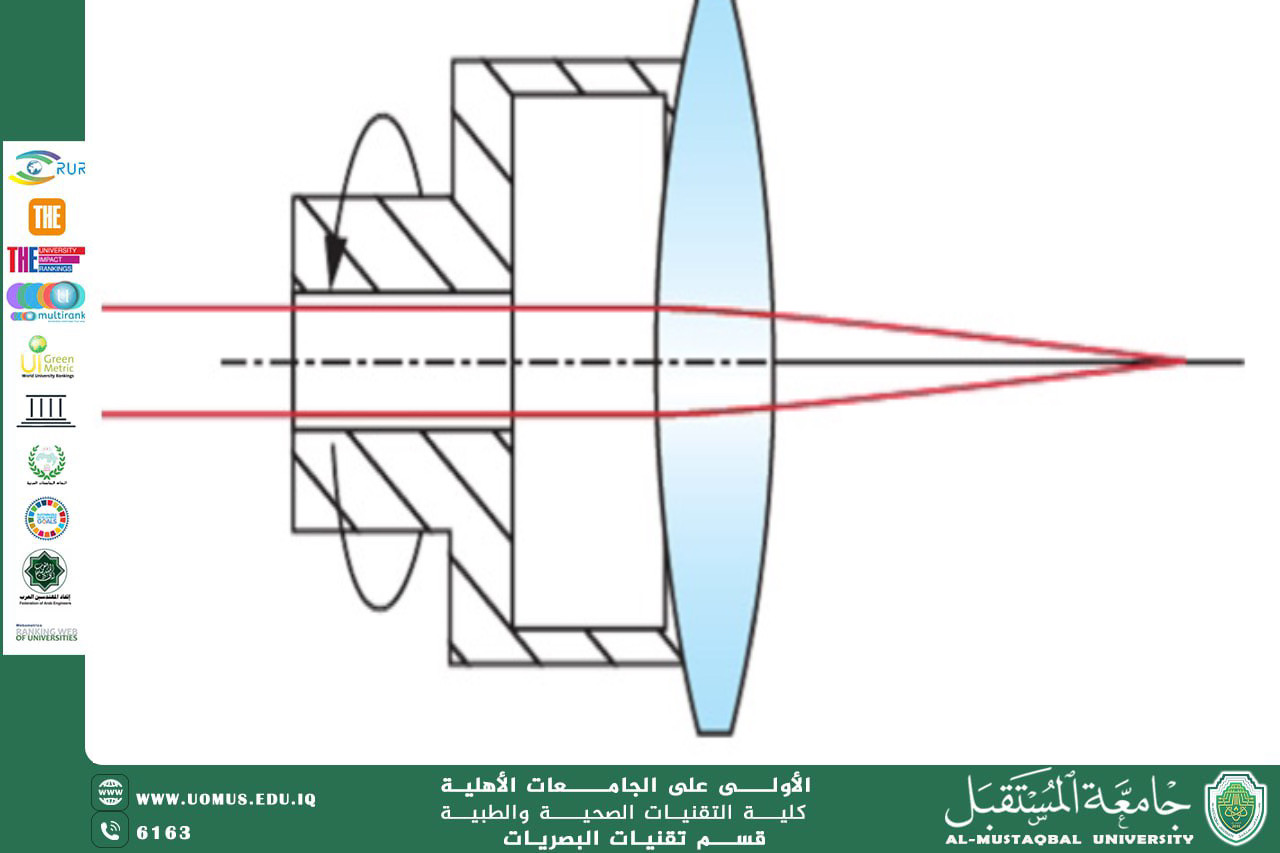
Introduction<br />Centration refers to the point on the lens axis through which any light ray passes in a manner that is parallel to both the incident and emerging rays. This point is known as the optical center. When viewing through the lens from a distant point, the image does not shift when the lens is slightly rotated around a vertical or horizontal axis intersecting this center, as the rays converge at a fixed focal point within the eye.<br />Spherical Polishing and Its Role in Achieving Proper Lens Centration<br />Spherical polishing involves refining the curvature of lens surfaces using ultra-fine abrasive materials to achieve a high degree of surface smoothness. This smoothness is essential for facilitating later centration processes.<br />Before centration begins, the polished spherical surfaces are examined for accuracy and smoothness using Newton’s rings interferometry. Additionally, the optical surfaces are inspected for defects such as dust, scratches, pits, or inclusions using specialized inspection tools.<br />Every lens contains a mechanical axis, determined by its outer edge prior to mounting on the centration (centering) machine, and an optical axis, as illustrated in Figure 1. The optical axis is defined by the center of curvature of each lens surface. The goal of centration is to align the optical axis with the mechanical axis, achieving a match at the optical center.<br />Sources of Decentration and Its Impacts<br />If the optical axis does not meet required specifications, the lens must be returned for re-polishing. Decentration can occur due to operator inexperience or changes in lens curvature caused by fluctuations in ambient temperature (~25°C), which can alter the polishing medium’s behavior. This is especially problematic for low-powered lenses (e.g., ±0.25 or ±0.50 D) in both glass and plastic materials.<br />Significant decentration—greater than 2 mm from the lens’s true center—is considered unacceptable. Tolerances typically range from 150 to 250 micrometers. Although partial correction is possible during centration using precision equipment, successful adjustment largely depends on the technician’s experience.<br />Steps for Achieving Proper Lens Centration<br />After verifying surface smoothness using interferometry (Newton’s rings) and inspecting for surface defects, the lens is coated with shellac to protect the polished surface from external contaminants. The lenses are then sent to the centration stage to align the optical axis with the mechanical axis of the machine—ensuring the resulting image converges accurately at the desired focal point.<br />The lens is first cleaned thoroughly of shellac, then mounted onto the centration machine using wax for secure fixation (as shown in Figure 1). The outer diameter is then ground to match the desired size using grinding stones selected according to the required fineness. Lens diameters, typically 65 mm or 70 mm, are measured using a mechanical vernier caliper to ensure proper sizing and axis alignment. The lens is then cleaned once more.<br />Any misalignment during this process can cause spherical aberration, underscoring the importance of precision throughout centration.<br />