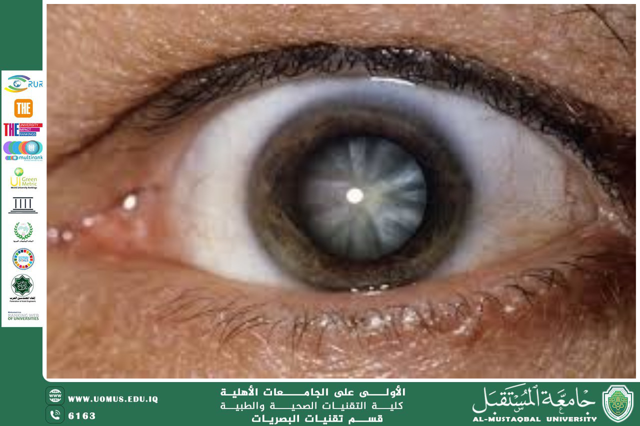

A scientific article by the lecturer, Lect. Ali Hadi Al-Husseini (Aphakia (Absence of the Crystalline Lens)
22/07/2025 Share :
Definition<br />Aphakia refers to the absence of the eye’s natural crystalline lens, typically as a result of surgical removal—most commonly following cataract extraction. It can also result from penetrating trauma, ulceration, or rarely, a congenital defect. The absence of the lens leads to a loss of accommodation, significant hyperopia (farsightedness), and deepening of the anterior chamber. Potential complications include vitreous or retinal detachment and glaucoma.<br />Incidence in Children<br />Congenital aphakia is rare. It usually results from surgical removal of congenital cataracts, which are often caused by intrauterine infections or genetic factors. In many cases—especially when affecting only one eye—the exact cause of the cataract is difficult to determine.<br />Pupil Characteristics<br />Individuals with aphakia often exhibit relatively small pupils with reduced dilation capacity.<br />Causes<br />• Surgical removal of the lens, especially in cataract surgery, is the most common cause of aphakia.<br />• Spontaneous traumatic absorption or congenital absence of the lens is extremely rare.<br />• Partial or traumatic lens dislocation can also result in functional aphakia.<br />Signs and Symptoms<br />• High Hyperopia: Without the focusing power of the lens, the eye becomes significantly farsighted.<br />• Complete Loss of Accommodation: The absence of the lens eliminates the eye’s ability to adjust focus for different distances.<br />• Visual Impairment: The combination of high hyperopia and loss of accommodation results in blurred distance and near vision.<br />• Cyanopsia (Blue Vision): Some aphakic individuals report seeing ultraviolet light—normally blocked by the lens—as bluish-white or violet.<br />• Erythropsia (Red Vision): Occasionally, objects may appear reddish in color.<br />• Deep Anterior Chamber: The anterior chamber deepens due to the absence of the lens.<br />• Iridodonesis: Visible tremor or quivering of the iris during eye movement.<br />• Purkinje Image Testing: Only two images are visible—those from the anterior and posterior corneal surfaces.<br />• Surgical Signs: Surgical aphakia may show iridectomy marks or irregular astigmatism from corneal wound healing, particularly following intracapsular or extracapsular cataract extraction.<br />Major Complications of Surgical Aphakia<br />• Spectacle Intolerance: Patients may not tolerate aphakic spectacles due to:<br />o Image magnification (up to 30%)<br />o Optical distortions<br />o Prism effects<br />o Ring scotomas (“jack-in-the-box” phenomenon)<br />o Anisometropia, leading to diplopia if only one eye is aphakic<br />• Secondary Angle-Closure Glaucoma: May result from vitreous prolapse<br />• Retinal Detachment<br />• Bullous Keratopathy: Especially in long-standing aphakia<br />Treatment Options<br />Aphakia can be managed by:<br />• Spectacles<br />• Contact lenses<br />• Intraocular lens (IOL) implantation<br />• Refractive corneal surgery (in selected cases)<br />Eyes that have received intraocular lenses are often described as “pseudophakic”, distinguishing them from true aphakic eyes.<br />