
A scientific article by the lecturer, Lect. Mohaimen Sameer Aref/ Teaching Assistant. Danah Mohammed Salim (Color Blindness)
20/08/2025 Share :
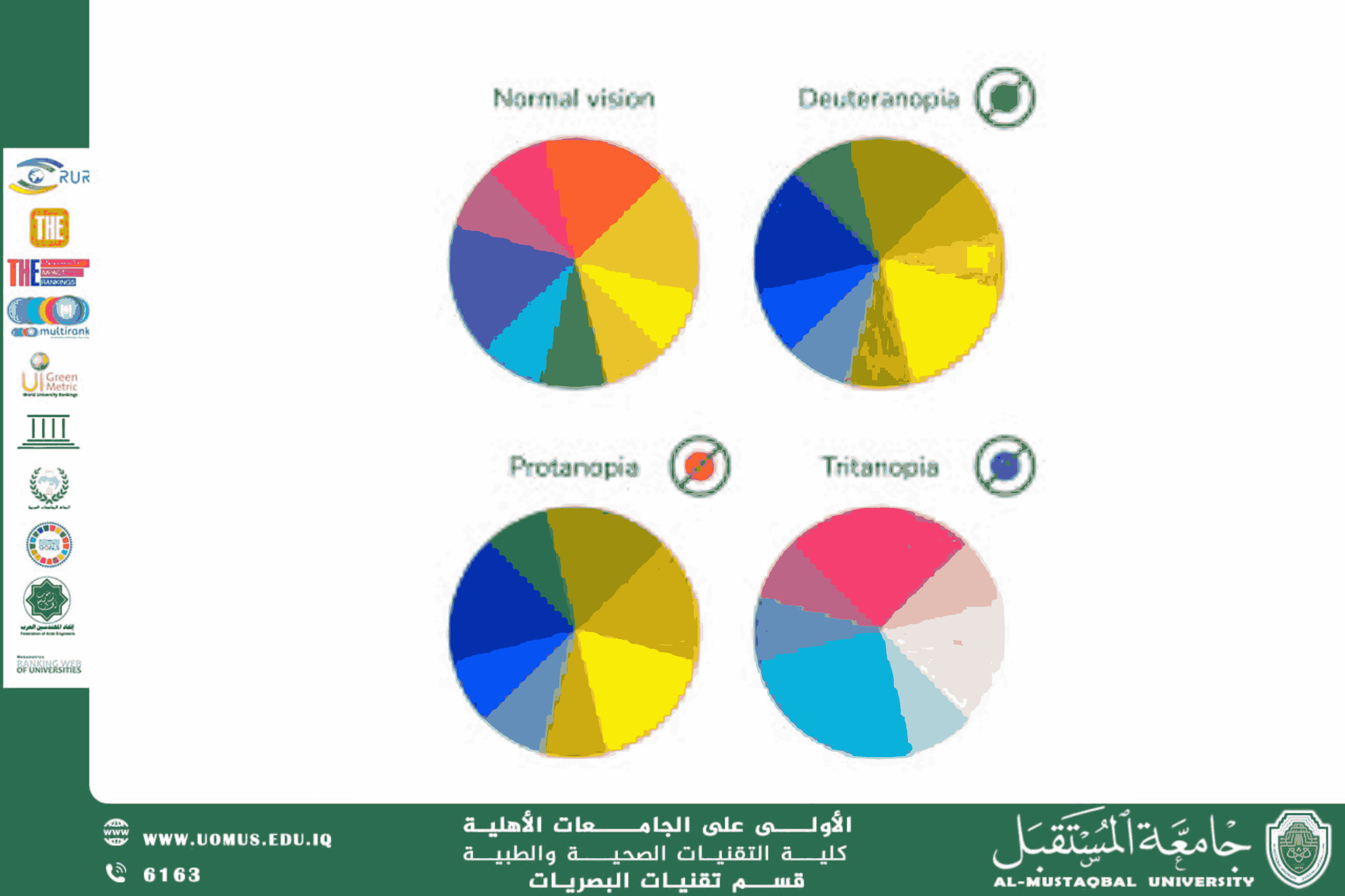
Color blindness, also known as color vision deficiency (CVD), is a visual disorder characterized by the inability to perceive colors in a normal way or to distinguish between certain hues. The most common forms involve difficulty in differentiating red and green, and less frequently, blue. This condition originates from defects in the cone photoreceptors of the retina, which are responsible for color vision. The present review outlines the mechanisms of color vision, theories explaining it, the etiology and types of color blindness, its impact on professional practice, diagnostic methods, psychological consequences, and current strategies for adaptation and management.<br /> <br />Introduction<br /><br />The human retina contains two main types of photoreceptor cells:<br />1. Rod photoreceptors: Cylindrical in shape, they are highly sensitive to low-intensity light and crucial for scotopic (night) vision. Each retina contains approximately 120 million rods.<br />2. Cone photoreceptors: Conical in shape, they function under high light intensity and are responsible for color perception. Cones are subdivided into three types based on spectral sensitivity:<br />o Long-wavelength (red-sensitive).<br />o Medium-wavelength (green-sensitive).<br />o Short-wavelength (blue-sensitive).<br /><br />The human retina contains approximately 6 million cones. Color blindness occurs when one type of cone is absent, nonfunctional, or exhibits an abnormal spectral response.<br /> <br />Theories of Color Vision<br /><br />Several theories have been proposed to explain human color perception:<br />• Trichromatic Theory (Young–Helmholtz): Proposes the existence of three distinct cone types sensitive to red, green, and blue wavelengths.<br />• Opponent Color Theory (Hering): Suggests that color vision is mediated by three opposing pairs of mechanisms:<br />o Red–green.<br />o Blue–yellow.<br />o Black–white.<br /><br />According to this theory, stimulation of one member of the pair inhibits the other, allowing for complex color discrimination through neural processing in the retina and brain.<br /> <br />Etiology and Types of Color Blindness<br /><br />1. Congenital Color Blindness<br /><br />Congenital forms are inherited and linked to genetic mutations on the X chromosome, explaining their higher prevalence in males (~0.8%) compared to females (~0.5%).<br />• Anomalous Trichromacy: Partial deficiency in one cone pigment.<br />o Protanomaly: Reduced sensitivity to red.<br />o Deuteranomaly: Reduced sensitivity to green (most common).<br />o Tritanomaly: Reduced sensitivity to blue (rare).<br />• Dichromacy: Complete absence of one cone pigment.<br />o Protanopia: Absence of red perception.<br />o Deuteranopia: Absence of green perception.<br />o Tritanopia: Absence of blue perception.<br />• Monochromacy: Extremely rare, in which only one or no cone type functions. Patients perceive the world in grayscale (black and white), often accompanied by photophobia and reduced visual acuity.<br /><br />2. Acquired Color Blindness<br /><br />Unlike congenital cases, acquired color blindness results from external or pathological factors and may be reversible. Common causes include:<br />• Use of certain medications (e.g., drugs for heart failure or hypertension).<br />• Optic nerve disorders (often affecting red–green discrimination).<br />• Retinal and choroidal diseases (commonly affecting blue–yellow perception).<br /> <br />Occupational Impact of Color Blindness<br /><br />Color blindness has significant implications in professions requiring precise color discrimination:<br />• Aviation: Pilots must accurately distinguish navigational lights and signals (red, green, white, yellow, blue). Therefore, color vision testing is mandatory during medical evaluations.<br />• Dentistry: Accurate color perception is essential for detecting caries, assessing gum health, and matching restorative materials to natural tooth color.<br /> <br />Diagnostic Tests for Color Blindness<br /><br />Several standardized tests are used to assess color vision:<br />• Ishihara Plates Test: Widely used, consists of pseudo-isochromatic plates containing numbers or patterns embedded in colored dots.<br />• Farnsworth–Munsell 100 Hue Test: Requires arranging 85 colored caps in sequential order.<br />• Farnsworth D-15 Test: A shorter version with 15 caps.<br />• Nagel Anomaloscope: A highly precise optical device for measuring red–green deficiencies.<br /> <br />Psychological and Social Impact<br /><br />Patients with color vision deficiency may experience psychological stress, reduced self-confidence, and even bullying, particularly when their condition is disclosed. Public awareness, social support, and professional counseling are essential to mitigate these negative effects and improve quality of life.<br /> <br />Management and Adaptation<br />• Congenital CVD: Currently has no definitive cure. However, adaptation strategies include:<br />o Specially designed glasses and contact lenses that enhance contrast between colors.<br />o Mobile applications and digital aids for color identification.<br />• Acquired CVD: Management focuses on treating the underlying cause, such as adjusting medications or managing ocular diseases.<br /> <br />Conclusion<br /><br />Color blindness is a relatively common visual disorder with significant genetic and clinical implications. Although congenital forms remain incurable, early detection, occupational screening, and technological aids can greatly enhance patient adaptation. Acquired forms, on the other hand, may be reversible if the underlying cause is addressed. Raising awareness about the condition not only aids patients in their daily life but also helps reduce social stigma and improve integration into professional environments.<br />