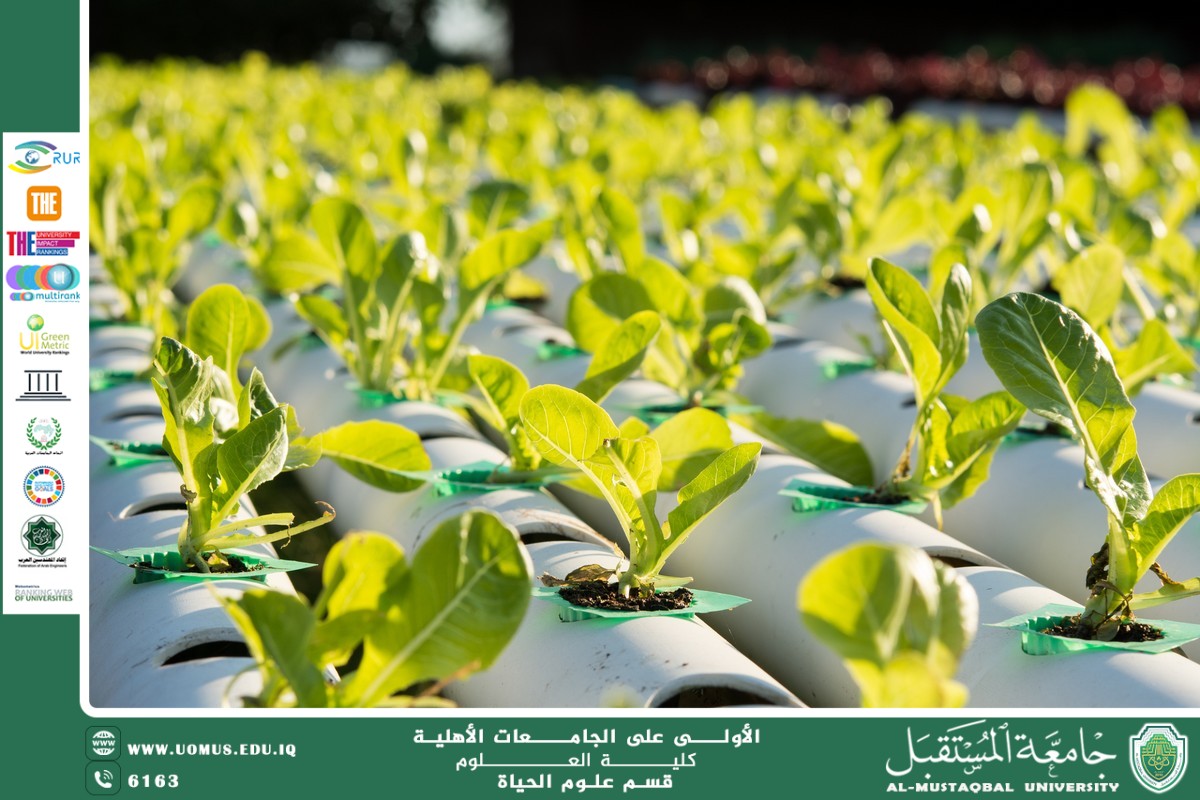
"A scientific article by Miss Noor al-Huda Azmi Hassan entitled "Soilless Agriculture and its Environmental Impact"
19/10/2025 Share :
Hydroponics is a modern farming system that relies on growing plants in nutrient-rich water solutions instead of traditional soil. Plants are supplied with nutrients directly through water, allowing them to grow in enclosed or semi-enclosed environments, such as greenhouses or vertical farms.
First: The Concept of Hydroponics
In hydroponic systems, soil is replaced with an inert growing medium such as:
Perlite
Rockwool
Coconut peat
Plants are supplied with water mixed with essential minerals (such as nitrogen, phosphorus, potassium, calcium, etc.).
The pH and nutrient concentration are precisely controlled, resulting in more efficient plant growth.
Second: Environmental Impacts of Hydroponics
Advantages:
Water Conservation:
Hydroponics consumes 70% to 90% less water compared to traditional agriculture.
Water and nutrients are recycled within the system, minimizing waste.
Reduced pesticide and fertilizer use:
The enclosed environment limits the spread of pests and diseases.
Consequently, chemical pollution of soil and groundwater is reduced.
Increased productivity:
More plants can be grown in a small area (especially in vertical farms).
Ideal for urban or desert regions.
Year-round cultivation:
Hydroponic systems are climate-controlled, allowing for continuous production without dependence on seasons.
Reduced soil degradation:
No soil is used, thus preventing salinization, erosion, or degradation of agricultural land.
Disadvantages:
Energy consumption:
Systems require energy to operate pumps, lighting (especially in vertical farms), and cooling or heating systems.
High initial cost:
Installing hydroponic systems, sensors, and pumps is expensive compared to traditional farming.
Precise system management:
Any imbalance in nutrient concentration or pH can lead to rapid crop loss.
It requires advanced technical knowledge and continuous monitoring.
Disposing of excess water:
If not reused or treated, it can pollute the environment with excess chemicals.
Soilless agriculture represents a sustainable and innovative approach to food security, especially in arid or densely populated areas.
However, achieving full environmental sustainability requires:
Reliance on renewable energy to power the systems.
Effective wastewater management.
Improved technical efficiency to reduce costs and emissions.
Al-Mustaqbal University is the first university in Iraq.
الهدف 11 : الحياة في البر