The Role of Students in Awareness-Raising for Water Consumption Conservation By Dr. Arshad Shakir Kazem الوصف بالعربي الوصف بالانكليزي تاريخ النشر الصنف اللغة الصورة الملفات المسموح بها: JPG, PNG | الحد الأعلى 500 كيلوبايت | يجب أن تكون الصورة مربعة أو أ
16/12/2025 Share :
تاريخ النشر
الصنف
اللغة
الصورة
الملفات المسموح بها: JPG, PNG | الحد الأعلى 500 كيلوبايت | يجب أن تكون الصورة مربعة أو أفقية
الصور الإضافية (حتى 3) — مطلوبة صورة واحدة على الأقل
صورة 1
JPG/PNG ≤ 500KB
إزالة
صورة 2
JPG/PNG ≤ 500KB
إزالة
صورة 3
JPG/PNG ≤ 500KB
إزالة
إضافة مرفق
إضافةإلغاء
Water consumption conservation represents one of the most significant environmental and social challenges facing countries in light of population growth, urban expansion, and climate change. Students emerge as an influential social group with the capacity to spread environmental awareness and actively contribute to adopting sustainable behaviors. Therefore, involving students in awareness campaigns aimed at rationalizing water consumption is a fundamental step toward achieving water resource sustainability and building a conscious society engaged in environmental protection.
The Importance of Students’ Role in Rationalizing Water Use
Experts agree that students constitute an effective force within society due to their ability to learn, adapt, and influence individual and collective behavior. The importance of students’ role can be summarized as follows:
1. Broad Social Influence:
Students possess wide social networks within schools and universities, as well as through social media platforms, enabling them to convey awareness messages rapidly and effectively.
2. Ability to Acquire Awareness Skills:
School and university education provides an appropriate environment for developing leadership and communication skills that students need to participate in environmental awareness campaigns.
3. Daily Practices:
Students account for a considerable proportion of water consumption in households and educational institutions; therefore, modifying their behavior directly contributes to reducing water waste.
4. Building a Culture of Sustainability:
Student engagement in environmental activities enhances values of responsibility and environmental citizenship.
The Role of Students in Promoting a Culture of Water Conservation
Students can contribute in various ways to strengthening a culture of rational water use, most notably:
1. Student Initiatives within Schools and Universities
• Preparing awareness brochures and posters on methods of water conservation.
• Organizing field campaigns on campus to encourage students to reduce unnecessary water use.
• Participating in competitions and scientific projects focused on sustainability and resource conservation.
2. Digital Awareness
• Publishing visual and written content on social media platforms highlighting the risks of water overconsumption.
• Producing videos or infographics illustrating household water-saving practices, such as repairing leaks, using water-saving devices, reducing shower duration, and applying drip irrigation.
3. Scientific Research and Academic Projects
• Conducting small-scale research studies on water consumption in schools and homes and ways to improve efficiency.
• Developing scientific projects for irrigating school gardens using smart irrigation systems or reusing greywater.
4. Voluntary Work and Community Initiatives
• Cooperating with environmental organizations and municipalities to implement awareness campaigns for families.
• Participating in river and aquatic environment clean-up campaigns to reinforce a sense of responsibility toward natural resources.
Examples of Water Conservation Practices Students Can Promote
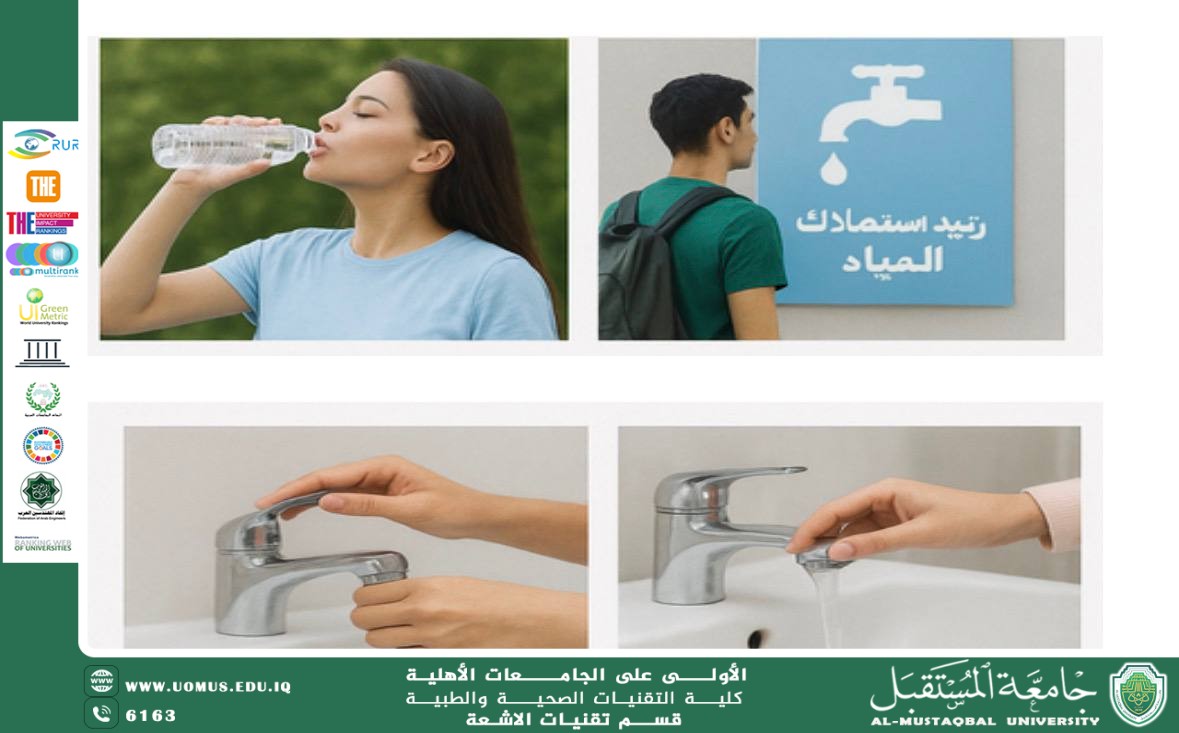
• Turning off the tap while brushing teeth or applying soap.
• Using showers instead of filling bathtubs.
• Ensuring there are no leaks at home or in schools.
• Using water-saving devices such as low-flow faucets and showerheads.
• Irrigating gardens early in the morning or at sunset to reduce evaporation.
• Reusing water from washing vegetables to irrigate plants.
Challenges Facing Students in Awareness Activities
Despite the importance of students’ role, several challenges persist, including:
• Limited environmental knowledge among some students.
• Insufficient resources and facilities within educational institutions to support initiatives.
• Lack of adequate training programs in environmental leadership skills.
• Weak coordination between schools and governmental institutions in awareness efforts.
Conclusion
Water consumption conservation is a collective responsibility, and students represent a fundamental pillar in this process due to their awareness and capacity to influence and drive change. By supporting student initiatives, enhancing environmental education, and providing platforms for community participation, it is possible to build a generation capable of protecting water resources and embedding sustainability values within society. Therefore, empowering students in this field is not an option, but a national necessity to ensure water security for future generations.
Al-Mustaqbal university is the top-ranked among Iraqi universities.