From Education to Economic Empowerment: The Role of Quality Education in Reducing Poverty
23/12/2025 Share :
Prof. Dr. Haider Ali Al-Dulaimi
College of Administrative Sciences – Al-Mustaqbal University
Poverty is one of the most complex challenges facing contemporary societies,
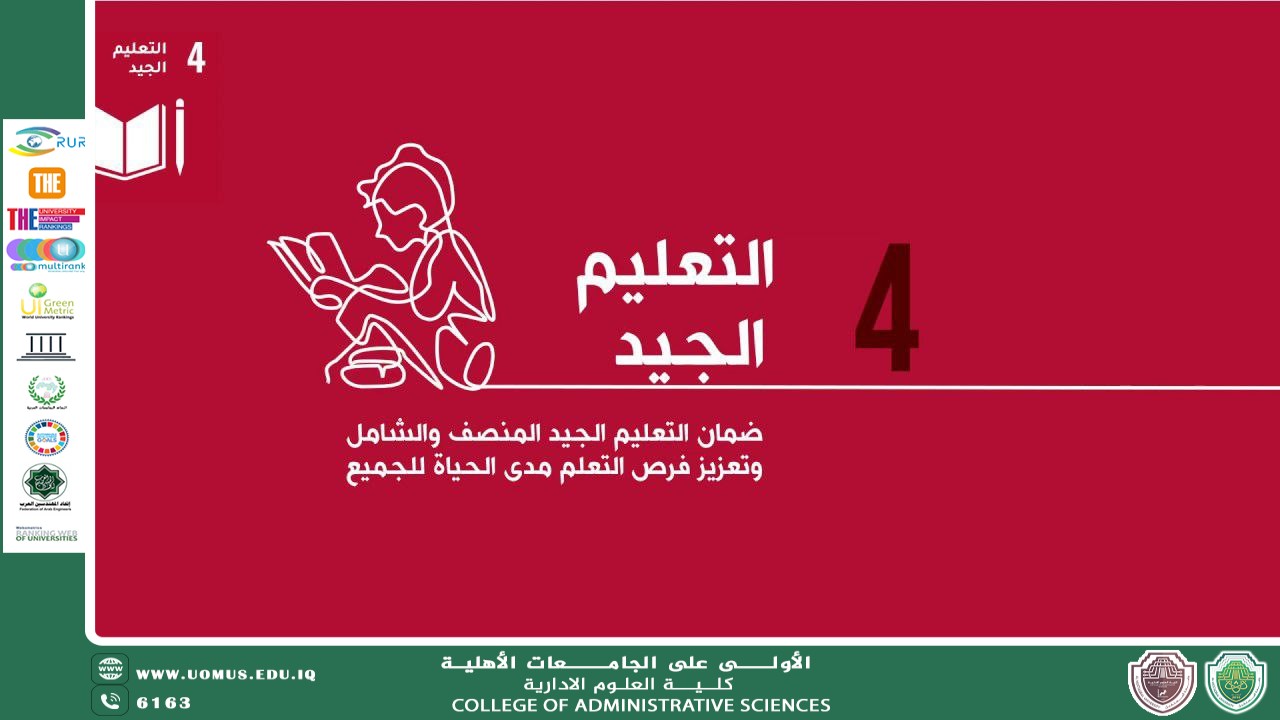
due to its economic, social, and humanitarian impacts that extend to stability and sustainable development. The United Nations Sustainable Development Goals have emphasized that eradicating poverty in all its forms (Goal 1) cannot be achieved in isolation from ensuring inclusive, equitable, and quality education (Goal 4), as education is the most effective tool for human development and for empowering individuals economically and socially.
Quality education is not limited to the transmission of knowledge; rather, it extends to the development of skills and capacities that enable individuals to enter the labor market efficiently and improve their chances of obtaining decent employment and sustainable income. The higher the level of education, the greater an individual’s ability to make sound economic decisions, enhance productivity, and increase opportunities to escape the cycle of poverty.
Education also contributes to fostering entrepreneurship and innovation by equipping students with applied knowledge and practical skills that qualify them to establish small and medium-sized enterprises. These enterprises represent an important driver of economic growth and job creation, particularly in resource-limited communities. In this context, quality education becomes a tool for empowerment rather than dependency, and for production rather than consumption.
The social role of education in breaking the intergenerational cycle of poverty cannot be overlooked. Education opens broader horizons for vulnerable groups, reinforces the principle of equal opportunity, and contributes to reducing economic and social disparities. Moreover, informed education promotes the values of work, responsibility, and community participation, which positively reflect on social stability and local development.
Hence, the importance of the role of educational institutions—especially universities and colleges—emerges in aligning their academic programs with labor market requirements and adopting modern curricula that focus on quality, application, and skills development, in addition to encouraging scientific research linked to development, economic issues, and poverty reduction.
In conclusion, investing in quality education is a direct investment in human capital and represents the most sustainable pathway to economic empowerment and poverty reduction. Through education, capacities are built; through capacities, opportunities are created; and through opportunities, comprehensive development is achieved—development that societies aspire to in pursuit of a more just and prosperous future.