An Article entitled (Solid State Lasers)
23/02/2022 Share :
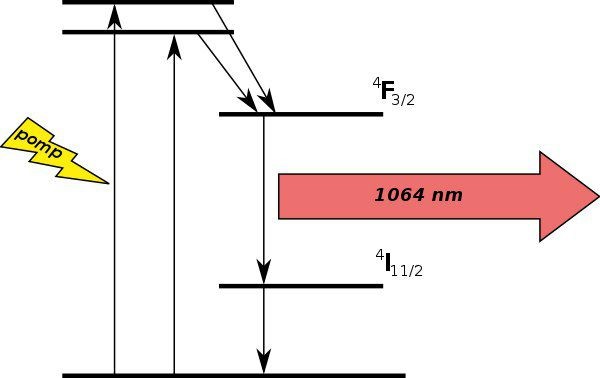
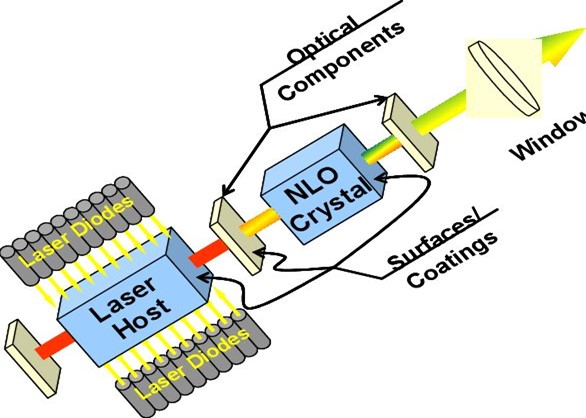
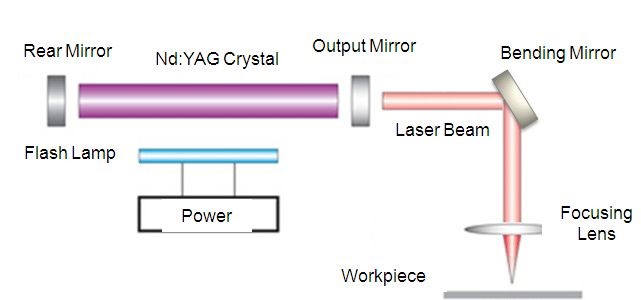
Solid state laser is a laser in which the active medium is an insulating crystal or glass. The first laser that was discovered and worked successfully is the solid-state laser, and that was in June 1960, and it is a sapphire laser, and its use has continued since then, and in general, solid-state laser materials are transparent, insulating, and resist heat. The metal, for example, the chromium (Cr) ion in a sapphire crystal, or the rare earth metal, such as the nd ion (Nd) in the glass . These ions are present in a small percentage of about 0.01-0.1% in a crystal or glass and are responsible for generating and amplifying the laser beam. The work of the laser takes its place between the energy levels of these ions, and the frequency of the stimulated rays is a feature of the single ion present in the crystalline environment and integrated in it in general. The laser material is in the form of a rod whose two ends are polished and made with a high degree of smoothness to form two parallel surfaces called the laser rod. This rod is placed between two opposite mirrors (or its ends are coated with a reflective material to form the two mirrors of the resonator) High-intensity electromagnetic radiation is shined on it by a flash lamp, which is often in the form of a spiral surrounding the laser rod. The use of the most common optical pumping method in the work of solid-state lasers, and flash pumping i.e. intermittent leads to the production of a pulsed laser as well. The dimensions of the laser model are ( 6 cm) in length and (6 mm) in diameter, but sometimes rods less than (1 cm) or longer than (30 cm) are used. The figure below shows diode- pumped solid state laser<br /><br />By: MSc. Hawraa Abd Alkareem